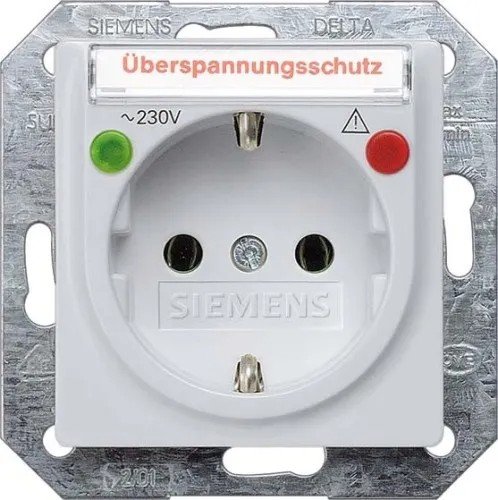
A Delta i-system aluminum Schuko socket with overvoltage protection — part number 5UB1936 — costs more than an unprotected Delta socket on the same frame. Nobody puts one in every room. The question is: which sockets get the protection, and which get the standard version? This is not a technology question — the varistor and thermal disconnect inside the 5UB1936 work the same as in any other surge-protected socket. It is a placement question. And answering it means thinking about what is plugged into each socket, how far the socket is from the distribution board, and whether the upstream SPD has already done enough.
This article provides a room-by-room decision framework. It also explains how to ensure a Type 3 socket SPD coordinates with the Type 2 device in your panel — because a socket SPD installed behind a panel SPD that has already failed is just a varistor waiting to die alone.
First, Check the Panel: No Upstream SPD, No Point
A Type 3 surge-protected socket has a single-digit kiloamp energy rating — enough for the residual of a surge that has already been through a Type 1 or Type 2 SPD, not enough for the surge itself. If your distribution board has no SPD, the first surge event that arrives at the socket will likely destroy the varistor. The thermal disconnect will trip safely, the indicator will go dark, and you will have paid extra for a socket whose protection lasted one event.
Before installing any surge-protected socket, confirm two things at the distribution board:
- A Type 2 SPD is present and its indicator shows green
- If the panel SPD's end-of-life indicator is red or dark, it is dead. Replace it before adding Type 3 devices downstream. A dead upstream SPD is not neutral — it means any surge reaching the socket is unattenuated.
- The SPD is installed within 0.5 meters of the incoming supply
- SPD connecting leads must be short. Every meter of lead wire adds roughly 1 kV of let-through voltage during a fast surge due to lead inductance — effectively downgrading the SPD's protection level. If the panel SPD is installed at the end of a meter-long tail, fix that first.
A surge-protected socket behind a dead panel SPD is like a lifeboat behind a ship that has already sunk. The socket SPD handles the leftovers. If there are no leftovers — because the upstream SPD is absent or dead — the socket SPD takes the full hit alone, and it will not survive the second one.
Room by Room: Where Surge Protection Earns Its Keep
Not every socket in the house needs a varistor behind it. The decision turns on two variables: what is plugged in, and how far the socket is from the panel.
| Room | Risk Profile | Surge Socket? |
|---|---|---|
| Home office / study | Desktop PC, NAS, router, monitor — multiple items with switch-mode power supplies that have no surge tolerance beyond 1 kV. One lost NAS equals ten years of surge socket cost. | Yes — every socket feeding IT equipment |
| Living room / media center | TV, game console, soundbar, streaming box. Modern TVs have fragile mainboards that fail after moderate surges — often over a year after the event due to latent semiconductor damage. | Yes — at least the socket behind the TV unit |
| Kitchen | Refrigerator, dishwasher, microwave — mostly inductive loads with robust power supplies. A fridge compressor handles voltage spikes better than a router chipset. | Skip — unless there is a socket for a coffee machine with electronic controls or a smart display |
| Bedroom | Phone charger, bedside lamp, maybe a radio. Nothing with a hard drive. Nothing that costs more than the socket itself. | Skip — unless there is a CPAP machine or medical device |
| Hallway / corridor | Vacuum cleaner, floor lamp — intermittent, robust loads. | Skip |
| Garage / workshop | Power tools, battery chargers. However — long cable runs from the panel to a detached garage create high inductance, and reflected wave overshoot can double the surge voltage at the far end. The distance itself creates risk. | Yes — if the garage is detached or more than 20 meters of cable from the panel |
| Home server closet | Server, switch, UPS, backup drives. The highest concentration of surge-sensitive electronics in the building. | Yes — surge-protected socket on every outlet feeding rack equipment, even if a UPS is in line |
The pattern is simple: if the socket feeds a device with a microprocessor, a hard drive, or a display panel, it justifies surge protection. If it feeds a motor, a heating element, or a simple power supply, it does not. The 5UB1936 — with its aluminum frame — is usually chosen for visible areas like the home office or living room, where the metal finish matches other Delta i-system aluminum accessories (switches, dimmers, data outlets) and the surge protection window adds a functional detail that clients notice.
Cable Distance Changes the Math
A socket 30 meters from the distribution board faces a different surge environment than one 3 meters away. The installation cable between the board and the socket has inductance — roughly 0.5 µH per meter for standard 1.5 mm² NYM cable. During a fast surge transient with a rise time of a few microseconds, that inductance creates a voltage drop that subtracts from the clamping effect of the panel SPD.
More critically, reflected wave overshoot at the open end of the cable — the socket — can nearly double the peak voltage. If the panel SPD clamps to 1.5 kV at the board, the socket 30 meters away may see 2.5 kV or more. A Type 3 SPD at the socket catches this locally induced overvoltage and clamps it to under 600 V.
The practical rule: sockets within 10 meters of cable from the panel are in the SPD's effective protection zone and may not justify a surge-protected variant unless they feed sensitive electronics. Sockets beyond 20 meters — in a detached garage, a garden office, an upstairs study at the far end of a long radial circuit — are where the socket SPD does work the panel SPD physically cannot.
Aluminum Frame: More Than a Finish
The 5UB1936 uses Delta i-system's aluminum frame — the same metal series that covers switches, dimmers, thermostats, and data outlets. The frame material does not affect surge protection performance. But it affects two things that matter during installation:
- Earthing continuity. A metal frame on a Schuko socket is connected to the protective earth via the mounting screws and the frame's contact tabs. In a TN-S or TN-C-S installation, this provides an additional earth path and ensures the frame cannot become live under fault conditions. The surge protection varistor's earth path is through the socket's PE terminal, not the frame — but the metal frame's earthing is a secondary safety layer the plastic frame lacks.
- Heat dissipation. The varistor inside a surge-protected socket runs slightly warm under normal operation due to leakage current — typically a few milliwatts, not enough to matter. But under sustained overvoltage conditions (e.g., a 260 V grid during a solar inverter fault), the MOV's leakage current increases and so does its temperature. The aluminum frame provides a modest thermal path to ambient that a plastic frame does not — not enough to prevent thermal runaway, but enough to delay it slightly and reduce nuisance trips in areas with frequent minor overvoltages.
Neither of these is a reason to choose the aluminum version over the standard white plastic version for surge protection alone. The aluminum frame is an aesthetic and tactile choice. But if you are already specifying Delta i-system aluminum accessories throughout a room, the 5UB1936 keeps the surge-protected socket visually consistent with the rest of the installation.
What SPD coordination actually means in a residential panel
IEC 61643-11 requires that Type 1, Type 2, and Type 3 SPDs in the same installation be coordinated — meaning each downstream device must survive the let-through energy of the upstream device. In a residential setting with a Type 2 SPD in the panel and a Type 3 in the socket, coordination is almost always satisfied because 20 meters or more of cable between them adds enough impedance to limit the energy reaching the socket SPD. The exception is when both SPDs are close together — a Type 2 in a sub-panel and a Type 3 in an adjacent socket on the same stud wall, less than 2 meters apart. In that case, the cable impedance is negligible and the socket SPD may see energy beyond its rating. The fix is simple: use a coordinated SPD pair from the same manufacturer, or ensure at least 10 meters of cable separates the Type 2 and Type 3 devices.
Can I use a multi-outlet power strip with surge protection instead of a surge-protected socket?
Yes — electrically, a quality surge-protected power strip is a Type 3 SPD in a different form factor. The advantage of the built-in socket like the 5UB1936 is that it cannot be unplugged, moved, or borrowed for another room. It is part of the fixed installation. The advantage of the power strip is that it protects multiple devices from one SPD. In practice, the best setup for a home office is a surge-protected wall socket and a surge-protected power strip — not for double protection, but because the power strip protects against surges induced in the strip's own cable, which the wall socket SPD cannot catch. The two Type 3 devices protect different segments of the same circuit.
Does the Schuko standard change anything about surge protection?
Schuko (CEE 7/3) sockets have side-contact earthing — the PE connection is made via spring clips on the socket frame that contact the plug's earth tabs before the line and neutral pins engage. This "earth-first, disconnect-last" sequence is required for safety and also benefits surge protection: the varistor's earth reference is established before power is applied, and the earth path is never broken while the plug is inserted or withdrawn. In socket standards where the earth pin is the same length as the line and neutral pins (e.g., some older national standards), a hot-plug event can momentarily energize the equipment without an earth reference — during which the surge protection is floating and ineffective. Schuko's staggered contact design eliminates this window.
Related Content
- Browse all surge protective devices — Type 1, Type 2, and Type 3 SPDs for panel and point-of-use installation
- Circuit breakers and protection devices — complementary overcurrent and residual current protection for residential panels
- Electrical and power products — sockets, switches, and installation materials including the full Delta i-system range
- Read our related article on what sits inside a surge-protected socket — varistor aging, thermal disconnect, and how the indicator works