An access control reader at a data center door holds a Wiegand interface that has not changed since 1979. When an employee presents a credential, the reader transmits the badge number as a stream of 26 to 37 bits over two wires — D0 for zeros, D1 for ones — at roughly 100 microseconds per bit. The controller receives the bitstream, checks it against the access database, and unlocks the door. The protocol is unidirectional: the reader talks, the controller listens. There is no encryption. There is no message authentication. An attacker who gains physical access to the Wiegand cable between the reader and the controller can clip on a logic analyzer, read the badge number as it passes in clear text, and replay it with a $20 microcontroller to unlock the door. Worse: the attacker can cut the Wiegand cable and inject their own signal, because the controller has no mechanism to detect that the reader has been disconnected and replaced by an attacker's device. OSDP (Open Supervised Device Protocol), standardized as IEC 60839-11-5 and mandated by the U.S. federal government for all new access control deployments since 2020, replaces Wiegand's two unidirectional wires with RS-485 multi-drop — a bidirectional, encrypted, and continuously supervised connection. This article compares Wiegand and OSDP on security, wiring topology, device management, and migration strategy — so physical security system designers and integrators can plan the transition from a protocol designed in the era of magnetic stripe cards to one designed for the era of cyber-physical attacks.
The Security Gap: Unidirectional vs Bidirectional and Supervised
Wiegand has no security. It transmits the entire credential in cleartext — the facility code and card number, separated by a parity bit — on every read. The controller trusts whatever arrives on the D0/D1 lines. There is no handshake, no challenge-response, no cryptographic verification. The controller cannot interrogate the reader ("are you still there?"), cannot detect tamper, and cannot distinguish between a reader that has been disconnected and a reader that is simply not being presented credentials. An attacker who gains access to the cable — often routed through unsecured ceiling plenum space between the reader on the secure side of the door and the controller in a telecom closet — owns the access decision.
OSDP runs over RS-485 and supports AES-128 encryption for all data between the reader and the controller. The controller continuously polls the reader — typically every 100 to 200 ms — and if the reader fails to respond, the controller knows the reader has been disconnected or tampered with, and can trigger an alarm. The bidirectional link also enables the controller to send commands to the reader: change the LED color from red to green upon access granted, activate the buzzer, display a text message on an LCD reader, or — critically — update the reader's firmware over the wire without a physical visit to every door.
Wiring: Two Readers, One Cable
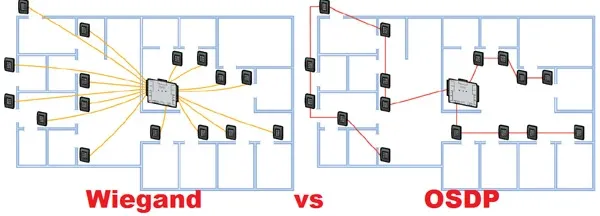
Wiegand requires a dedicated home-run cable per reader — typically 6 to 10 conductors (power, ground, D0, D1, LED control, buzzer, tamper) pulled from each reader back to the controller. A 16-door access control panel has 16 cables entering the cabinet, each with 6 to 10 conductors — 128 to 160 terminations. At the reader end, the cable run is typically limited to 150 meters (500 feet) due to voltage drop on the power conductors and signal degradation on the unshielded D0/D1 lines.
OSDP's RS-485 multi-drop capability allows multiple readers to share a single 4-conductor cable (two for power, two for RS-485 data) up to 1,200 meters (4,000 feet). A 16-door panel might wire 4 readers to each of 4 RS-485 trunks, reducing the cable count from 16 to 4 and terminations from roughly 150 to roughly 40. The cable savings alone often cover the incremental cost of OSDP-capable readers and controllers in a greenfield installation. In a retrofit, the existing Wiegand cable can often be re-used for OSDP — RS-485 runs successfully on 22 AWG twisted-pair cable at the distances typical for door access control — reducing the retrofit to a head-end controller and reader swap with no new cable pulls.
Device Management and Interoperability
Wiegand readers are low-level electrical interfaces: connect D0, D1, power, ground, and the reader sends bits. There is no device identity, no manufacturer and model information, no firmware version, no configuration settings communicated to the controller. The access control system does not know what reader is connected — only that something is sending bitstreams. Device replacement is manual: install the new reader, confirm it reads cards, and update the access control database manually.
OSDP readers report their identity — manufacturer, model, firmware version, serial number — to the controller upon connection. The controller can verify that the reader is the expected model and firmware revision before accepting credential data. Firmware updates are deployed from the access control head-end over the RS-485 link to every reader on the system — a zero-truck-roll process that turns a facility-wide firmware update from a physical visit to every door into a scheduled software operation. For a 200-door facility, the labor cost avoidance from remote firmware updates alone can justify the OSDP migration over a 3 to 5-year lifecycle.
Migration: How to Transition from Wiegand to OSDP
OSDP migration is staged, not rip-and-replace. Most OSDP-capable controllers support a mixed mode where some ports run Wiegand and others run OSDP. An existing Wiegand reader on an existing cable can be replaced with an OSDP reader and the controller port reconfigured to OSDP — typically requiring a firmware update to the controller and a port-mode configuration change in the access control software. The existing cable is re-terminated from the Wiegand terminal block to the RS-485 A/B terminals at both ends. The migration can be phased: replace readers in high-security areas first (data centers, executive offices, perimeter doors), followed by interior doors over subsequent budget cycles.
Wiegand has served access control for over 40 years with a design so simple it rarely fails electrically. But simplicity is not security — and in an era where physical access control systems are increasingly targeted as the weakest link in a facility's cyber-physical security posture, a protocol that transmits credentials in cleartext over an unauthenticated, unsupervised, unencrypted link is a vulnerability that the industry has finally agreed to retire. OSDP is the replacement — not because it is newer, but because it is supervised, encrypted, and capable of telling the difference between a reader that is idle and a reader that has been replaced by an attacker.