A GE Additive Arcam EBM machine preheats a bed of Ti-6Al-4V powder to 700°C with a scanned electron beam, then melts each layer at 1,000°C — in a vacuum. The part emerges from the powder cake with zero macroscopic residual stress but a surface roughness of 25 to 35 µm Ra. A block of laser powder bed fusion machines across the factory floor — EOS, SLM Solutions, Trumpf — scans a 200-watt fiber laser across a 30°C powder bed in argon, melting Ti-6Al-4V at 1,660°C in a 50-micron spot. The part comes out with 5 to 10 µm Ra surface finish and 300 to 500 MPa of residual tensile stress at the surface — stress that must be relieved before the part leaves the build plate or it will distort during wire EDM cut-off. Same alloy, same additive family, two fundamentally different metallurgical outcomes. This article compares EBM and L-PBF for Ti-6Al-4V aerospace production across microstructure, surface finish, residual stress, build speed, and post-processing — so manufacturing engineers can match the process to the part's geometric and fatigue requirements.
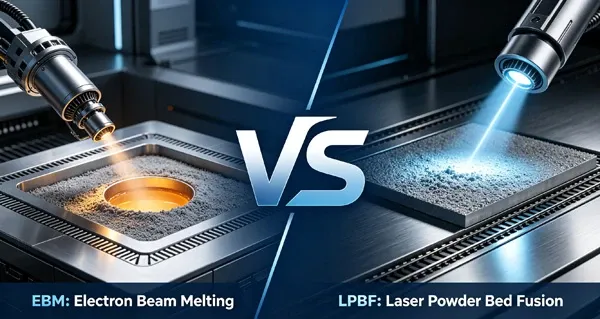
How Each Process Affects the Titanium Microstructure
L-PBF melts Ti-6Al-4V powder in a fraction of a millisecond as the laser scans past. The melt pool — roughly 100 µm wide by 50 µm deep — solidifies at cooling rates exceeding 10⁵ to 10⁶ K/s. This rapid solidification produces a fully martensitic α' microstructure: fine, acicular (needle-like) hexagonal grains with high strength (1,100 to 1,200 MPa UTS) but low ductility (6 to 10% elongation). The as-built L-PBF part is stronger than wrought annealed Ti-6Al-4V — and more brittle.
EBM preheats the entire powder bed to 700 to 750°C before melting each layer, and the vacuum environment slows cooling. The as-built part cools through the beta-transus temperature (995°C) slowly enough that the martensitic α' decomposes in-situ into a lamellar α+β microstructure — alternating platelets of alpha and beta titanium phases — that closely resembles the microstructure of cast and HIP'd Ti-6Al-4V. As-built EBM parts have UTS of 950 to 1,050 MPa and elongation of 10 to 16% — slightly lower strength than L-PBF but significantly higher ductility and damage tolerance.
Residual Stress: The Post-Processing Divider
L-PBF generates high residual tensile stress at the part surface — typically 300 to 500 MPa in Ti-6Al-4V — because each layer cools and contracts while the layers below are already solid and cold (30 to 80°C bed temperature). The thermal gradient across the solidifying layer pulls the surface into tension. Parts must stay attached to the build plate until stress relief — typically 650 to 800°C for 2 to 4 hours in vacuum or argon — or they will distort. Thin walls, long aspect ratios, and unsupported overhangs are particularly vulnerable; support structures in L-PBF serve a mechanical anchoring function against thermal distortion, not just a heat-dissipation function.
EBM, by maintaining the entire build at 700°C throughout the process, eliminates the thermal gradient that drives residual stress in L-PBF. The part emerges essentially stress-free. This has two practical consequences: EBM parts require no stress relief cycle before removal from the build plate, and EBM can build geometries — tall, thin-walled structures, large unsupported spans — that would distort or crack in L-PBF regardless of support structure design. For thin-walled aerospace brackets and heat exchanger cores, this single difference often decides the process choice.
Surface Finish: As-Built and After Post-Processing
L-PBF produces as-built surface roughness of 5 to 10 µm Ra on vertical walls, 10 to 20 µm Ra on down-skin (overhanging) surfaces. The fine laser spot (50 to 100 µm diameter) and thin powder layers (30 to 60 µm) produce a relatively smooth surface that can be machined, blasted, or chemically milled to 1 to 3 µm Ra for fatigue-critical applications.
EBM produces as-built surface roughness of 25 to 35 µm Ra — roughly 3 to 5 times rougher than L-PBF. The larger electron beam spot (200 to 400 µm diameter), thicker layers (50 to 100 µm), and partial sintering of adjacent powder particles from the high bed temperature all contribute to the rougher surface. For fatigue-critical aerospace parts, EBM surfaces require more aggressive post-processing — typically abrasive blasting followed by chemical milling or electrochemical machining — to remove the surface roughness layer that acts as a population of stress concentrations. The post-processing cost partially offsets the stress-relief advantage.
Which process is faster for production?
EBM builds faster than L-PBF for Ti-6Al-4V — typically 55 to 80 cm³/hour per machine versus 15 to 30 cm³/hour for a single-laser L-PBF system. The electron beam can be deflected electromagnetically (no moving mirrors), scan speeds reach 8,000 m/s, and multiple melt pools can be maintained simultaneously. Multi-laser L-PBF systems (4 lasers per build chamber) narrow the gap to 60 to 100 cm³/hour, at higher capital cost and complexity.
But build speed alone does not determine throughput. The EBM process adds overhead: the build chamber must be evacuated to 10⁻⁴ mbar before heating begins (30 to 60 minutes), the powder bed must be preheated to 700°C before melting starts (30 to 45 minutes), and the completed build must cool from 700°C to below 100°C before the chamber can be opened (2 to 6 hours depending on build size). L-PBF has minimal preheat and cooldown overhead. For a 20-hour build, the 3 to 6 hours of EBM non-melting overhead may swing the effective throughput advantage back to multi-laser L-PBF. Build your production cost model on total cycle time, not just melting rate.
When to choose which process for titanium aerospace parts
| Requirement | Recommended Process | Why |
|---|---|---|
| Fatigue-critical parts (rotating components, structural brackets) | L-PBF + HIP + surface finishing | Finer as-built surface reduces stress concentration population; HIP closes internal pores; post-process surface finish can achieve <2 µm Ra |
| Thin-walled structures prone to distortion (ducting, manifolds) | EBM | Stress-free as-built condition; no distortion during build plate removal; good ductility in thin sections |
| Large, solid parts (structural fittings, landing gear components) | EBM | Higher build rate, no residual stress accumulation through thick sections, good as-built toughness |
| Parts with fine internal channels or lattice structures | L-PBF | Finer feature resolution (100 µm vs 300 µm minimum wall); smoother internal channel surfaces reduce pressure drop |
| Low-volume production (1 to 50 parts/year) | L-PBF | Wider machine availability, lower non-recurring engineering cost, shorter process development cycle |
| High-volume production (>500 parts/year) | EBM | Stackable builds with no support structure removal labor; higher throughput per machine for suited geometries |
EBM and L-PBF are not competitors for the same part — they are complementary processes optimized for different thermal histories. L-PBF produces stronger, smoother parts at the cost of residual stress and build speed. EBM produces tougher, stress-free parts at the cost of surface finish and feature resolution. The right process is the one whose native thermal history matches the part's geometry and service requirements — not the one whose spec sheet looks better in a benchmark table.