Direct answer: Allen-Bradley PowerMonitor meters scale from a basic readout (500) to a plant-wide power-quality platform (5000). The tiers differ in local compute, communications, and waveform capture. Choose the 500 for simple kWh, the 1000 to put the meter on EtherNet/IP, and the 5000 only when you must diagnose sags, swells, and transients.
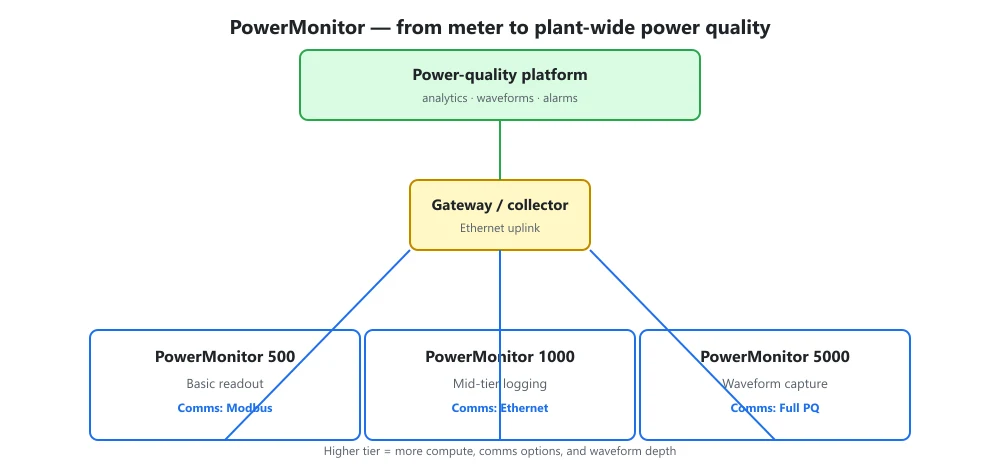
Allen-Bradley PowerMonitor meters scale from a basic panel-mounted readout to a plant-wide power-quality platform. The three tiers differ in how much they compute locally, what they communicate, and whether they capture waveform-level events. Choose by what you must see, not by the name.
| Tier | Monitoring depth | Communications |
|---|---|---|
| PowerMonitor 500 | Metering, basic demand | Modbus, simple polling |
| PowerMonitor 1000 | Metering + more parameters | EtherNet/IP, broader integration |
| PowerMonitor 5000 | Full power quality, waveforms | High-speed, scalable nodes |
Choosing the right PowerMonitor tier
PowerMonitor 500 for the single-feed panel
PowerMonitor 500 is the entry meter for one feed or a small panel: energy and demand on a single circuit with basic power quality. Use it for sub-metering and tenant billing where you need a reading, not a waveform.
PowerMonitor 1000 when integration matters
PowerMonitor 1000 adds more feeds and tighter integration into control and SCADA, so it fits a motor control center or a small substation that needs several measurements in one package. Choose it when the meter must sit inside a larger automation system rather than stand alone.
PowerMonitor 5000 for power quality
PowerMonitor 5000 is the power-quality tier: IEC 61000-4-30 Class A measurement, waveform capture, and harmonics. Specify it wherever you must prove compliance, chase voltage dips, or diagnose why a drive trips on a dirty supply.
Common mistake
Do not assume the 500 or 1000 can substitute for the 5000 on power quality. Only the 5000 captures waveform-level events that explain why a drive tripped. For billing, verify the specific model's ANSI or IEC revenue-class rating before relying on it.
For standalone energy metering outside the Rockwell stack, our power meter category covers multi-brand options that feed the same dashboards.
PowerMonitor FAQ
Can I upgrade a 500 to a 5000 later?
Not as a drop-in. The tiers differ in hardware and measurement class, so moving from a 500 to a 5000 means swapping the meter and re-commissioning the measurement, not a firmware update. Decide the measurement class up front if power-quality proof may be required later.
Do all three support revenue-grade billing?
The 500 and 1000 cover revenue and sub-metering needs; the 5000 adds certified power-quality class on top. If billing accuracy is the only requirement, the 500 or 1000 is enough, but only the 5000 gives you the harmonic and waveform evidence utilities and auditors ask for.
Related reading: Send meter and controller data to the cloud