A gate controller that only accepts commands from a keypad or a hardwired pushbutton is an island. A gate controller that accepts commands over Bluetooth, TCP/IP, or a cloud platform is a node in a facility-wide perimeter management system. But each remote access architecture brings a different set of trade-offs in range, latency, security, and recurring cost. Choosing the wrong one locks you into a topology that is either overbuilt for the application or dangerously exposed to the public internet.
Bluetooth: Zero-Infrastructure, Short-Range Direct Control
Bluetooth Low Energy (BLE) gate controllers pair directly with a smartphone or tablet, typically within a 10–50 meter radius. The architecture is the simplest possible: no server, no router, no SIM card. A maintenance technician or security guard opens the app, authenticates via the phone biometric or a stored credential, and sends the open/close command over an encrypted BLE link. The gate controller itself is essentially a BLE peripheral with a relay output.
The appeal is cost. No monthly cellular data plan, no Ethernet cable trenching to a remote gate pedestal, no IT department involvement to open firewall ports. The limitation is range and concurrency. Only one user can connect to a BLE peripheral at a time, and that user must be physically present. For a gated community with residents who each want to open the gate from their phone from 200 meters away on approach, BLE alone does not work — you need a longer-range architecture.
TCP/IP: Wired Reliability on the Local Network
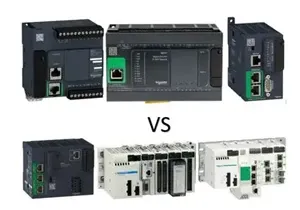
A TCP/IP-connected gate controller sits on the facility LAN — either via Ethernet cable or a local Wi-Fi bridge — and communicates with a management server or directly with client applications over standard IP protocols. The architecture supports concurrent multi-user access, centralized access logs, and integration with existing physical security information management (PSIM) systems. Controllers like the IDEC MicroSmart Pentra bring an embedded web server to the gate, allowing any browser on the local network to access a control dashboard without installing client software.
The critical constraint: TCP/IP remote access stops at the LAN boundary unless you explicitly expose the controller to the internet — which, without a VPN or a properly configured reverse proxy with TLS termination, is a security risk. For a single-site industrial facility where all gates are within the campus LAN footprint, TCP/IP is the sweet spot: reliable, low-latency, IT-manageable, and independent of any third-party cloud subscription.
Cloud: Anywhere Access at the Cost of Dependency
Cloud-connected gate controllers use cellular (4G LTE, NB-IoT, or LTE-M) or Ethernet to maintain a persistent outbound connection to a cloud platform. The platform provides a web dashboard and mobile app for gate control from anywhere with internet access. All authentication, access logging, and firmware updates are managed server-side. This is the only architecture that supports multi-site, geographically distributed perimeter management — an operator at a central security operations center can monitor and control gates across dozens of facilities on a single pane of glass.
The trade-offs are recurring costs (cellular data plan or cloud subscription per gate), latency (cloud round-trip adds 100–500 ms vs. 5–20 ms for local TCP/IP), and loss-of-connectivity risk. During a cloud provider outage or cellular network degradation, cloud-dependent gates may lose remote control capability entirely. Most industrial-grade cloud gate controllers mitigate this with a local fallback: the gate stores a whitelist of authorized credentials and continues to operate autonomously even when the cloud connection drops. For multi-site applications, also consider industrial Ethernet switches and fieldbus gateways to build resilient local-area connectivity at each site before connecting to the cloud.
Decision Framework: Match the Architecture to the Threat Model
| Criterion | Bluetooth | TCP/IP | Cloud |
|---|---|---|---|
| Range | 10–50 m | LAN footprint | Unlimited (cellular/internet) |
| Concurrent users | 1 | Unlimited (LAN server) | Unlimited (cloud platform) |
| Cybersecurity exposure | Minimal (no IP stack) | Moderate (LAN-only unless exposed) | High (internet-facing by design) |
| Recurring cost | None | None beyond LAN maintenance | Cellular plan + cloud subscription |
| Offline operation | Full local control | Full local control | Requires local fallback logic |