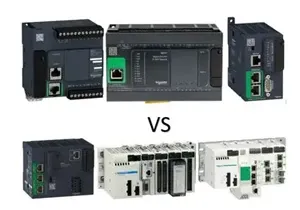
The VersaMax platform from Emerson (formerly GE Intelligent Platforms) spans two product families that serve the same machine-control market but differ fundamentally in architecture. VersaMax is a modular PLC and I/O system — the CPU, power supply, communication modules, and I/O modules are separate slices that snap together on a DIN rail, configurable from a handful of I/O points to several hundred. VersaMax Micro is a compact, all-in-one PLC with a fixed number of onboard I/O points — typically 14 to 64 — plus limited expansion capability. Choosing between them is not a simple bigger-vs-smaller decision; it is about whether the machine's I/O count will grow over its lifecycle, whether the communication protocol may change, and whether field-side spare parts interchangeability matters across multiple machine types in the same plant.
What VersaMax Modular Offers That VersaMax Micro Cannot
The defining capability of VersaMax modular is I/O composition freedom. The CPU rack can accept any mix of discrete input, discrete output, analog input, analog output, high-speed counter, and communication modules — in whatever quantity and arrangement the application requires. A machine that needs 24 inputs and 8 outputs today but may expand to 48 inputs and 24 outputs next year starts with the CPU and the I/O it needs now, leaving empty slots for future expansion. The expansion requires adding modules and updating the configuration — no rewiring, no panel space negotiation, no new part number to stock.
VersaMax modular also supports multiple network interfaces through a common backplane. The Emerson VersaMax Network Interface allows the same I/O modules to communicate over PROFIBUS-DP, DeviceNet, or AS-i by swapping the network adapter — the I/O modules and field wiring remain unchanged. This is valuable for OEMs who ship machines with different communication protocols depending on the customer's existing PLC platform. A machine built for a European customer using PROFIBUS uses the same I/O modules as the same machine built for a North American customer using DeviceNet — only the network adapter changes.
What VersaMax Micro Does Better
VersaMax Micro wins on simplicity and footprint. A VersaMax Micro with 28 I/O points is a single DIN-rail module roughly 125 mm wide that requires no backplane, no inter-module connectors, and no module selection decisions — the I/O mix is fixed by the part number. For a machine builder producing 500 units per year of a standardized conveyor controller with a known, stable I/O count, the VersaMax Micro eliminates the engineering overhead of module selection and the assembly overhead of snapping together six separate slices per controller.
The cost comparison also favors VersaMax Micro at the low end of the I/O range. Below roughly 40 I/O points, the combined cost of a VersaMax CPU, backplane, power supply, and individual I/O modules exceeds the cost of a functionally equivalent VersaMax Micro. The crossover point where modular becomes more cost-effective is approximately 50–60 I/O points, depending on the analog I/O mix. For the majority of small machine applications — a pump controller, a small conveyor, a labeling station — VersaMax Micro hits the cost target that modular cannot match. Browse modular PLCs and compact PLCs for both architecture options.
How to Choose: The Decision Criteria
The primary decision factor is I/O count trajectory. If the machine's I/O count is fixed and known — 24 inputs, 12 outputs, never changing — VersaMax Micro is the more cost-effective choice. If the I/O count may grow from 30 to 80 points over the machine's production life as options and variants are added, VersaMax modular avoids the cost and engineering disruption of switching PLC families mid-lifecycle.
The secondary factor is multi-protocol requirements. If the machine ships to customers with different PLC platforms and must communicate on their protocol, VersaMax modular with interchangeable network adapters provides a single I/O hardware platform for multiple communication protocols. VersaMax Micro has fixed communication — typically a single serial port and optionally an Ethernet port — and cannot adapt to a different protocol without an external gateway. The tertiary factor is spare parts consolidation: a plant with five different machine types, all built on VersaMax modular I/O, stocks one set of I/O modules that service all five machines. The same plant using VersaMax Micro on each machine stocks a different part number for each machine type's specific Micro model. For maintenance organizations, the fewer unique part numbers, the lower the spares inventory cost and the faster the mean time to repair. See PLC platforms for the full range of machine control options.
VersaMax modular and VersaMax Micro are not competitors — they are two points on the same platform continuum. Choose Micro when the I/O count is fixed and low; choose modular when the machine may grow, the protocol may change, or the maintenance organization values interchangeability across machines.