A packaging machine with 180 sensors and 90 actuators spread across a 15-meter frame can be wired two ways. The centralized approach brings every sensor cable and every actuator cable back to a single control cabinet at one end of the machine — roughly 270 individual conductors bundled into cable trays, each one cut to length, labeled, terminated, and checked during commissioning. The distributed approach places I/O blocks at four points along the machine frame, connected back to the controller by a single Ethernet cable at each point — reducing the total copper weight by 60–70%, the cabinet footprint by 40%, and the wiring errors during commissioning by a larger margin. This article compares the two architectures across installation cost, commissioning time, maintenance accessibility, and application fit.
How Distributed I/O Changes the Physical Architecture of a Machine
In centralized I/O, the PLC rack holds all input and output modules in one physical location. Every field device — limit switch, photoeye, solenoid valve, proxy sensor — has a home-run cable that terminates at the PLC cabinet. The terminal strip in the cabinet maps each field wire to a specific PLC I/O point, and that mapping exists only in the wiring schedule document. Changing a sensor from input 3 to input 7 means rewiring the terminal strip.
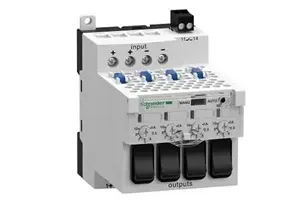
In distributed I/O, small I/O blocks mount directly on the machine frame near the sensors and actuators they serve. Each block connects to the controller via a single industrial Ethernet cable — PROFINET, EtherNet/IP, or EtherCAT — carrying power and communication. The I/O block becomes part of the machine's mechanical structure, not the cabinet. A distributed block serving the infeed station of the packaging machine might handle 16 inputs and 8 outputs within a 1-meter radius, eliminating 24 home-run cables. Browse networked remote I/O and remote I/O modules for distributed options.
Where Distributed I/O Delivers the Largest Payback
Four machine characteristics strongly favor distributed I/O. First, physical span: when the distance from the first sensor to the last actuator exceeds 5 meters, the copper savings alone can justify distributed I/O. At 15 meters of machine length with 270 field conductors averaging 8 meters each, centralized wiring uses approximately 2,160 meters of copper; distributed I/O with four blocks reduces this to roughly 350 meters of field wiring plus 60 meters of Ethernet cable.
Second, modular machine construction: machines built from standardized mechanical modules — each with its own set of sensors and actuators — map naturally to distributed I/O. Each mechanical module gets its own I/O block, pre-wired and tested at the module builder's shop, then connected to the machine network with one cable during final assembly. This is the dominant architecture in automotive body-in-white lines, where welding cells are built as self-contained modules and integrated on-site.
Third, commissioning parallelism: centralized I/O forces sequential commissioning — the electrician must complete all field wiring before the controls engineer can begin I/O checkout. Distributed I/O allows parallel work: as each machine section is mechanically assembled, its I/O block is connected and the controls engineer checks out that section while electricians continue wiring the next. Fourth, maintenance accessibility: when a sensor fails at 2 AM, a distributed I/O block with per-point LED diagnostics tells the maintenance technician which sensor is faulty without walking to the main cabinet and cross-referencing a wiring schedule.
Where Centralized I/O Still Makes Sense
Centralized I/O retains three structural advantages. The environmental advantage: the control cabinet provides a controlled environment (IP54–IP66, temperature-regulated, filtered air) that protects the I/O modules from dust, moisture, vibration, and temperature extremes. Distributed I/O blocks mounted on the machine frame must survive these conditions in their own enclosures — typically IP67-rated blocks that cost more per point than their IP20 cabinet-mounted equivalents.
The density advantage: for machines with highly concentrated I/O — a small assembly cell where 80% of the sensors are within 2 meters of the cabinet — centralized I/O eliminates the overhead of configuring, powering, and managing multiple network nodes. The lifecycle advantage: centralized I/O modules from a major PLC vendor will be available as spares for 10–15 years; distributed I/O blocks from a smaller vendor may have shorter support lifecycles. For machines intended to operate unchanged for 15+ years, the centralized cabinet is the lower-risk choice. See PLC platforms for both centralized and distributed I/O options.
Distributed I/O is not about mounting electronics closer to the machine — it is about reducing the total length of copper that must be cut, labeled, terminated, checked, and maintained for the next 15 years. The savings are not in the I/O hardware; they are in the wiring labor that the hardware eliminates.