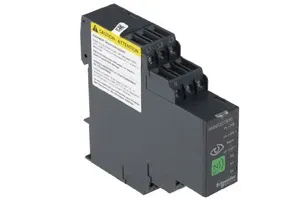
Breaker-level synchronization sits between the genset controller and the grid's rules, and Woodward's LS-521 (8440-1947 class) owns that middle: a front-door graphical LCD for the operator, synch-check and closing control for the breaker, and the grid-decoupling protections — ROCOF, vector shift, over/under voltage and frequency — that interconnection standards demand. The LS-521-5-P1 variant adds 5 A CT inputs for the measurement path, rounding the family for direct-current-measurement installations.
What the LS-521 owns
The closing decision. Genset controllers decide when to run and share; the LS-521 decides when the breaker may close — phase, slip, voltage magnitude and frequency all inside the window, ROCOF and vector-shift guarding against closing onto a wobbling grid. Its protection suite aligns with interconnection codes such as VDE-AR-N-4105, which is the German distributed-generation rulebook many export projects inherit.
The single CAN bus architecture
The family's integration trick is one CAN bus shared with the easYgen controllers: status, commands and measurements ride the same pair, and the panel's wiring diagram stays one line instead of a harness study. Front-door mounting puts the LCD at the switchgear door where operators already stand — commissioning and event-reading without opening cubicles.
The decision rule
Breaker sync with grid-code protection at the switchgear tier: LS-521. Genset-tier paralleling logic: the easYgen family it partners with. Plants that measure current directly at the controller specify the -5-P1's CT path; plants with external metering run the base build. Everything lands in the same switchgear control bay and the same CAN discipline.
Why ROCOF and vector shift on a genset breaker?
Because distributed generation inherits grid rules: losing mains must be detected fast (ROCOF and vector shift are the classic islanding detectors) before reclosing hazards appear. A breaker that can close to a dead line must also refuse to close to a dying one.
Can LS-521 and easYgen share one bus safely?
That is the design: CAN with deterministic roles — the LS-521 owns breaker decisions, the easYgen owns the engine, and the arbitration is documented. Mixed fleets follow the same convention; the bus is the integration, not a cable choice.