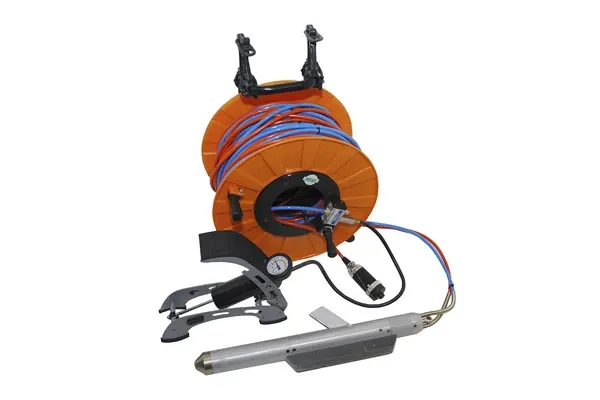
Downhole seismic surveys live or die by coupling: the geophone must move with the formation, not with the borehole's acoustics. A tool suspended on a cable touches the wall at two points and behaves like a microphone in a wind tunnel — every tube ringing, every reflecti reflection, every measurement arguing with its surroundings. The pneumatic clamping class — P.A.S.I.'s GFA-50/100 among them — solves it with air: 2–3 bar presses the three 10 Hz geophones against the borehole wall, and the formation's motion finally reaches the sensors honestly.
Why coupling is the measurement
A geophone reports the velocity of whatever moves it. Uncoupled, that is the cable, the tool body's resonance and the borehole fluid's slosh — a signal contaminated before the electronics begin. Clamped pneumatically, the sensor shares the wall's motion directly: crosshole tomography between boreholes, downhole V s profiling and vertical seismic profiling all read the formation instead of the fixture. The air clamps deploy in seconds and release without cement or guesswork — surveys move depth-to-depth at working pace.
What the 3×10 Hz configuration means
Three orthogonal 10 Hz geophones — one vertical, two horizontal — capture the full vector wavefield per station: compressional and shear arrivals with their directions intact. Vs profiling needs the shear pick; crosshole needs the vector geometry. The 10 Hz natural frequency suits the seismic band's energy without demanding the low-frequency heroics that surface arrays sometimes need.
The decision rule
Depth surveys — crosshole, downhole, Vs30 — want the clamped downhole unit; the surface array cannot reach the formation's interior and the uncoupled tool lies. Surface arrays keep their own honest work: near-surface mapping and passive surveys where the ground itself is the instrument. The data lands in the same vibration-sensing analysis world either way — coupling decides whose data is worth analyzing.
Why pneumatic and not mechanical clamping?
Speed and conformance: air acts in seconds, conforms to the wall's irregularity uniformly, and releases without the mechanical memories that screw-jacks leave. Down a borehole, deployment pace is survey economics.
Does the clamping disturb the formation I am measuring?
The pressure is local and static — it loads the wall a few centimeters from the sensors, while the measurement reads waves arriving from meters away. Surveys verify by repeatability, and the clamped geometry repeats honestly.