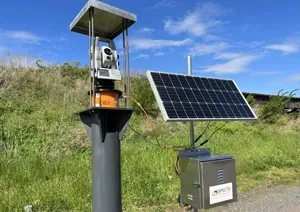
Solar Wireless Geophone
Cabled seismic arrays bury kilometers of cable and swap batteries yearly. Solar wireless nodes like Resensys SeniMax run a decade — what changes on the survey.

Selection guides, head-to-head comparisons, and field-tested configuration notes for control engineers, integrators, and maintenance teams.
Cabled seismic arrays bury kilometers of cable and swap batteries yearly. Solar wireless nodes like Resensys SeniMax run a decade — what changes on the survey.
Slip rings transfer torque signals through brushes — a wear item, speed-limited, and noise-prone. Non-contact magnetoelastic sensors measure shaft magnetization through an air gap — no wear, no speed limit.
A VFD running its own PID loop samples at 1-2 ms internally. A PLC PID samples at scan time plus network latency, typically 10-50 ms.
Weighing-based verification subtracts tare from gross per blister — accurate but cycle-time limited. Eddy current detects metallic tablet presence through foil instantly, without weighing.
RFID transponders embedded in the floor encode absolute position — unlike magnetic tape which only provides lateral guidance.
An open-loop stepper stalls silently and the controller never knows. A closed-loop stepper detects lost steps and compensates in real time. When the cost of one missed step exceeds the incremental cost of adding the encoder.
Adding an I/O expansion module costs $200-$800 and takes one DIN-rail slot. Upgrading the controller costs $2,000-$8,000 plus reprogramming and re-validation.
A machine builder in Ohio ships a conveyor system to a customer in rural Texas. The machines control panel has a 5 HP three-phase-input VFD . The customers site has single-phase 240 V power no three-phase service within half a mile. The drive powers up, displays an input-phase-loss fault, and refuses to run.
An automotive assembly plant has 27 HMIs on the floor, each collecting cycle-time data from a local PLC. The corporate IIoT team wants this data in AWS for a machine-learning OEE model. The controls engineer wants the HMIs to keep updating every 100 ms regardless of what happens to the cloud connection.
The traditional drive architecture a wall-mounted VFD in a cabinet, connected to a motor 20 meters away by a shielded cable has dominated industrial automation for four decades. It works. But a competitor that eliminates the cable, the cabinet space, and much of the installation labor is gaining ground: the integrated motor-inverter, where the drive electronics are mounted directly on the motor housing.
How hot standby CPU redundancy synchronizes dual processors for bumpless failover in under 50 ms — and when it justifies the cost over warm standby, software redundancy, or TMR for critical process control.