
Product Specifications
- Manufacturer
- Megger Group Limited
- Series
- BVM (BVM150 / BVM300 / BVM600)
- Product Type
- Battery Voltage Monitor – Automated Capacity Test System
- Design & Expansion
- Modular, 1 BVM per battery/jar; daisy‑chain up to 2×120 cells (max. 242 units); Auto Discovery feature for automatic configuration
- Measurement
- Voltage ranges: 0–5 V DC and 0–20 V DC; resolution: 1 mV; inaccuracy: < 0.1 % of full scale ±0.01 V DC
- Software Integration
- Compatible with TORKEL Win and PowerDB Test Data Management software
- Compliance
- IEC test method; meets NERC/FERC requirements
- Power & Environment
- 100–240 V AC, 50/60 Hz, 50 VA max; operating 5 °C to +50 °C; max. string voltage 300 V DC per loop
Product Description
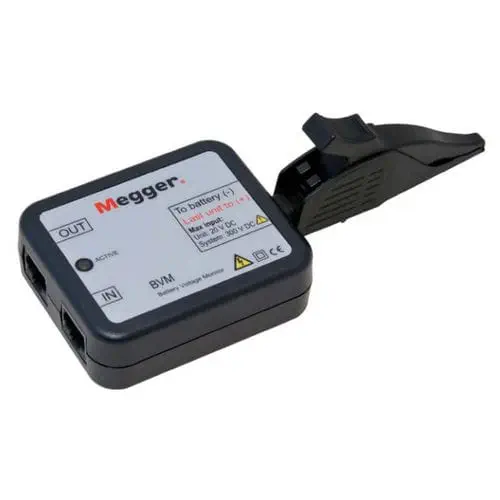
The Megger BVM series is a modular battery voltage monitor engineered to replace manual cell voltage measurement during industrial battery capacity testing. It is not a handheld voltmeter nor a standalone battery analyzer—each BVM module is a dedicated measurement channel assigned to a single battery or jar cell, and up to 242 modules can be connected in a daisy‑chain configuration to cover any battery bank size. The system integrates with Megger TORKEL load units and PowerDB or TORKEL Win test data management software to provide a fully automated capacity discharge test compliant with IEC, NERC, and FERC standards. The BVM eliminates human reading errors, accelerates test setup, and produces auditable test reports ready for regulatory submission.
Why Automate Battery Capacity Testing?
- Manual Measurement Is Error‑Prone and Unsustainable: A typical substation battery bank contains 60–240 individual cells or jars. Measuring each manually with a handheld voltmeter during a discharge test takes hours of technician time, introduces human reading errors, and makes it nearly impossible to capture voltage values at consistent time intervals across all cells. The BVM automates this process: every module samples its assigned cell simultaneously, records the voltage with 1 mV resolution, and transmits the data to PowerDB or TORKEL Win for real‑time display and post‑test analysis. The result is a complete, time‑synchronized voltage profile for every cell in the bank—without manual transcription.
- IEC/NERC Compliance: Regulatory standards require that battery capacity tests be performed according to documented procedures with traceable data. The BVM, combined with TORKEL load units and PowerDB software, satisfies IEC test methods for stationary lead‑acid and Ni‑Cd batteries, and meets NERC/FERC requirements for utility battery maintenance documentation. Automated report generation reduces the audit burden by providing timestamped, serialized data in a standardized format.
Daisy‑Chain Architecture — One Module Per Cell, Infinite Scalability
- Modular, One‑Channel‑Per‑Cell Design: Unlike multi‑channel rack‑mounted data acquisition systems that have fixed channel counts, the BVM uses a distributed architecture: one compact module is dedicated to each battery cell. Each module connects directly to the positive and negative terminals of its assigned cell using the supplied dolphin clips or banana‑plug clamps, minimizing lead length and the associated noise pickup.
- Daisy‑Chain up to 2 × 120 Cells: Modules connect to each other in a daisy‑chain using standard RJ45 cables. A single loop supports up to 120 cells, and two loops can be combined to monitor up to 242 cells—sufficient for any utility substation, data center UPS, or telecom battery plant. If the bank expands, additional BVM modules can be purchased and added to the chain without replacing the existing infrastructure.
- Auto Discovery Eliminates Configuration Errors: Each BVM module is identical and interchangeable—there is no need to assign addresses or configure positions manually. The host device automatically discovers how many modules are connected, determines their physical order in the chain, and assigns each a sequential identification number. This feature eliminates a common source of setup error in multi‑channel measurement systems and reduces test preparation time from hours to minutes.
Precision Measurement and Seamless Software Integration
- < 0.1% Full‑Scale Accuracy with 1 mV Resolution: The BVM achieves a measurement inaccuracy of less than 0.1% of full scale ± 0.01 V DC, with 1 mV resolution across both the 0–5 V and 0–20 V input ranges. This level of precision enables reliable detection of weak cells before they compromise the entire battery string—a degradation that may only manifest as a few tens of millivolts of deviation under load.
- TORKEL and PowerDB Integration: The BVM is designed to work as part of the Megger battery testing ecosystem. When connected to a TORKEL load unit, the discharge test is fully automated: the TORKEL applies a controlled load current while the BVM monitors cell voltages. PowerDB software collects all data, displays real‑time voltage trends per cell, and generates a complete test report with pass/fail criteria based on IEC‑defined voltage limits. TORKEL Win provides an alternative software interface for users who prefer standalone test execution without PowerDB database management.
- Flexible Connection Options: Each BVM module is supplied with dolphin clips and interchangeable banana‑plug clamps to accommodate different battery terminal types. The RJ45 daisy‑chain cabling uses standard Ethernet patch leads, avoiding proprietary cables that would complicate field replacement.
Applications
- Electrical power substation battery bank capacity testing (60–240 cell strings, lead‑acid or Ni‑Cd)
- Data center UPS battery maintenance (individual cell monitoring during scheduled discharge tests)
- Telecom facility central office battery plant testing (−48 V DC systems)
- Industrial emergency backup battery system commissioning and periodic maintenance
- Any application requiring automated, traceable, IEC/NERC‑compliant battery capacity discharge testing
Resources & Documentation
Battery Voltage Monitor, Capacity Test, Daisy‑Chain 2×120 Cells – BVM | Megger
Product Specifications
- Manufacturer
- Megger Group Limited
- Series
- BVM (BVM150 / BVM300 / BVM600)
- Product Type
- Battery Voltage Monitor – Automated Capacity Test System
- Design & Expansion
- Modular, 1 BVM per battery/jar; daisy‑chain up to 2×120 cells (max. 242 units); Auto Discovery feature for automatic configuration
- Measurement
- Voltage ranges: 0–5 V DC and 0–20 V DC; resolution: 1 mV; inaccuracy: < 0.1 % of full scale ±0.01 V DC
- Software Integration
- Compatible with TORKEL Win and PowerDB Test Data Management software
- Compliance
- IEC test method; meets NERC/FERC requirements
- Power & Environment
- 100–240 V AC, 50/60 Hz, 50 VA max; operating 5 °C to +50 °C; max. string voltage 300 V DC per loop