
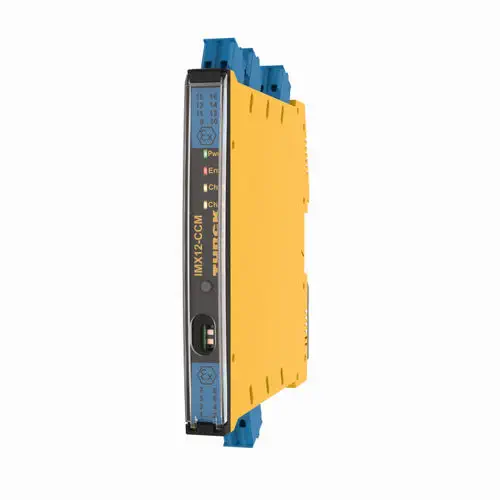
Product Specifications
- Manufacturer
- TURCK (Turck, Inc., Germany)
- Model
- IMX12-CCM05-MTI-1I2T-HC/L/CC (Order: 100030580)
- Product Type
- Cabinet Guard / Temperature Monitoring Module (ATEX/IECEx)
- Sensors
- Integrated temperature (NTC), humidity (capacitive), and triangulation sensor (door distance)
- Outputs
- 2 potential-free contacts (galvanically isolated); A1/A2 via removable spring-type terminals, 2-pin
- Configuration
- Local pushbutton teach-in; HART interface for remote parameterization; 4 LEDs: Pwr/Fault/Out1/Out2
- Power & Mounting
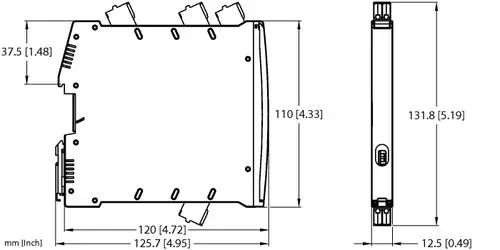
- 24 VDC; 120 × 12.5 × 128 mm; DIN rail (EN 60715); IP20; -25 to +70 °C; 135 g
- Approvals
- ATEX, IECEx (Zone 2 hazardous area use)
Product Description
The Turck IMX12-CCM05-MTI-1I2T-HC/L/CC is an ATEX/IECEx‑certified cabinet guard that combines three integrated environmental sensors—temperature, humidity, and a triangulation‑based door‑status detector—into a single, 12.5 mm wide DIN‑rail module. Designed for monitoring control cabinets in Zone 2 hazardous areas, the device provides two galvanically isolated potential‑free relay contacts that signal limit value exceedances to a host PLC, DCS, or safety instrumented system. The pushbutton teach‑in function allows local calibration of alarm thresholds (temperature, humidity, door gap distance) without additional tools, while the integrated HART interface enables remote parameterization via any standard HART communicator. Four front‑panel LEDs provide at‑a‑glance indication of power status, a collective fault signal (flashing red per NE 43), and the individual states of both switching outputs.
How the Three Internal Sensors Work Together
- Temperature Detection: An integrated NTC resistance temperature sensor continuously monitors the ambient temperature inside the control cabinet. When the measured temperature exceeds the user‑defined upper limit or drops below the lower limit, the associated relay output (A1 or A2) changes state and the corresponding yellow LED illuminates. The temperature threshold range is set during teach‑in operation and can be fine‑tuned via HART, enabling precise overtemperature protection for heat‑sensitive electronics such as PLC CPUs, power supplies, and frequency converters.
- Humidity Detection: A capacitive humidity sensor monitors the absolute humidity within the cabinet enclosure. Exceeding the humidity limit—typically indicative of a failed enclosure seal, an open cabinet door, or a malfunctioning cabinet heater—triggers the second potential‑free contact. This provides early warning of condensation conditions that could lead to electrical creepage, corrosion of terminals, or ground faults in high‑voltage circuits.
- Triangulation Sensor for Door Distance Monitoring: The third integrated sensor uses optical triangulation to detect whether the control cabinet door is properly closed. This sensor continuously measures the distance to the cabinet door or front panel; when the door is opened or ajar beyond the teach‑in calibrated threshold, the relay output activates, providing a real‑time signal that the cabinet seal is compromised before humidity or temperature deviations occur.
Teach‑In Calibration and HART Remote Access
- Pushbutton Teach‑In: The device comes with pre‑configured default limit values for temperature and humidity from the factory. For installation‑specific conditions—where a particular cabinet's internal heat load differs from the general default—the user can press and hold the front‑panel pushbutton for 2–6 seconds. The Pwr LED flashes green, and the device automatically captures the current ambient temperature, relative humidity, and door gap distance as reference values, then applies configurable offset thresholds to each parameter. Three separate parameter groups (for the two relays combined) can be taught independently.
- HART Interface for Extended Parameterization: Beyond the teach‑in function, all alarm thresholds, hysteresis values, and relay assignment logic are accessible via the built‑in HART interface. When connected to a HART‑compatible handheld terminal or a PC with a HART‑USB interface, operators can verify the current sensor readings, configure relay activation logic (trip‑on‑high vs. trip‑on‑low), set hysteresis bands, and download diagnostic logs—all without opening the control cabinet or connecting to the device locally.
Electrical Installation and Supply Considerations
- Potential‑Free Relay Outputs with Galvanic Isolation: The two relay outputs (A1 and A2) are potential‑free and galvanically isolated from the device's internal electronics, allowing them to be connected to any external control system without concern for ground loops or potential differences between the module and the host controller. Each relay contact can handle typical logic‑level signaling to a PLC digital input (24 V DC) or low‑power dry‑contact circuits up to 30 V DC / 0.5 A, suitable for directly driving alarm indicators, solenoid‑operated pilot valves for cabinet purge air, or emergency shutdown relays in safety‑instrumented systems.
- Spring‑Type Terminal Blocks: The device is equipped with eight removable spring‑type terminals (2‑pin each, 4 black + 4 blue). These terminals accommodate solid or stranded conductors up to 2.5 mm² without tools, allowing quick and reliable installation in densely populated control cabinets. The removable terminal design enables pre‑wiring of the cabinet harness on the bench, after which the module can be snapped into the pre‑wired spring terminals without disturbing any existing wiring.
- Power Supply Architecture for Ex Applications: The module itself requires a 24 V DC supply (nominal voltage, via the loop‑powered HART architecture). When installed in an ATEX/IECEx Zone 2 location, the supply must be sourced from a Turck IMX12-AI01 isolating transducer (or equivalent ATEX‑certified current‑limited power supply) that limits the available energy below the ignition threshold for the classified gas/dust group. The module does not generate its own supply voltage and does not require a separate intrinsically safe barrier—the isolating transducer provides both power and intrinsic safety while also offering galvanic isolation between the hazardous‑area and safe‑area sides of the circuit.
- Compact DIN‑Rail Housing: At just 12.5 mm wide, 120 mm long, and 128 mm high, the module occupies minimal rail space and can be installed alongside other IM(X)12 series interface modules using the standard Turck Powerbridge connector system for common 24 VDC power distribution across multiple modules, reducing wiring complexity in multi‑module installations.
Applications
- Control cabinet environmental monitoring in chemical, petrochemical, pharmaceutical, and offshore installations where ATEX/IECEx Zone 2 certification is mandatory
- Protection of sensitive electronics (PLC, DCS, safety controllers) from over‑temperature conditions caused by blocked ventilation fans or internal heat buildup
- Early detection of condensation risk in outdoor enclosures, transformer housings, and remote terminal unit (RTU) cabinets exposed to humid ambient air
- Supervision of control cabinet door status on remotely operated or inaccessible equipment, reducing unnecessary site visits by maintenance technicians
- Integration with higher‑level SCADA or asset management systems via HART for continuous monitoring and diagnostic data collection
Resources & Documentation
Cabinet Guard, Temp./Humidity/Door, ATEX/IECEx – IMX12-CCM05 | Turck
Product Specifications
- Manufacturer
- TURCK (Turck, Inc., Germany)
- Model
- IMX12-CCM05-MTI-1I2T-HC/L/CC (Order: 100030580)
- Product Type
- Cabinet Guard / Temperature Monitoring Module (ATEX/IECEx)
- Sensors
- Integrated temperature (NTC), humidity (capacitive), and triangulation sensor (door distance)
- Outputs
- 2 potential-free contacts (galvanically isolated); A1/A2 via removable spring-type terminals, 2-pin
- Configuration
- Local pushbutton teach-in; HART interface for remote parameterization; 4 LEDs: Pwr/Fault/Out1/Out2
- Power & Mounting
- 24 VDC; 120 × 12.5 × 128 mm; DIN rail (EN 60715); IP20; -25 to +70 °C; 135 g
- Approvals
- ATEX, IECEx (Zone 2 hazardous area use)
Resources & Documentation
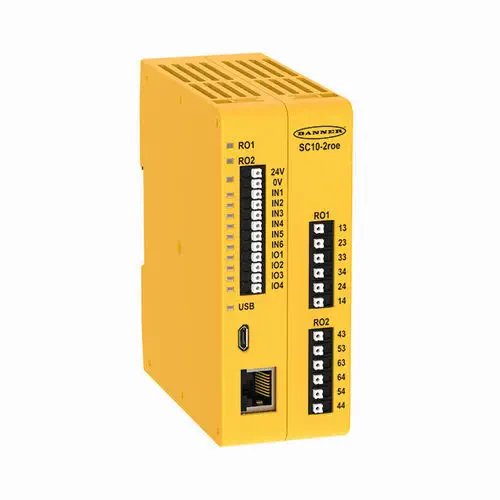
TURCK SC10-2ROE
PLe/SIL 3, 4 configurable I/O, PROFINET/Modbus TCP, IP20