
Product Specifications
- Manufacturer
- Kipp & Zonen (OTT HydroMet group, Netherlands)
- Model
- DustIQ
- Product Type
- Optical Soiling Monitoring System for PV Panels
- Measurement Range
- Transmission Loss (TL): 0‑50 %; Soiling Ratio (SR): 100‑50 %
- Accuracy & Sensors
- TL accuracy: ±0.1 % of rdg ±1 % (after dust calibration); panel temp sensor: -20 to +100 °C, ±1 °C; tilt X & Y: -180° to 180°, ±1°
- Communication & Power
- Modbus® RTU over 2‑wire RS‑485 (3 units max. per daisy‑chain); 12‑30 VDC, max. < 2.5 W; 8‑pin ODU connector
- Environmental & Physical
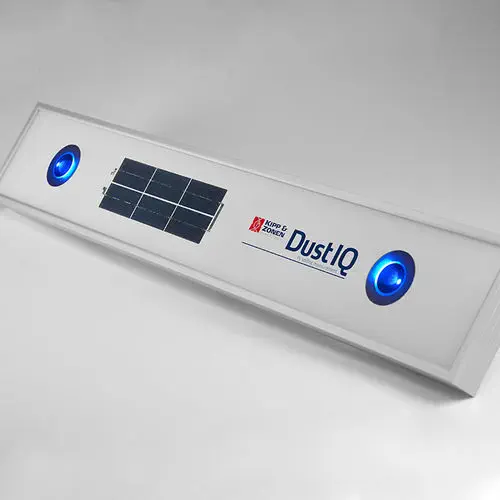
- IP65 anodized aluminum housing; -20 to +60 °C operating; 990 × 160 × 35 mm; 4 kg (unit) + 600 g (clamps)
- Plant Integration
- Maintenance‑free operation, no moving parts; integrated into leading plant management software for automatic cleaning alarms
Product Description
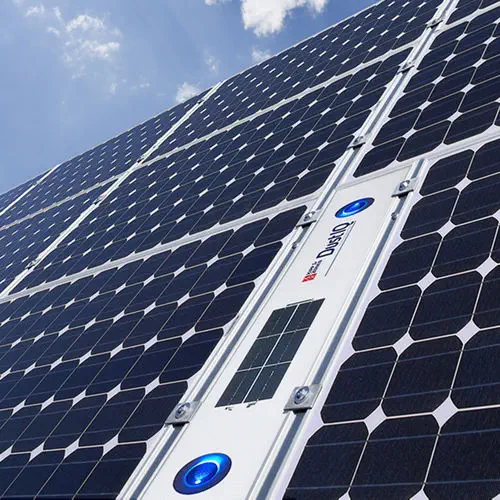
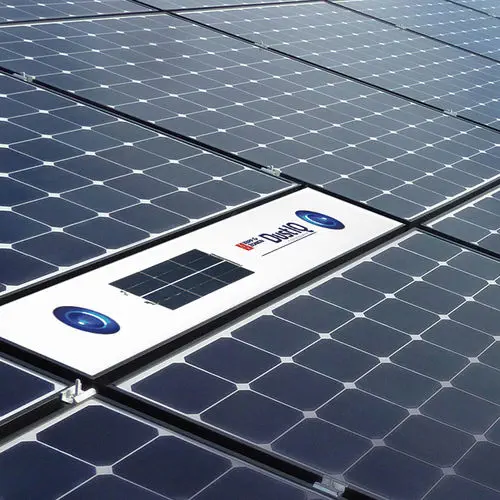
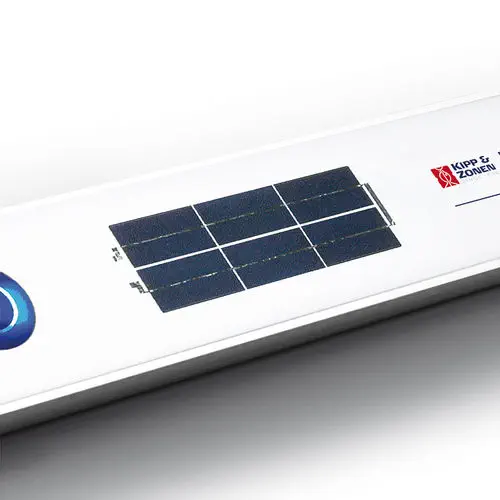
The Kipp & Zonen DustIQ is a soiling monitoring system purpose‑built to solve the single largest operational uncertainty for utility‑scale solar parks: knowing exactly when and where to clean PV panels. Using Optical Soiling Measurement (OSM) technology, the DustIQ continuously quantifies the Transmission Loss (TL) caused by dust, sand, pollen, and other accumulated debris—from 0% up to 50% blockage. Unlike camera‑based or reference‑cell methods, OSM uses an internal LED light source that makes it self‑contained and completely independent of sunlight. This enables the DustIQ to provide actionable soiling data to the plant management software 24 hours a day, 7 days a week, regardless of weather conditions or time of day—allowing solar park operators to replace rigid, costly cleaning schedules with precise, condition‑based maintenance decisions.
OSM Technology — How It Works Without Sunlight
- Internal LED Light Source for Round‑the‑Clock Operation: The Optical Soiling Measurement (OSM) principle uses a built‑in LED light source that illuminates the surface of the PV panel and measures the amount of scattered and reflected light—which is directly proportional to the soiling accumulation. Because the light source is internal and controlled, the DustIQ is completely independent of sunlight and can operate at any time: night, dawn, dusk, and during periods of heavy cloud cover. Camera‑based inspection systems and human visual inspection both require adequate daylight, so they leave critical gaps in data coverage during the exact periods when maintenance crews would be planning the next day's cleaning activities.
- Continuous Optical Transmission Loss Trending: The system directly measures the percentage of sunlight that has become blocked or scattered in such a way that it does not reach the solar cells—the Transmission Loss (TL). This TL value is continuously tracked alongside the complementary Soiling Ratio (SR = 100 – TL), giving the plant management system a direct, quantitative measure of revenue lost to soiling. The data can be trended over weeks, months, or seasons, allowing the identification of seasonal soiling patterns—such as post‑harvest dust storms in agricultural regions or pollen seasons—that might otherwise go undetected with periodic inspection.
- No Moving Parts — Zero Mechanical Maintenance: The OSM sensor head, the Modbus communication interface, the digital signal processing, and the panel temperature compensation are all performed with zero mechanical moving parts. This eliminates the wear and tear associated with motorized shutters, rotating mirrors, or cleaning mechanisms found in some competing soiling measurement systems. The DustIQ is intended to be mounted in the same solar park environment as the panels it monitors, and the absence of moving parts ensures it does not become a maintenance burden itself—an important consideration for solar parks located in arid, dusty regions where abrasive sand ingress can rapidly degrade mechanical components.
Data‑Driven Cleaning Alerts — From "Schedule‑Based" to "Need‑Based"
- Integrated Modbus RS‑485 Communication: The DustIQ communicates using Modbus RTU over 2‑wire RS‑485—the de‑facto industrial communication protocol for solar plant monitoring systems. This allows the DustIQ to integrate natively with existing SCADA and plant management platforms without requiring a separate data acquisition gateway. Up to 3 DustIQ units can be daisy‑chained on a single RS‑485 bus, providing a compact, network‑efficient solution for monitoring soiling variation across a solar park.
- User‑Configurable Soiling Ratio Alarms: Within the plant management software, operators can set Soiling Ratio (SR) alarm thresholds. When the SR drops below a configurable setpoint—for example, 95%—the system automatically generates an alert. This transforms the cleaning decision from a fixed calendar‑based activity ("clean every two weeks") into a precise, condition‑based process based on real‑time field data. The result is a significant reduction in unnecessary cleaning cycles (saving water, labor, and chemical cleaning agents) while preventing prolonged periods of reduced energy yield.
- Spatial Soiling Variation Monitoring: The cost‑effective price point of the DustIQ allows operators to economically deploy multiple units across different zones of a large solar park—near the edge where dust ingress is highest, in the center, and near the cleaning station. This provides a spatial map of soiling variation that reveals localized soiling sources—such as a particular dirt road, adjacent agricultural activity, or a prevailing wind pattern—enabling targeted cleaning of only the affected zones.
- Digital Signal Processing for Data Quality: The DustIQ incorporates digital signal processing with automatic temperature compensation, accounting for detector temperature sensitivity effects. This ensures that the TL/SR measurement values remain stable and trustworthy despite the large thermal swings common in exposed solar park environments.
Robust and Maintenance‑Free Solar Park Installation
- IP65 Anodized Aluminum Enclosure: The DustIQ is housed in a sealed IP65‑rated anodized aluminum enclosure. This provides protection against dust ingress and low‑pressure water jets, enabling the sensor to be cleaned with the same equipment used for the PV panels themselves—pressure washers, rotating brush cleaning systems, or manual wiping—without risk of water damage. The total unpacked weight is 4 kg for the unit, and 600 g for the mounting clamps, suitable for mounting alongside existing PV panel support structures.
- Tilt‑Sensing Integration: The DustIQ measures tilt (inclination) in both X and Y axes, providing confirmation that the sensor is correctly aligned with the plane of the PV array. This ensures that the soiling accumulation pattern on the DustIQ accurately replicates the pattern on the panels it represents, giving representative soiling measurements across the park.
- Integrated PV Panel Temperature Sensor: A built‑in temperature sensor measures the temperature of the adjacent panel surface (-20 to +100 °C, ±1 °C) in addition to the optical soiling data. This dual‑parameter reporting allows operators to track solar panel temperature trends alongside soiling data, adding thermodynamic context to cleaning and maintenance decision‑making.
- Daisy‑Chain Capability: Up to three DustIQ instruments can be connected in a single daisy‑chain network via the 8‑pin ODU connector, maximizing RS‑485 bus bandwidth and reducing cable runs across the solar park. The included 10‑meter UV‑resistant cable is suitable for outdoor solar park deployment, and longer cable lengths (25 m, 50 m) are available for larger installations.
Applications
- Utility‑scale solar parks requiring data‑driven, condition‑based cleaning schedule optimization
- Commercial and industrial (C&I) rooftop solar arrays where seasonal soiling patterns affect ROI
- Solar parks in arid, agricultural, or industrial areas where dust, pollen, or sand accumulation is rapid and variable
- Long‑term soiling studies and performance guarantee verification for EPC and O&M contracts
Resources & Documentation
PV Panel Soiling Monitor, Dust Transmission Loss 0‑50%, RS‑485, IP65 – DustIQ | Kipp & Zonen
Product Specifications
- Manufacturer
- Kipp & Zonen (OTT HydroMet group, Netherlands)
- Model
- DustIQ
- Product Type
- Optical Soiling Monitoring System for PV Panels
- Measurement Range
- Transmission Loss (TL): 0‑50 %; Soiling Ratio (SR): 100‑50 %
- Accuracy & Sensors
- TL accuracy: ±0.1 % of rdg ±1 % (after dust calibration); panel temp sensor: -20 to +100 °C, ±1 °C; tilt X & Y: -180° to 180°, ±1°
- Communication & Power
- Modbus® RTU over 2‑wire RS‑485 (3 units max. per daisy‑chain); 12‑30 VDC, max. < 2.5 W; 8‑pin ODU connector
- Environmental & Physical
- IP65 anodized aluminum housing; -20 to +60 °C operating; 990 × 160 × 35 mm; 4 kg (unit) + 600 g (clamps)
- Plant Integration
- Maintenance‑free operation, no moving parts; integrated into leading plant management software for automatic cleaning alarms