
Product Specifications
- Brand
- PCE Deutschland GmbH
- Part Number
- PCE-WSAC 50
- Product Type
- Wind Speed Alarm Controller
- Measuring Range
- 0–50 m/s (0–110 mph)
- Accuracy
- ±0.2 m/s or ±3% of Measuring Range
- Signal Input
- 4–20 mA or 0–5 V / 0–10 V (Selectable)
- Alarm Relays
- 2 × NO/NC, Max 250 VAC / 10 A
- Alarm Stages
- Pre-Alarm (Yellow LED + Intermittent Sound) / Full Alarm (Red LED + Continuous Sound)
- Filter Modes
- Instant, 2-Minute Average, 5-Minute Average
- Optional Interface
- RS-485 Modbus RTU
- Power Supply
- 115 VAC / 230 VAC / 24 VDC (Variant-Dependent)
- Operating Temperature
- -20°C to 60°C
- Dimensions
- 197.5 × 90 × 45 mm
- Weight
- ~400 g
Product Description
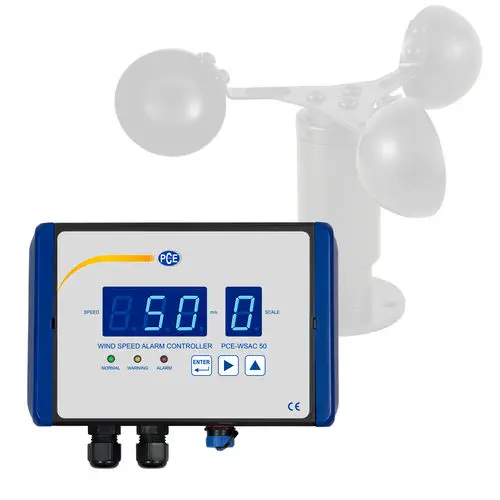
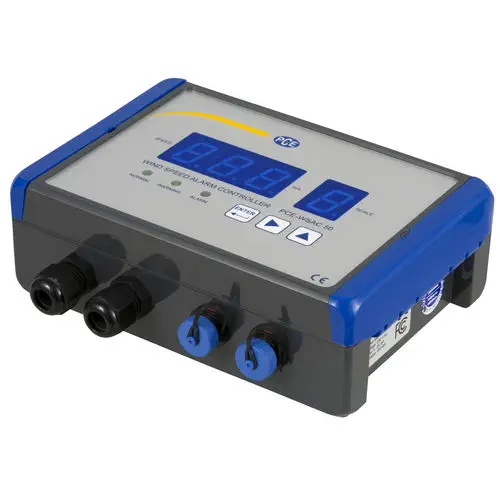
The PCE Instruments PCE-WSAC 50 is a wired wind speed alarm controller built for outdoor industrial environments where wind conditions directly affect operational safety — tower cranes, construction sites, material-handling gantries, wind turbine maintenance platforms, and temporary event structures. It provides continuous wind monitoring with a two-stage alarm escalation logic: the pre-alarm warns operators to prepare for potential shutdown, and the full alarm signals that wind has reached a dangerous threshold requiring immediate action. Both alarm relays are volt-free changeover contacts, so they can be wired into existing site safety interlocks, PLC inputs, or standalone strobe-and-horn assemblies without additional interface hardware.
How do the two alarm stages work?
The user sets two independent wind speed thresholds via the front-panel configuration menu (password-protected at 888). When wind speed exceeds the pre-alarm setpoint, the controller activates a yellow LED and an intermittent audible buzzer — this is the warning stage, giving crane operators or site supervisors time to secure loads, reposition equipment, or prepare for a full stop. If wind speed continues to rise and crosses the full-alarm setpoint, the controller switches to a red LED with a continuous audible tone and energises the second relay, which can be wired to trigger an automatic equipment shutdown. Both alarms deactivate automatically when wind speed drops back below the respective thresholds, preventing nuisance latch-up after a gust passes. The user can also select between instant, 2-minute-average, or 5-minute-average wind speed calculation as the basis for alarm triggering — the averaged modes filter out short gusts that do not represent sustained hazardous conditions.
Which sensor works with the PCE-WSAC 50?
The controller accepts standard industrial anemometer outputs — 4–20 mA current loop or 0–5 V / 0–10 V voltage signals — making it compatible with most cup, propeller, and ultrasonic anemometers on the market. PCE offers matching wind sensors separately, but the standardised input means users can integrate existing site anemometers without replacing them. The controller supplies 12 VDC or 24 VDC sensor excitation voltage, so the anemometer can be powered directly from the PCE-WSAC 50 without a separate power supply at the sensor mounting point. For applications requiring digital data integration, an optional RS-485 Modbus RTU interface allows the controller to transmit real-time wind speed, alarm status, and average values to a central SCADA or building management system.
Resources & Documentation
PCE Instruments PCE-WSAC 50 Wind Speed Alarm Controller with Dual Relay Outputs
Product Specifications
- Brand
- PCE Deutschland GmbH
- Part Number
- PCE-WSAC 50
- Product Type
- Wind Speed Alarm Controller
- Measuring Range
- 0–50 m/s (0–110 mph)
- Accuracy
- ±0.2 m/s or ±3% of Measuring Range
- Signal Input
- 4–20 mA or 0–5 V / 0–10 V (Selectable)
- Alarm Relays
- 2 × NO/NC, Max 250 VAC / 10 A
- Alarm Stages
- Pre-Alarm (Yellow LED + Intermittent Sound) / Full Alarm (Red LED + Continuous Sound)
- Filter Modes
- Instant, 2-Minute Average, 5-Minute Average
- Optional Interface
- RS-485 Modbus RTU
- Power Supply
- 115 VAC / 230 VAC / 24 VDC (Variant-Dependent)
- Operating Temperature
- -20°C to 60°C
- Dimensions
- 197.5 × 90 × 45 mm
- Weight
- ~400 g