
Product Specifications
- Manufacturer
- DURAG GROUP (Hegwein brand, Germany)
- Model
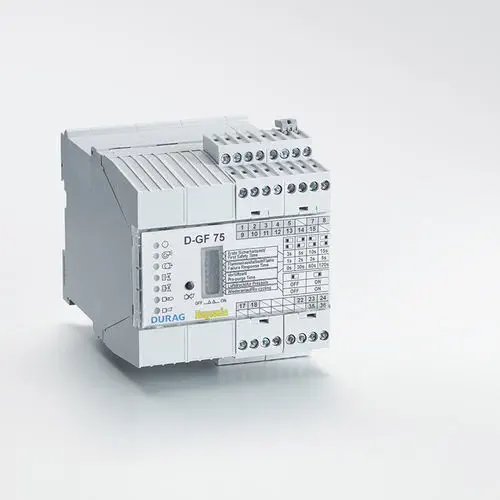
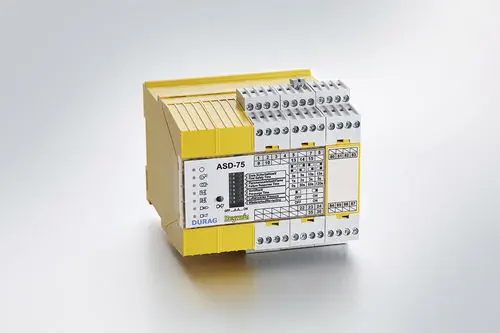
- D‑GF 75 (ASD‑75 variant with external flame signal input)
- Product Type
- EN 298 Self‑Monitoring Fail‑Safe Automatic Burner Control Unit
- Flame Monitoring
- Integrated ionisation flame monitor (D‑GF 75); external flame‑signal input 90‑110 V DC (ASD‑75)
- Safety Times
- Adjustable start‑up 3 / 5 / 10 / 15 s; flame‑failure response 1 / 2 / 3 / 5 s; pre‑purge 0 / 30 / 60 / 120 s
- Operation Modes
- Intermittent (D‑GF 75‑10) or continuous max. 72 h (D‑GF 75‑20); optional automatic re‑cycling after flame loss
- Gas Valve Monitoring
- Integrated system according to TRD 604
- Power & Environment
- 115‑230 V AC 50/60 Hz, 20 W; IP20; DIN rail (TS35); −20 to +60 °C; 5 A terminal load; 500 g; 100 k‑cycle design life
Product Description
The DURAG D‑GF 75 (also available as ASD‑75 for external flame signal input) is a self‑monitoring, fail‑safe automatic burner control unit compliant with EN 298, the European standard governing the safety, construction, and performance of automatic burner control systems. It is designed for gas and oil burners of any capacity, from small pilot burners to large industrial combustion systems. Unlike simple flame relays that only provide flame‑on/flame‑off signalling, the D‑GF 75 executes a complete safety‑critical control sequence: pre‑purge the combustion chamber, initiate ignition, monitor flame establishment within a defined safety time window, maintain continuous flame supervision during operation, and execute an immediate safety shutdown if flame failure is detected—all without relying on an external PLC or separate safety logic solver.
How the EN 298 Safety Cycle Works
- Pre‑purge Phase: Before any ignition attempt, the controller can be configured to execute a pre‑purge of the boiler combustion chamber. The pre‑purge time is adjustable via hardware selection: 0 s (for atmospheric burners that do not require a purge), 30 s, 60 s, or 120 s. An optional air‑pressure check can be enabled to verify that the combustion air fan is delivering adequate airflow before the purge timer starts, preventing a purging cycle with insufficient air.
- Ignition and Safety Time Window: After the pre‑purge completes, the controller energises the ignition transformer and opens the gas valves. The start‑up safety time defines how long the controller waits for a flame signal before it must lock out. This time is adjustable: 3 s (for burners with rapid flame establishment, such as atmospheric gas burners with direct spark ignition), 5 s, 10 s, or 15 s (for larger burners with longer flame propagation paths, such as duct burners or oil burners requiring a vapourising phase). If no flame is detected within this window, the controller immediately closes the gas valves, de‑energises the ignition transformer, and enters a lockout state that requires manual reset.
- Operating Position and Flame Failure Response: Once a flame is established, the controller continuously monitors the flame signal. If the flame is lost during operation—due to a sudden fuel pressure drop, a blocked burner nozzle, or combustion air disturbance—the controller responds within an adjustable safety time: 1 s, 2 s, 3 s, or 5 s. This graded response allows the user to balance safety against nuisance trips: a 1 s response for fast‑acting gas burners where any flame loss indicates a hazardous condition, or a 5 s response for oil burners where momentary flame flicker is a normal operating characteristic.
- Two Operational Versions: The D‑GF 75‑10 is designed for intermittent operation, where the burner cycles on and off in response to load demand. The D‑GF 75‑20 supports continuous operation for up to 72 hours, after which the burner must be deliberately shut down and restarted. This complies with the EN 298 requirement that continuous‑operation burners undergo a controlled restart at least once every 72 hours to verify the integrity of the flame monitoring system.
- Optional Re‑cycling: If flame is lost during the operating position, the controller can be configured to automatically attempt one re‑ignition cycle (re‑cycling) rather than immediately entering lockout. This is useful in applications where flame loss may be caused by a transient condition—such as a momentary draft surge in a boiler—rather than a hard fault. If re‑ignition is unsuccessful, the controller locks out.
Integrated Ionization Flame Monitoring — No External Amplifier Needed
- D‑GF 75: Built‑In Ionization Flame Monitor: The standard D‑GF 75 variant contains an integrated ionization flame monitoring circuit. It connects directly to a flame ionization electrode (also called a flame rod) inserted into the burner flame zone. The controller applies a low‑voltage AC signal to the electrode and monitors the rectified DC current that flows through the ionised gases in the flame. Because flame gases contain free ions and electrons, they act as a conductor and rectifier; the controller detects the resulting DC current as proof of flame. This eliminates the need for an external flame amplifier module, reducing component count, wiring, and cost.
- ASD‑75: External Flame Signal Input: The ASD‑75 variant replaces the internal ionization circuit with an input for an external flame monitor that provides a 90‑110 V DC flame signal. This allows the controller to be paired with optical flame scanners (UV or IR), or other specialised flame detection devices such as those used on multi‑burner installations where a single flame scanner monitors multiple burners via a fibre‑optic network.
- Integrated Gas Valve Monitoring System (TRD 604): The D‑GF 75 includes an integrated gas valve proving system according to the German TRD 604 technical rules for steam boilers. This system monitors the pressure in the test volume between two safety shutoff valves (SSVs) before each burner start and verifies that neither valve is leaking. If the pressure in the test volume rises above a threshold, the upstream valve is leaking; if it falls below a threshold, the downstream valve is leaking. Either condition prevents burner start‑up and triggers an alarm. This valve proving sequence is executed automatically by the controller and does not require an external PLC or separate gas‑pressure switch logic.
DIN Rail Installation, Electrical Ratings and Environmental Tolerances
- Compact DIN‑Rail Mounting: The controller is housed in an IP20 enclosure designed for TS35 DIN rail mounting inside a control cabinet. This format is compatible with standard industrial electrical panels where the burner controller is installed alongside circuit breakers, contactors, and terminal blocks. The compact design occupies minimal rail space—comparable to a standard modular contactor or circuit breaker.
- Wide‑Range Supply Voltage: The D‑GF 75 operates from a supply voltage of 115 V AC or 230 V AC at 50/60 Hz, with a power consumption of 20 W. According to manufacturer data, the controller operates from 220‑230 V AC with a tolerance of –15 % / +10 %, providing sufficient headroom for typical voltage fluctuations in industrial power networks. The terminal contacts are rated for 5 A.
- Industrial Environmental Tolerance: The controller is rated for ambient temperatures from −20 °C to +60 °C. When two or more units are installed in the same enclosure, the upper limit is reduced to +45 °C to account for mutual heating. The maximum permissible relative humidity is 90 % (non‑condensing). The controller withstands vibration of 0.5 G in all three axes over a frequency range of 10‑150 Hz, and provides insulation resistance greater than 50 MΩ at 500 V DC with dielectric strength of 1500 V AC for one minute.
- Long Service Life: The controller is designed for 100 000 normal operating cycles under rated conditions, and weighs approximately 500 g.
Applications
- Chemical and petrochemical industry: burner control on reactors, distillation columns, thermal oxidisers, and process heaters where EN 298 compliance is mandatory
- Refineries: pilot and main burner control on crude heaters, reformer furnaces, and steam generators
- Cement plants: rotary kiln burner control, preheater/calciner burner management, and coal dust firing systems
- Waste incineration: control of auxiliary burners and start‑up burners on municipal and hazardous waste incinerators
- Steam generators and heating plants: burner control for industrial boilers in food processing, textile, paper, and pharmaceutical industries
- Any industrial combustion application requiring EN 298 compliant automatic burner control, adjustable safety times, and integrated flame supervision
EN 298 Burner Control, Integrated Ionization, Adjustable Safety Times – D‑GF 75 | DURAG
Product Specifications
- Manufacturer
- DURAG GROUP (Hegwein brand, Germany)
- Model
- D‑GF 75 (ASD‑75 variant with external flame signal input)
- Product Type
- EN 298 Self‑Monitoring Fail‑Safe Automatic Burner Control Unit
- Flame Monitoring
- Integrated ionisation flame monitor (D‑GF 75); external flame‑signal input 90‑110 V DC (ASD‑75)
- Safety Times
- Adjustable start‑up 3 / 5 / 10 / 15 s; flame‑failure response 1 / 2 / 3 / 5 s; pre‑purge 0 / 30 / 60 / 120 s
- Operation Modes
- Intermittent (D‑GF 75‑10) or continuous max. 72 h (D‑GF 75‑20); optional automatic re‑cycling after flame loss
- Gas Valve Monitoring
- Integrated system according to TRD 604
- Power & Environment
- 115‑230 V AC 50/60 Hz, 20 W; IP20; DIN rail (TS35); −20 to +60 °C; 5 A terminal load; 500 g; 100 k‑cycle design life
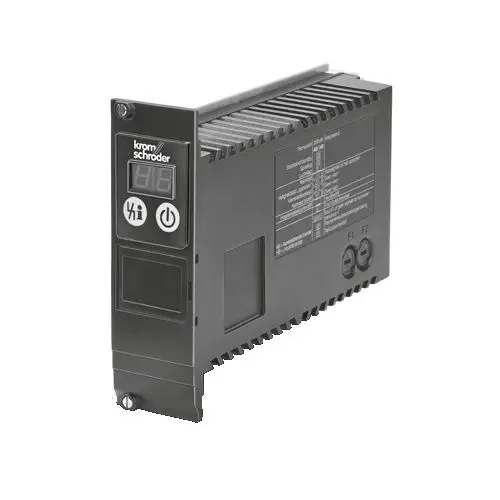
Honeywell Thermal Solutions PFU
SIL 3-certified flame safeguard control for industrial gas burners