
Product Specifications
- Brand
- Panasonic
- Part Number
- DTPS III
- Product Type
- Robot Offline Programming and Simulation Software
- Series
- DTPS
- Platform
- Windows 8.1 / 10
- CAD Import Formats
- XGL, 3DXML, OBJ, VRML, STL, IGES, DXF
- Simulation Features
- 3D Collision Detection, Reach Verification, Takt-Time Estimation
- Multi-Robot Support
- Yes
- Compatible Controllers
- G2, WGIII, WGII-III Series
- Minimum Specs
- 1.6 GHz CPU, 1 GB RAM, 128 MB VRAM
Product Description
Panasonic DTPS III (DeskTop Programming & Simulation) is the offline programming environment for Panasonic's arc welding robot range. Unlike general-purpose robot simulation packages that treat the controller as a black box and approximate motion paths, DTPS III embeds the same kinematic engine and interpolation algorithms that run on the physical G2 and WGIII-series controllers — so a simulated weld path that completes in 12.3 seconds on the PC will complete in 12.3 seconds on the factory floor, and a reachability warning flagged in simulation is a real axis-limit or singularity condition, not a modelling artefact. The practical consequence is that programs developed offline transfer to the physical cell with minimal touch-up: Panasonic reports that on-site teaching time is reduced by approximately one third compared to pendant-only programming.
What CAD capabilities are built into DTPS III?
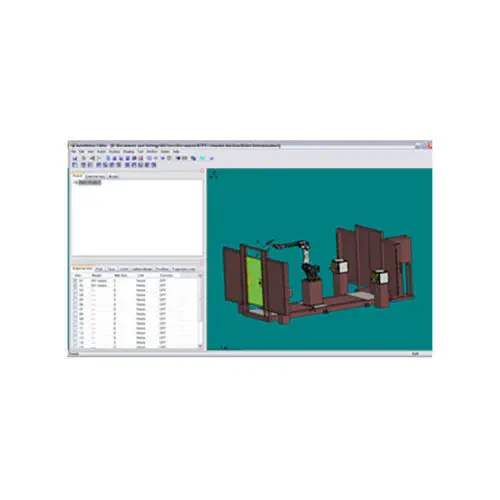
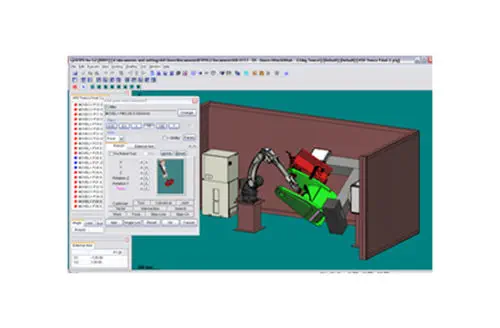
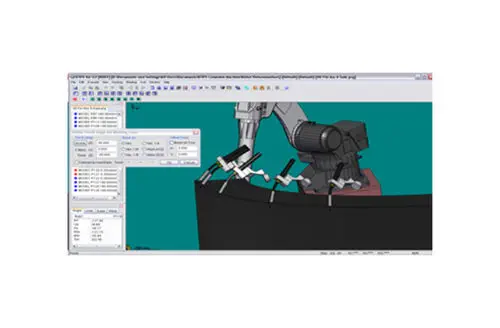
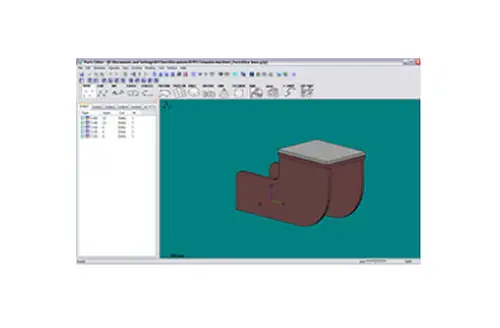
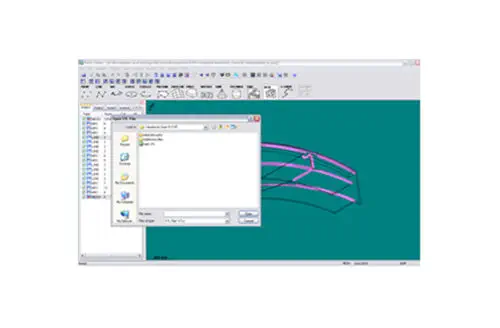
DTPS III includes a lightweight built-in CAD module for creating and editing workpiece shapes, jigs, and fixtures without launching a separate CAD application. For parts designed externally, it imports a broad range of 3D and 2D formats: XGL, 3DXML, OBJ, VRML, and STL for 3D geometry; IGES for surfaces and wireframes; DXF for 2D profiles. Weld lines can be added directly to imported parts within the DTPS environment, and the complete layout — robot, positioner, workpiece, jigs, safety fencing — is assembled in a 3D workspace for simulation. Collision and interference detection runs against the full assembly, catching torch-to-fixture conflicts and joint-limit violations before the physical cell is built. Simulation animations can be exported as video files for operator training and customer review.
How does offline programming change production economics?
The traditional teach-pendant workflow requires the robot cell to be taken out of production while programs are taught — a welding cell that earns €200 per hour is losing that revenue for every hour the pendant is in the operator's hands. DTPS III moves program creation, editing, and verification to a desktop PC, so the cell keeps running while the next job is being programmed. Takt-time estimation allows the production planner to quote a new part accurately before committing machine time. Multi-robot support means a cell with two or three coordinated welding robots can be programmed and simulated as a single system, with the software tracking inter-robot collision zones and coordinating motion sequences. The system requirements are deliberately modest — 1.6 GHz CPU, 1 GB RAM, 128 MB VRAM — reflecting Panasonic's design intent that DTPS III should run on the same laptop an application engineer carries to a customer site.
Resources & Documentation
Panasonic DTPS III Offline Welding Robot Programming and 3D Simulation Software
Product Specifications
- Brand
- Panasonic
- Part Number
- DTPS III
- Product Type
- Robot Offline Programming and Simulation Software
- Series
- DTPS
- Platform
- Windows 8.1 / 10
- CAD Import Formats
- XGL, 3DXML, OBJ, VRML, STL, IGES, DXF
- Simulation Features
- 3D Collision Detection, Reach Verification, Takt-Time Estimation
- Multi-Robot Support
- Yes
- Compatible Controllers
- G2, WGIII, WGII-III Series
- Minimum Specs
- 1.6 GHz CPU, 1 GB RAM, 128 MB VRAM
Resources & Documentation
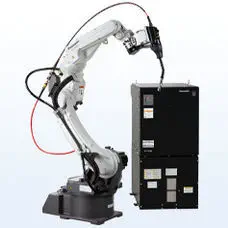
Panasonic TAWERS
Arc welding robot with Super Active Wire Process