
Product Specifications
- Brand
- Andor Technology
- Part Number
- ZL41 Wave
- Type
- Scientific sCMOS Camera
- Series
- ZL41 Wave
- Sensor Options
- 4.2 MP (2048 × 2048) / 5.5 MP (2560 × 2160)
- Pixel Size
- 6.5 µm
- Read Noise
- 0.9 e⁻ (median, rolling shutter)
- Peak QE
- 82%
- Max. Frame Rate
- 100 fps (Camera Link)
- Shutter
- Rolling Shutter; Global Shutter (5.5 MP only)
- Interface
- USB 3.0 / Camera Link
Product Description
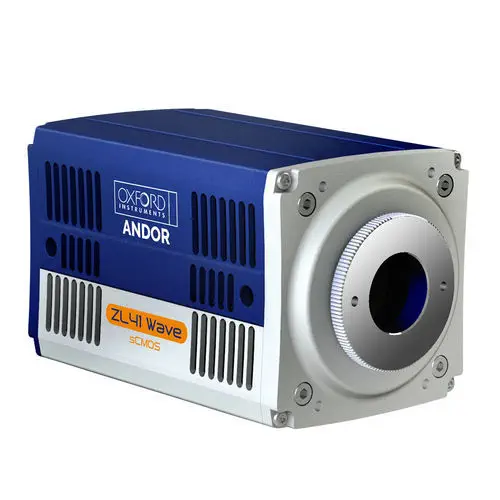
The Andor Technology ZL41 Wave is a next-generation sCMOS camera platform that succeeds the Zyla series, engineered for the sensitivity demands of physical science and astronomy. With a median read noise of 0.9 e⁻ and peak quantum efficiency of 82% on a front-illuminated sensor with microlenses, it captures faint signals — from exoplanet transits to ion-trap fluorescence — that cameras with higher noise floors simply cannot resolve. An FPGA-generated timestamp with 25 ns accuracy and 100 fps full-frame throughput over Camera Link make it equally suited to high-speed transient capture and long-exposure integration.
How does the ZL41 Wave achieve 0.9 e⁻ read noise?
Andor combines a low-noise CMOS sensor with proprietary in-camera calibration and thermoelectric cooling to –5 °C (operable at –20 °C ambient). The sensor chamber carries a 5-year condensation warranty. Front-illuminated architecture with microlenses eliminates the etaloning fringes that plague back-illuminated sensors in the near-infrared, while still delivering 82% QE. On-sensor correlated double sampling and advanced baseline subtraction push the noise floor to sub-electron levels in rolling-shutter mode.
What separates the 4.2 MP and 5.5 MP variants?
| Parameter | ZL41 Wave 4.2 | ZL41 Wave 5.5 |
|---|---|---|
| Sensor Resolution | 2048 × 2048 | 2560 × 2160 |
| Shutter Modes | Rolling Shutter | Rolling + Global Shutter |
| Read Noise (Rolling) | 0.9 e⁻ | 0.9 e⁻ |
| Read Noise (Global) | — | 2.3 e⁻ |
| PIV Inter-Frame Gap | — | ~100 ns |
| Max Frame Rate (full) | 100 fps | 100 fps |
The 4.2 MP variant prioritizes ultimate sensitivity for astronomy and quantum imaging. The 5.5 MP variant adds a global shutter mode that freezes motion in particle imaging velocimetry, fluid dynamics, and object tracking — at the cost of higher read noise in global-shutter operation.
What applications is this camera built for?
The ZL41 Wave serves physical science disciplines where every photon counts. In astronomy, it handles photometry, astrometry, lucky imaging, speckle interferometry, and occultation timing. In quantum optics, it images ion traps, cold-atom clouds, and Bose-Einstein condensates with sub-electron noise. In large-facility science — synchrotrons, free-electron lasers, and accelerator beamlines — its 25-ns timestamping, GPU-accelerated data pipeline, and EPICS/Tango/Lima driver support make it a drop-in detector for beam diagnostics and X-ray tomography. Software support spans Windows and Linux, with SDKs for LabVIEW, MATLAB, and Python, plus ASCOM for astronomy automation.
Resources & Documentation
Andor Technology ZL41 Wave sCMOS Camera with 0.9 e⁻ Read Noise
Product Specifications
- Brand
- Andor Technology
- Part Number
- ZL41 Wave
- Type
- Scientific sCMOS Camera
- Series
- ZL41 Wave
- Sensor Options
- 4.2 MP (2048 × 2048) / 5.5 MP (2560 × 2160)
- Pixel Size
- 6.5 µm
- Read Noise
- 0.9 e⁻ (median, rolling shutter)
- Peak QE
- 82%
- Max. Frame Rate
- 100 fps (Camera Link)
- Shutter
- Rolling Shutter; Global Shutter (5.5 MP only)
- Interface
- USB 3.0 / Camera Link
Resources & Documentation

Andor Technology Solis S
Unified spectrograph and camera control for Raman, PL, LIBS, and multi-track spectroscopy
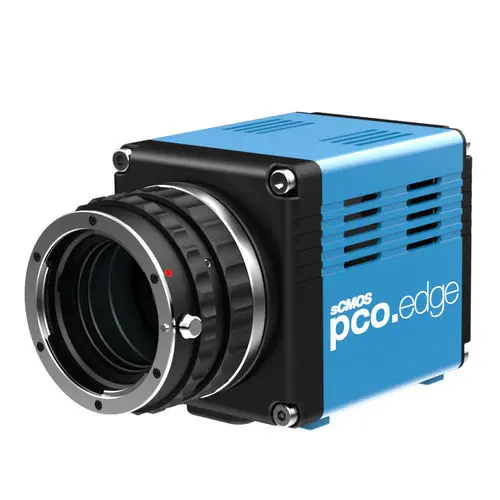
Excelitas Technologies pco.edge 3.1
3.1 MP sCMOS with 1.1 e⁻ readout noise and global shutter