
Product Specifications
- Brand
- Rohde & Schwarz
- Part Number
- QPS201
- Type
- Millimeter-Wave Personnel Security Scanner
- Frequency
- 70–80 GHz (Millimeter Wave)
- Transmit Power
- ~1 mW (Extremely Low, Below Mobile Phone Emissions)
- Scan Technology
- Fully Electronic Flat-Panel Array, Multistatic Antennas, No Moving Parts
- Acquisition Time
- ~32 ms per Panel
- Result Display
- ~2.5 s
- Detection
- All Material Types — Metal, Ceramic, Plastic, Liquids, Organic
- Privacy
- AI Anomaly Detection on Generic Body Silhouette (No Anatomical Image)
- Dimensions
- 1,750 × 2,320 × 1,433 mm (W × H × D)
- Certifications
- ECAC, TSA, STAC
Product Description
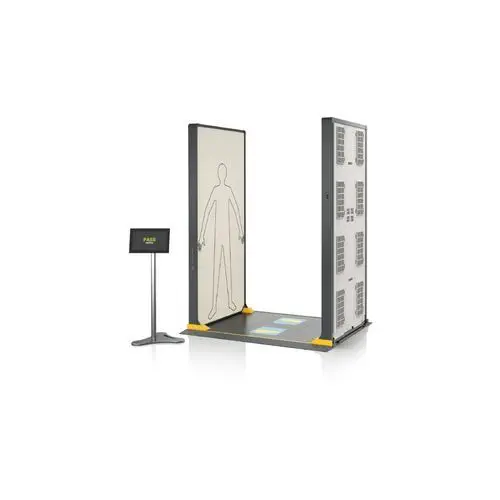
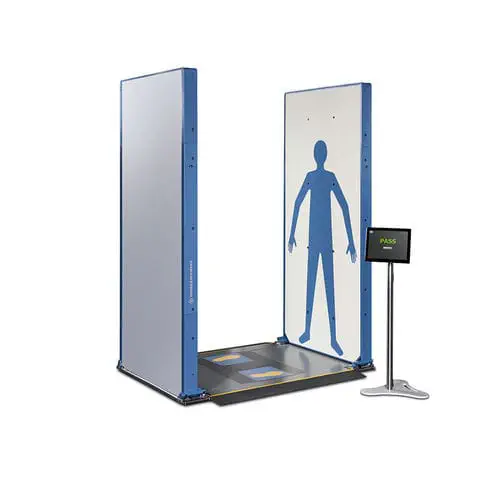
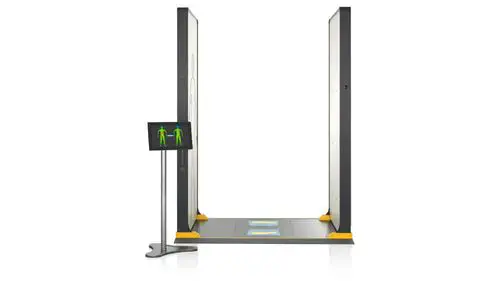
The QPS201 is a millimeter-wave personnel security scanner that screens standing passengers for concealed threats — metallic and non-metallic — without emitting ionizing radiation and without generating an anatomically revealing image. Two flat panels, each embedded with thousands of transmit and receive antennas, perform a fully electronic scan in 32 milliseconds. An AI-based anomaly detection algorithm then maps any detected object onto a generic body silhouette, preserving privacy while directing the operator to the exact location of an alert for a targeted pat-down.
Why millimeter-wave over X-ray for people screening?
X-ray transmission systems — the standard for baggage — are not used for routine passenger screening because even low-dose ionizing radiation is medically unjustified for mass population scanning. Millimeter-wave sits in the non-ionizing portion of the spectrum (70–80 GHz, ~1 mW transmit power — well below a mobile phone's emissions) and penetrates clothing while reflecting off skin and concealed objects. The QPS201's multistatic antenna architecture collects both amplitude and phase information from multiple angles simultaneously, distinguishing threats from benign items (belt buckles, coins, folded paper) by their dielectric properties and shape — not just density. The result is an all-materials detection capability — ceramic blades, plastic explosives, liquid precursors — that metal-detector archways cannot achieve, without the health concerns of X-ray.
How does the AI-based detection preserve privacy?
Conventional body scanners generate a grayscale image of the passenger's body surface and rely on a remote human operator to interpret it — a workflow that raises privacy concerns and requires a separate viewing room. The QPS201 replaces this with on-system AI: the detection algorithm analyzes the raw radar data directly, classifies anomalies by threat likelihood, and renders only a colored marker on a standardized gender-neutral silhouette. No image of the passenger's body is ever displayed, stored, or transmitted. This architecture also eliminates the throughput delay of remote human review — results are ready in approximately 2.5 seconds, enabling a single-lane throughput that keeps pace with the baggage X-ray queue.
What does fully electronic architecture mean for maintenance?
First-generation body scanners used mechanically rotating antenna arms — a motor, gear train, and slip ring that required periodic calibration and were a single point of failure. The QPS201 has no moving parts. The antenna panels are fixed flat arrays mounted on service rails; if a panel module fails, it can be swapped individually without realigning the system. No mechanical recalibration is needed after service, and the open-lane design means the scanner does not obstruct emergency egress when not in active screening mode.
Resources & Documentation
Rohde & Schwarz QPS201 Millimeter-Wave Personnel Security Scanner, ECAC/TSA Certified
Product Specifications
- Brand
- Rohde & Schwarz
- Part Number
- QPS201
- Type
- Millimeter-Wave Personnel Security Scanner
- Frequency
- 70–80 GHz (Millimeter Wave)
- Transmit Power
- ~1 mW (Extremely Low, Below Mobile Phone Emissions)
- Scan Technology
- Fully Electronic Flat-Panel Array, Multistatic Antennas, No Moving Parts
- Acquisition Time
- ~32 ms per Panel
- Result Display
- ~2.5 s
- Detection
- All Material Types — Metal, Ceramic, Plastic, Liquids, Organic
- Privacy
- AI Anomaly Detection on Generic Body Silhouette (No Anatomical Image)
- Dimensions
- 1,750 × 2,320 × 1,433 mm (W × H × D)
- Certifications
- ECAC, TSA, STAC
Resources & Documentation
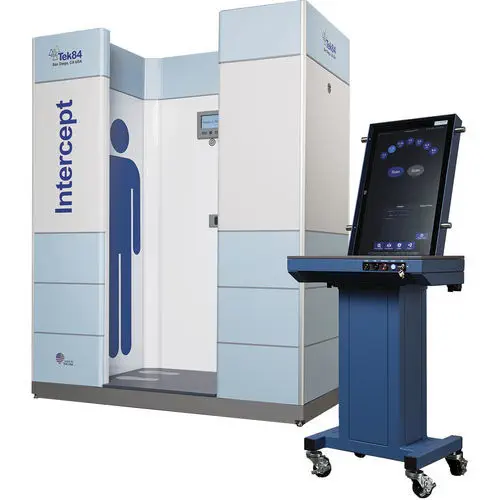
Tek84 INTERCEPT
Vertical-scan X-ray scanner for correctional contraband screening