
Product Specifications
- Brand
- Harbin Zhongfei New Technology Co., Ltd.
- Part Number
- PDJ
- Type
- Low-Voltage Turbine Generator Automation System
- Series
- PDJ
- Applicable Units
- <1000 kW, 400V Low-Voltage Hydropower Generators
- Excitation Modes
- 5 Types (3-Phase Full/Half Bridge, Single-Phase, IGBT, Brushless 20A/150V)
- Digital I/O
- 40 Inputs + 28 Outputs (68 Total)
- Protection Functions
- 12 (Overcurrent, Negative Sequence, Zero Sequence, Overload, Frequency, Voltage, etc.)
- Temperature Inputs
- 8 Channels, PT100/CU50, Independent 4-Stage Alarm per Channel
- Communication
- 2× RS232 + 2× RS485 + 2× Ethernet, MODBUS Protocol
- Speed Measurement
- Redundant (Residual Voltage + Gear-Tooth Frequency)
- Panel Dimensions
- 800 × 800 × 2260 mm
- Accuracy
- Voltage/Current/Frequency 0.5 Class, Active Power 1 Class
Product Description
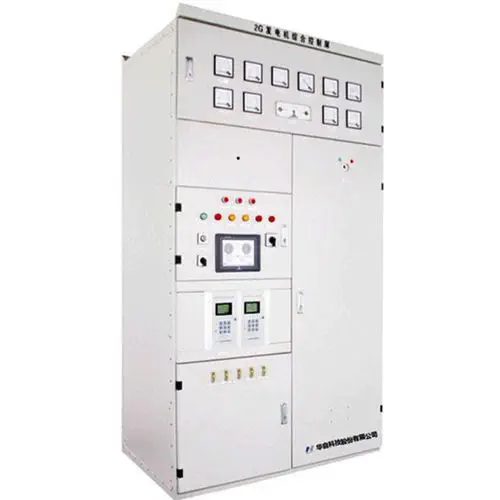
The PDJ is a purpose-built turbine generator automation system from Harbin Zhongfei New Technology Co., Ltd. — operating under the CSHNAC (China South Huaneng Automation Control) brand — designed specifically for low-voltage (400V) hydropower units with capacities under 1000 kW. It consolidates all control, protection, excitation, synchronization, and monitoring functions into a single 800 × 800 × 2260 mm floor-standing panel, eliminating the need for separate PLC, protection relay, synchronizer, and excitation regulator cabinets typical of larger power plants.
How does the PDJ handle speed measurement and synchronization?
Speed measurement uses a redundant dual-channel architecture: residual voltage measurement from the generator terminals (functional down to 2V residual) combined with gear-tooth frequency sensing for mechanical validation. If one channel fails, the other maintains full speed protection. The automatic quasi-synchronization function adjusts generator voltage and speed to match grid parameters, then issues the breaker close command when differential voltage (1–30V secondary), frequency difference (0.07–0.60 Hz), and phase angle difference (2–25°) all fall within configurable windows. This redundancy and range coverage supports both new installations and retrofit of aging hydropower plants where grid conditions may be less stable.
What excitation configurations does the PDJ support?
Five excitation modes cover virtually all low-voltage hydropower generator topologies: three-phase full-controlled bridge, three-phase half-controlled bridge, three-phase half-bridge half-controlled, single-phase half-controlled bridge, and IGBT-based excitation. The brushless excitation channel is rated at 20A / 150V; brushed configurations follow the generator manufacturer's design specifications. This flexibility means the PDJ can commission a new generator and also replace obsolete analog excitation regulators on machines from different eras and manufacturers.
What remote monitoring capability does the PDJ provide?
Six communication ports — two RS232, two RS485, and two Ethernet — support MODBUS protocol for integration with plant SCADA systems. Beyond local HMI operation, the PDJ supports mobile app and web-browser-based remote monitoring: operators can start/stop the unit, adjust load setpoints, acknowledge alarms, and review historical event records from a smartphone. The dual AC/DC power supply input ensures the panel remains operational and can execute a controlled shutdown sequence even if one supply source fails. SOE (Sequence of Events) recording with 2 ms resolution provides forensic data for post-trip analysis.
Harbin Zhongfei PDJ Low-Voltage Turbine Generator Automation System, 400V, <1000kW, 68 I/O
Product Specifications
- Brand
- Harbin Zhongfei New Technology Co., Ltd.
- Part Number
- PDJ
- Type
- Low-Voltage Turbine Generator Automation System
- Series
- PDJ
- Applicable Units
- <1000 kW, 400V Low-Voltage Hydropower Generators
- Excitation Modes
- 5 Types (3-Phase Full/Half Bridge, Single-Phase, IGBT, Brushless 20A/150V)
- Digital I/O
- 40 Inputs + 28 Outputs (68 Total)
- Protection Functions
- 12 (Overcurrent, Negative Sequence, Zero Sequence, Overload, Frequency, Voltage, etc.)
- Temperature Inputs
- 8 Channels, PT100/CU50, Independent 4-Stage Alarm per Channel
- Communication
- 2× RS232 + 2× RS485 + 2× Ethernet, MODBUS Protocol
- Speed Measurement
- Redundant (Residual Voltage + Gear-Tooth Frequency)
- Panel Dimensions
- 800 × 800 × 2260 mm
- Accuracy
- Voltage/Current/Frequency 0.5 Class, Active Power 1 Class
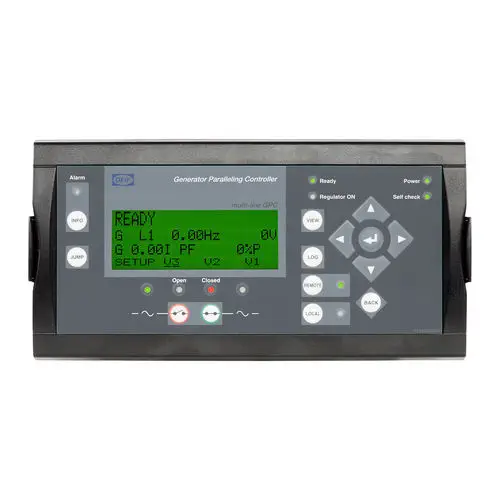
DEIF GPC-3 Gas
All-in-One Gas Engine Paralleling Controller