KraussMaffei ships its IR Series as a factory-integrated manipulator that shares the injection molding machine's MC6 control backbone. The alternative — bolting a general-purpose six-axis robot onto the same press — looks like a flexibility play on paper. But the real decision is not about hardware. It is about whether your control architecture is integrated or independent, and that choice compounds through every mold change, shift handover, and maintenance call for the next five to eight years.
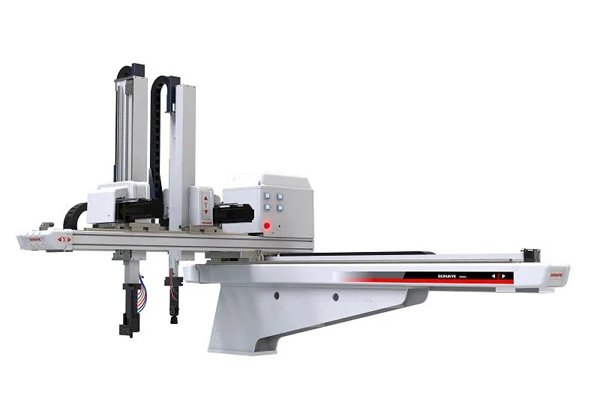
What integrated control actually changes at the machine level
When a KraussMaffei IR Series manipulator runs on the same MC6 controller as the press, the communication between ejection, clamping, and part removal is not fieldbus traffic. It is internal controller state.
- Signal path in an integrated system
- Clamp-open signal → controller internal variable → manipulator start. No intermediate PLC, no hardwired I/O, no DeviceNet or EtherCAT frame crossing a physical layer. The delay is in microseconds, not milliseconds.
- Signal path in an independent system
- Clamp-open signal → press controller → fieldbus output → robot controller input → robot motion start. Each boundary adds latency and a point of failure.
For a commodity part running a 20-second cycle, the difference is academic. For a thin-wall packaging application cycling under 2.5 seconds, a 30-millisecond communication gap between ejection and robot entry is the difference between a clean part and a crushed sprue. The integrated manipulator can pre-position during the metering phase — it knows the screw position directly. The standalone robot only learns the mold is open after the fact.
Where the general six-axis earns its keep
A dedicated manipulator does one job: extract parts and place them on a conveyor. When your process requires extraction plus downstream operations, the six-axis robot's extra degrees of freedom stop being a luxury and start determining whether you need a second automation cell at all.
Realistic downstream tasks that flip the calculation:
- Gate cutting and degating — hot-tip trimming with a pneumatic nipper, positioned at any angle the part geometry demands
- In-mold labeling or insert loading — placing a metal threaded insert into the mold before the next shot, requiring approach angles a Cartesian gantry cannot hit
- Flame or plasma surface treatment — activating a polyolefin part surface for adhesion while the next shot runs
- Vision inspection and sorting — presenting the part to a camera at multiple orientations before binning into QC pass/fail lanes
- Palletizing with layer patterns — building mixed-SKU pallets when the press alternates between two molds
A KraussMaffei IR manipulator handles extraction cleanly. Adding the third or fourth downstream step is where a dedicated unit runs out of axes — and where one six-axis robot can serve two presses with staggered cycles.
The TCO gap that procurement sheets miss
Most purchase comparisons stop at capital cost. The longer-term line items tilt the ranking, sometimes reversing the initial answer:
| Cost driver | Integrated manipulator | Standalone 6-axis robot |
|---|---|---|
| Hardware acquisition | Mid-range; often bundled with press purchase at a package discount | $25K–$80K depending on reach, payload, and brand |
| Integration engineering | Near zero — pre-integrated at factory acceptance | $2K–$5K per cell (PLC programming, safety interlock configuration, communication setup) |
| Mold changeover time | 30–60 minutes (recipe-based, operator stays on one HMI) | 2–4 hours (coordinate system recalibration, I/O handshake verification, path re-teaching) |
| Maintenance contract | One service provider, one preventive-maintenance schedule | Two service contracts, two sets of spare-part lead times |
| Operator training | Covered by press training — same HMI, same fault-diagnosis workflow | Separate robot programming training required; staffing risk when that operator leaves |
| Future redeployment | Low — essentially married to one press | High — re-deployable to a different station or a different press brand |
When frequent mold changes flip the argument
Shops that change molds more than four times a month face a compounding cost that few initial RFQs capture. Each mold change on a standalone robot costs 2–4 hours of re-teaching. At three changes per week, that is 24–48 hours of lost production time every month — roughly one full shift of downtime. At a $150/hour machine rate, the annual cost of that downtime can exceed the entire installed cost of the robot within two years.
An integrated manipulator running the same changeover schedule re-loads a stored recipe. The operator verifies pick position with one or two dry cycles. The difference is not a convenience — it is a capacity-planning variable. If your production scheduler would have to add a Saturday shift just to recover changeover losses, the integrated path is already cheaper.
What is the minimum cycle time where integration actually matters?
Integration starts to matter around a 5-second cycle. Below that threshold — common in closure and thin-wall packaging — the microsecond-scale synchronization between ejection and manipulator entry is load-bearing. Above 15 seconds, even a 30-millisecond fieldbus delay is under 0.2% of the cycle, and the flexibility of an independent robot usually outweighs the control advantage. Between 5 and 15 seconds, run the TCO model against your specific mold-change frequency.
Can a single six-axis robot serve multiple injection molding machines?
Yes, and this is the strongest argument for the independent path in mixed-brand shops. One six-axis robot on a linear track can tend two or even three presses, provided the combined cycle times leave enough idle window for the robot to complete extraction and any downstream tasks on each press. The catch is that a robot failure now stops two or three presses instead of one. Risk concentration is the hidden cost of multi-machine tending — factor in the hourly cost of cascaded downtime before declaring the single-robot layout cheaper.
When is re-deployability worth paying for upfront?
If your shop runs more than two injection molding machine brands, the standalone robot avoids brand lock-in. When you replace Press A with a different OEM five years from now, the robot stays. That future-proofing has real financial value — estimate the avoided robot re-purchase cost and discount it back to present value at your cost of capital. For a six-axis robot with a 10-year service life, this alone can justify the higher integration cost.
Related Content
- Browse all Industrial Robots — full robot and automation catalog
- Robot Controllers — compact and modular controllers for robot integration
- Servo Drives & Motors — drive components for robot axis control
- Read our Small 6-Axis or SCARA for Micro-Assembly? — when extra axes matter at the small scale