A CNC router cutting a $400 aluminum plate at 8,000 mm/min runs on a stream of precisely timed step pulses from a PC. The USB cable connecting that PC to the motion controller carries those pulses — along with 5 volts of DC power and a ground wire shared between the PC's motherboard and the machine tool's frame. When the PC's power supply develops a ground fault — a common failure mode after 3 to 5 years of shop-floor operation — or when the spindle VFD injects high-frequency noise onto the ground plane, the USB connection drops for 200 milliseconds. The PC operating system re-enumerates the USB device. The motion controller loses position. The tool keeps moving — or stops moving — but the PC no longer knows where it is. The result, in the best case, is a ruined workpiece. In the worst case, the tool plunges into the table. An Ethernet-based motion controller, by contrast, is electrically isolated from the PC by the Ethernet transformer coupling at each end of the cable. A ground fault on the PC side does not propagate to the motion controller. If the PC crashes and stops sending packets, the controller's onboard motion buffer continues executing the last valid trajectory and then brings the machine to a controlled stop. This article explains the electrical and protocol-level differences between USB and Ethernet CNC control — and why the choice of communication interface directly determines what happens when the PC inevitably fails.
The Electrical Problem: USB Shares a Ground Reference
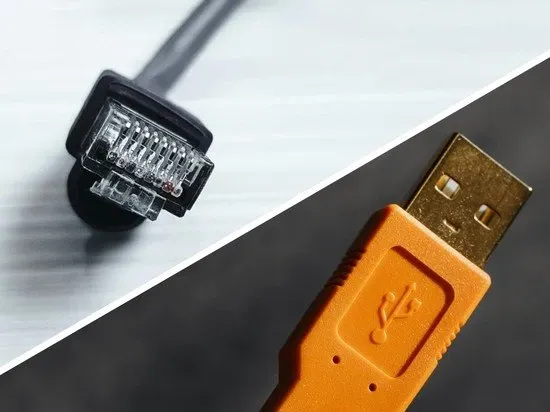
USB 2.0 is a single-ended signaling protocol with a shared ground reference between host and device. The USB cable's four wires — VBUS (+5V), D+, D−, and GND — connect the PC ground plane directly to the motion controller ground plane. Any voltage difference between these two grounds — from a ground loop, a VFD switching transient, a power supply fault, or electrostatic discharge — appears as common-mode noise on the D+ and D− lines. USB's differential receiver can reject common-mode noise up to roughly 2 volts. Above that, the receiver saturates, data errors occur, and the USB host controller resets the connection. The motion controller — now disconnected and waiting to re-enumerate — is blind. The machine tool is in motion with no trajectory controller.
Ethernet (10/100/1000BASE-T) is transformer-coupled at both ends. Each twisted pair in the CAT5e or CAT6 cable connects through a 1:1 isolation transformer rated for 1,500 V RMS hipot. There is no galvanic path between the PC ground and the motion controller ground. A ground fault on the PC side that raises the PC chassis to 120 V AC does not appear at the motion controller. The data signals are AC-coupled through the transformers; common-mode DC and low-frequency AC voltages are blocked entirely. This single design difference — the isolation transformer — is the reason industrial automation standardized on Ethernet-based fieldbuses (EtherCAT, PROFINET, EtherNet/IP) rather than USB.
Protocol Reliability: Packets vs Isochronous Streams
USB uses an isochronous or bulk transfer mode: the host initiates every transaction, and the device responds. If a transaction fails — CRC error, timeout, or bus reset — the host retries. During the retry window, no new motion commands reach the controller. The motion controller must decide, autonomously, what to do. Most USB motion controllers handle this by stopping — immediately, without deceleration, because the controller has no onboard trajectory planner to compute a deceleration ramp. The tool stops because the step pulses stop. The machine loses position because the PC's position counter advanced during the retry window but the controller never received those steps.
Ethernet-based motion controllers use a buffered command model. The PC or CNC software sends trajectory segments — typically 50 to 200 milliseconds of motion — to a first-in-first-out (FIFO) buffer in the controller. The controller executes the buffered segments autonomously, sending a status packet back to the PC after each segment completes. If the PC is late sending the next segment — because Windows decided to run a background update, because the Ethernet switch dropped a packet, because the PC crashed — the controller has 50 to 200 milliseconds of valid trajectory data remaining in its buffer. It continues executing that trajectory while signaling a buffer-underflow warning. If the buffer empties before the PC resumes, the controller decelerates to a controlled stop using the acceleration parameters programmed into its firmware. The machine stops where the software expects it to stop. Position is preserved. The workpiece is not necessarily scrapped — the operator can restart from the last completed trajectory segment.
What latency does each interface deliver?
USB 2.0 has a theoretical latency of 125 µs per microframe, with typical round-trip command-response latency of 0.5 to 2 ms under light USB bus loading. This is fast enough for CNC step pulse generation at up to 500 kHz — well above the 50 to 100 kHz practical maximum for most stepper drivers. USB's latency problem is not average — it is worst-case. A single USB bus reset adds 100 to 500 ms of latency. A Windows power management event that suspends the USB root hub adds 500 ms to multiple seconds.
Ethernet with a real-time protocol (EtherCAT, RT-Preempt Linux, or a dedicated motion controller with UDP command streaming) delivers round-trip latency of 50 to 200 µs — lower and more deterministic than USB. The raw speed advantage is modest. The determinism advantage — the worst-case latency is within a factor of 2 of the average, not a factor of 100 — is what matters for motion control.
When does USB still make sense for CNC control?
USB is appropriate for hobbyist and light-duty CNC machines where the cost of a workpiece failure is under $100, the machine is not operated unattended, and the PC running the control software is dedicated to that single task with USB power management disabled. USB is also appropriate for machines with an emergency-stop circuit that cuts motor power independently of the motion controller — if the USB connection drops, the operator hits the E-stop and the machine stops regardless of what the controller does. For any machine tool where an uncontrolled stop risks injury, tool damage, or a workpiece costing more than the Ethernet controller upgrade — roughly $200 to $500 — USB is the wrong choice.
The difference between USB and Ethernet for CNC control is not speed — it is survival. USB shares a ground with the PC and cannot survive the PC's failure. Ethernet is isolated, buffered, and designed to bring the machine to a controlled stop when the PC stops communicating. If the workpiece value exceeds the cost difference between a USB and an Ethernet motion controller — which is to say, for nearly any machine cutting metal — the Ethernet controller pays for itself the first time the PC crashes and the tool does not.