EN 14081 requires every piece of structural timber placed on the European market to be strength-graded. The standard permits two fundamentally different approaches: visual grading, which relies on a trained grader's eye, and machine stress rating (MSR), which measures stiffness non-destructively and derives strength from that measurement. The choice between them determines not just the grade yield from a log batch but also whether a mill can supply the higher strength classes—C24, C30, and above—that engineered wood products and truss manufacturers increasingly demand.
This article compares the two methods across the criteria that matter in a production environment: throughput, grade yield, consistency, and the ability to meet EN 14081's proof-loading and quality control requirements.
How visual grading works under EN 14081
Visual grading assigns each piece to a strength class by inspecting physical characteristics: knot size and location, slope of grain, wane, fissures, distortion, and rate of growth. EN 14081-1 defines the grading rules per species and strength class. A trained grader measures these features against the standard's limits for each class—C16, C24, C30, and so on—and stamps the piece accordingly. The process is inherently binary (pass/fail per characteristic) and adds no measurement data to the piece. The grader's skill is the measurement instrument, and calibration means periodic re-training and audit testing.
How MSR works
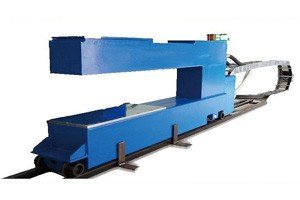
MSR passes each piece through a mechanical or acoustic testing station that measures its modulus of elasticity (MOE) non-destructively. The most common configuration uses a three-point bending test: rollers load the piece to a small deflection (well below the proportional limit) while load cells and displacement sensors record the force-vs-deflection curve. The machine computes MOE from this curve and assigns a grade based on the established MOE-to-MOR (modulus of rupture) correlation for the species. Some systems add density measurement via X-ray or gamma-ray densitometry to improve the prediction. The result is a continuous stiffness value per piece—not just a pass/fail box—which downstream buyers of engineered wood can use in their own design calculations.
Grade yield: the economic difference
The most consequential difference between the two methods is grade yield—the percentage of a log batch that achieves higher strength classes. Visual grading is conservative by design. A knot near the edge of a tension face reduces the assigned strength class even if the actual failure point of that piece under test would exceed the class limit. Studies on European spruce-pine-fir (SPF) published in Wood Science and Technology show that MSR typically recovers 15–25% more C24-equivalent pieces from the same log batch compared to visual grading, and 30–40% more C30-equivalent. For a mill processing 100,000 m³ per year, the revenue difference can exceed €500,000 annually—enough to amortize an MSR line in 18–24 months.
Throughput and line integration
Visual grading is paced by human inspection speed—typically 15–25 pieces per minute per grader. A line running 60 pieces per minute needs three full-time graders, and throughput drops on complex pieces that require more inspection time. MSR lines operate at 60–180 pieces per minute with a single operator monitoring the system, and throughput is independent of piece complexity. The bottleneck shifts from the grader to the infeed and outfeed handling. Modern MSR systems like the Metriguard 7200 Series integrate directly with the mill's optimizer and stacker control, feeding each piece's MOE value into the cut-to-length and sorting decisions upstream.
Consistency, documentation, and EN 14081 quality control
EN 14081-2 (the machine control section) imposes rigorous quality control requirements on MSR: daily proof-loading of calibration samples, ongoing correlation verification, and documented measurement traceability. These requirements are demanding. They are also the source of MSR's advantage—every graded piece carries a measured MOE value and a timestamped machine record, creating an audit trail that visual grading cannot match. When a truss manufacturer challenges a grade assignment, the mill can produce the measurement data for that specific piece. Visual grading leaves no per-piece record; the only documentation is the grader's stamp and certification.
Species scope and flexibility
Visual grading rules exist for nearly every commercial timber species because the rules are developed through visual correlation studies—faster and cheaper than the destructive testing program required to establish MOE-to-MOR relationships for MSR. A sawmill cutting multiple species on the same line can switch visual grading rules by swapping the grader's reference card. MSR requires a validated correlation for each species-grade combination, which limits its applicability to species with sufficient published mechanical property data. In practice, MSR is deployed primarily on spruce, pine, Douglas fir, and larch—the high-volume structural species—while visual grading covers the long tail of hardwoods and secondary species.
When does visual grading still win?
Visual grading remains the better choice in three scenarios. First, for low-volume mills cutting multiple species where the MSR validation cost cannot be amortized over enough volume—below roughly 30,000 m³ per year, visual grading usually makes more economic sense. Second, for species without established MSR settings: if you cut predominantly oak, ash, or chestnut for structural use, you will grade them visually because the MOE-MOR correlations have not been published at production scale. Third, for rough-sawn timber where surface finish is insufficient for reliable mechanical contact at the MSR rollers—though acoustic-based MSR systems partially address this limitation by using longitudinal stress wave velocity instead of bending deflection.
Hybrid approaches: the emerging middle ground
A growing number of mills run a hybrid grading line: the MSR system grades the mainline spruce-pine-fir volume at high speed, while a single visual grader handles the smaller volume of secondary species and oversized sections that exceed the MSR machine's cross-section capacity. This configuration captures the economic benefit of MSR on the high-volume species without sacrificing species flexibility. Some sensor-integrated grading systems combine visual scanning cameras with MOE measurement, using optical knot detection and grain-angle measurement alongside stiffness data to refine the grade prediction further.
The Metriguard 7200 Series remains the reference MSR system for high-volume European sawmills, measuring MOE at over 100 pieces per minute with ±2% repeatability and integrating directly with mill-wide optimization software.
Which method for EN 14081 compliance—a decision framework
- Choose visual grading if
- Your annual volume is under 30,000 m³, you cut multiple low-volume hardwood species, start-up capital is constrained, or you supply markets where C24 is the ceiling and no customer asks for per-piece stiffness data.
- Choose MSR if
- You process over 50,000 m³/year of spruce-pine-fir, your customer base includes truss and glulam manufacturers that need C30 and above, or you can capture the 15–25% grade-yield uplift as direct margin improvement.
- Choose a hybrid line if
- Your volume justifies MSR on the main species but you also cut enough secondary species that you cannot afford to lose visual grading flexibility entirely.