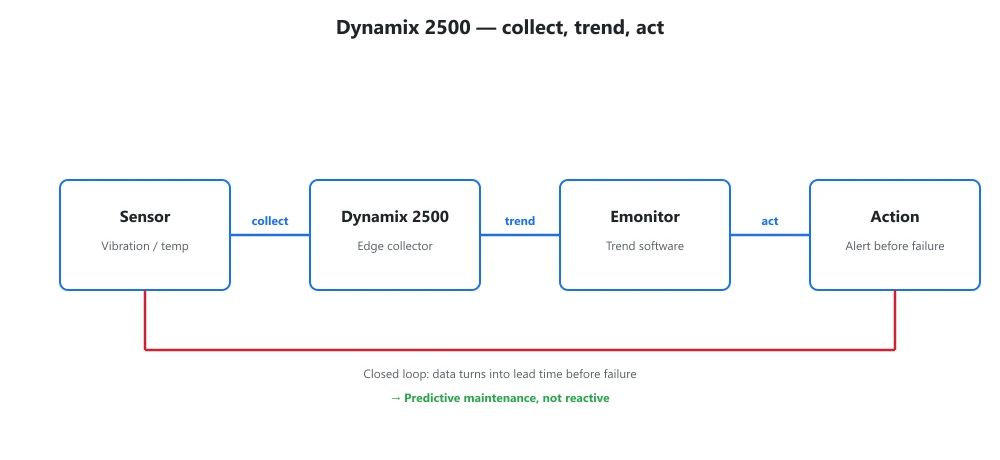
A bucket elevator carrying 400 tons per hour of grain develops a bearing temperature rise of 15°C per minute on the head pulley. In a centralized monitoring architecture, the RTD wired back to a PLC in the control room 200 meters away reports this trend on a 4-20 mA loop. The PLC's scan cycle — shared with 200 other I/O points — catches the reading every 3 seconds. The alarm threshold is 85°C. By the time the PLC trips the alarm at 85°C, the bearing has been overheating for 4 minutes, the grease has carbonized, and the shaft has begun to gall. In a distributed hazard monitoring system (DHMS), a local sensor node mounted on the elevator head section samples the same RTD at 100 Hz, detects the rate-of-rise anomaly at 55°C — 30°C below the absolute alarm threshold — and sends a predictive alert over Ethernet/IP to the control room before the bearing reaches a temperature that threatens ignition. This is the architectural difference that determines whether monitoring tells you that a problem happened or that a problem is developing. This article compares distributed and centralized monitoring architectures for bucket elevators and belt conveyors handling combustible dusts and bulk solids — and provides a framework for designing an Ethernet-based DHMS that meets NFPA 652 and ATEX dust hazard requirements.
What a DHMS Monitors — and Why It Is Different from Process Instrumentation
A DHMS for bulk solids handling monitors parameters whose primary value is not process control but hazard prevention. The distinction matters because it changes the sensor selection, the sampling rate, and the alarm logic:
| Parameter | What It Detects | Why It Matters for Hazard Prevention |
|---|---|---|
| Bearing temperature (head, tail, idler) | Friction heating from lubricant failure, misalignment, or contamination | A seized bearing on a bucket elevator is the #1 ignition source for grain dust explosions. NFPA 61 requires bearing temperature monitoring on all leg elevators handling grain. |
| Belt speed and alignment | Belt slip on the drive pulley (speed drops below threshold) and belt misalignment (edge sensor activation) | A slipping belt on a drive pulley generates frictional heat that can ignite the belt material or accumulated dust. Misalignment rubbing against the structure creates the same risk. |
| Plug/choke detection | Material backup at the discharge chute or transfer point | A choked discharge on a bucket elevator leg can bury the boot pulley, causing the belt to stall against a rotating drive pulley — rapid friction heating with the ignition energy of a blowtorch. |
| Vibration (accelerometer on bearing housing) | Early-stage bearing degradation, imbalance, belt splice passing frequency anomalies | Vibration spectrum analysis detects bearing faults weeks before temperature rise begins. A Bently Nevada 200350 seismic accelerometer with 4-20 mA output can feed both a local DHMS node and a plant-wide vibration monitoring system. |
| Dust concentration (optical or triboelectric) | Ambient dust levels approaching the minimum explosible concentration (MEC) | Triggers housekeeping alerts before the dust cloud is visible to operators. Grain dust MEC is approximately 50 g/m³ — a level that obscures vision at 2 meters. |
Centralized vs Distributed: The Architectural Trade-Off
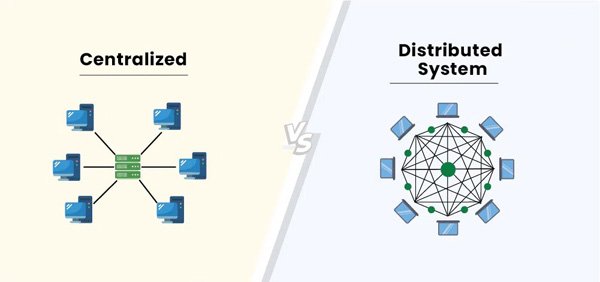
Centralized monitoring brings every sensor signal back to a single PLC or DCS in the control room. Each bearing RTD, each belt speed sensor, each alignment switch is home-run wired to an I/O card. The advantages are simplicity — one controller, one program, one set of alarm logic — and low hardware cost for small systems under 50 points. The disadvantages multiply with distance and point count:
- Signal degradation on long 4-20 mA runs, especially from thermocouple and RTD sensors — a 200-meter RTD run with 24 AWG wire adds approximately 1.7 Ω of lead resistance, introducing a 4.4°C offset at 100°C for a Pt100 sensor unless 3-wire or 4-wire compensation is used
- Scan cycle latency — a PLC with a 3-second scan cycle cannot detect a 15°C/minute bearing temperature rise quickly enough for predictive intervention
- Single point of failure — if the PLC fails, all monitoring stops; no local intelligence remains at the machine
- Cable cost dominates — for a facility with 8 bucket elevators and 20 belt conveyors, each with 5-8 sensors, 300+ home-run cables spanning 100-300 meters each generates cost and installation labor that often exceeds the sensor and controller hardware combined
Distributed monitoring (DHMS) places intelligent sensor nodes at each machine — one node per bucket elevator, one per conveyor drive section, one per transfer tower. Each node samples its local sensors at high speed (50 to 500 Hz for vibration, 1 to 10 Hz for temperature), performs local alarm calculations, and communicates results and trend data to a central server over Ethernet/IP, Modbus TCP, or PROFINET. The advantages invert centralized monitoring's weaknesses:
- High-speed local sampling detects rate-of-rise anomalies that a slow-scanning PLC misses
- Local intelligence survives network interruption — each node stores trend data and continues local alarm monitoring even if the Ethernet link drops
- Cable cost drops dramatically — each node is wired only to its local sensors (5 to 15 meters of cable per sensor, not 200), and a single Ethernet cable (or redundant ring) connects the node to the control network
- Scalability is linear — adding a new conveyor means adding one node with its local sensor set, not pulling 8 new cables 200 meters back to the control room
Ethernet-Based DHMS Network Topology
A DHMS network for a bulk solids handling facility should use a redundant ring topology: each sensor node has two Ethernet ports and connects to its two neighbors, forming a ring that returns to the central switch or server. Under normal operation, one link in the ring is logically blocked (RSTP — Rapid Spanning Tree Protocol, or MRP — Media Redundancy Protocol for PROFINET). If any single cable is cut or any single node fails, the blocked link activates and all remaining nodes remain reachable within <50 ms failover time.
The central server — typically an industrial PC running DHMS software or a safety PLC with DHMS function blocks — aggregates trend data, generates maintenance work orders from predictive alerts, and provides the operator interface. The server also bridges the DHMS network to the plant's DCS or SCADA system, forwarding a subset of alarms for operator action while keeping the full high-speed data set within the DHMS domain to avoid overloading the process control network.
For facilities with combustible dust environments, each DHMS node can also integrate gas and dust concentration sensors, combining bearing monitoring with atmospheric hazard detection in a single device at each machine location.
The architectural decision between centralized and distributed hazard monitoring ultimately reduces to a single question: do you want to know that a bearing failed, or that it is starting to fail? A centralized system with a 3-second scan cycle and absolute temperature alarms tells you the first. A distributed system with high-speed local sampling and rate-of-rise alarm logic tells you the second — early enough to schedule maintenance during a planned shutdown rather than responding to an unplanned one. For facilities handling combustible dusts where a single bearing failure can provide the ignition source for an explosion, the cost delta between these two answers is not measured in dollars.