A Tier-1 automotive supplier marks 80,000 transmission housings per year with a 2D Data Matrix code containing the part serial number, production date, and shift code. The mark must survive shot blasting, machining with coolant, alkaline wash, and 10 years of under-vehicle exposure to road salt and temperature cycling from -40°C to 125°C. A dot peen marker stamps the code into the aluminum casting with a hardened carbide stylus — indenting the surface to a depth of 0.1 to 0.3 mm in 2 to 4 seconds. A fiber laser marker vaporizes a 0.03 mm deep mark into the same surface at 6,000 mm/s — in 1.5 seconds — with no tool wear and no consumable stylus to replace. The dot peen system costs $5,000. The laser system costs $25,000. Over a 10-year production run of 800,000 parts, the dot peen system replaces 24 worn styli at $80 each ($1,920 in consumables) and requires zero software updates. The laser requires no consumables but needs the fiber laser source replaced at roughly year 7 ($4,000 to $7,000). The total 10-year cost difference is $18,000 to $23,000 in favor of dot peen — roughly 2.9 cents per part. This article compares the two marking technologies across mark permanence, material compatibility, speed, and lifetime cost — so manufacturing engineers can choose the technology that matches their production throughput, part material, and traceability durability requirements.
How Each Technology Creates a Mark
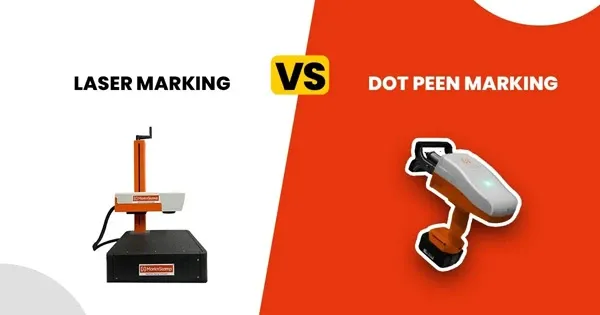
Dot peen marking is a cold-forming process: a pneumatically or electromechanically driven carbide stylus strikes the part surface at 5 to 10 impacts per second, producing a series of indentations that form characters or a Data Matrix pattern. Each impact plastically deforms the surface — no material is removed, no heat is generated, and the mark is a permanent geometric feature of the part. The mark depth is controlled by the impact force (typically 2 to 10 bar air pressure or electromagnetic force in electric units) and the stylus tip radius (0.1 to 0.5 mm). Deeper marks require higher force and slower cycle time. Dot peen requires the part surface to be accessible at a right angle — the stylus must strike perpendicular to the surface within ±10 degrees — and the part must resist the impact force without deflecting. Thin-walled parts below 1.5 mm wall thickness can deform or puncture under dot peen impact.
Laser marking uses a focused laser beam — typically a 20 to 50-watt pulsed fiber laser at 1,064 nm wavelength — to locally heat the surface. Depending on the material and laser parameters, the process can anneal (heat the metal surface to produce an oxide layer color change with no material removal — common on stainless steel medical instruments), engrave (vaporize a shallow cavity 0.02 to 0.1 mm deep — common on tooling and aerospace parts requiring depth for paint-over survival), or ablate a coating (remove paint, anodizing, or plating to expose the contrasting substrate — common on anodized aluminum nameplates and automotive VIN plates). The laser beam is steered by galvanometer mirrors at speeds up to 10,000 mm/s; no physical contact, no tool wear, and the mark can be applied to surfaces at angles up to 45 degrees from perpendicular.
Which materials work with each technology?
| Material | Dot Peen | Laser (Fiber, 1064 nm) |
|---|---|---|
| Steel, cast iron | Excellent — deep, high-contrast marks | Excellent — engraving or annealing; high speed |
| Aluminum (as-cast, machined) | Good — mark depth 0.1–0.3 mm; stylus wear is acceptable | Excellent — high contrast with surface oxidation; very fast |
| Stainless steel | Good — work-hardening can reduce stylus life | Excellent — annealing produces black oxide mark without material removal |
| Titanium | Poor to fair — high hardness wears styli rapidly; galling risk | Excellent — controlled oxide layer color marking; widely used in aerospace |
| Plastics (engineering polymers) | Poor — impact can crack or craze the surface | Good — CO₂ or UV laser preferred; fiber laser can char some polymers |
| Hardened steel (>50 HRC) | Poor — stylus cannot indent; skips or bounces | Good — engraving with sufficient power and slower speed |
| Glass, ceramics | Not compatible — material fractures | Fair to good — CO₂ or UV laser; fiber laser at 1064 nm transmits through many glasses |
Mark Durability: Which Mark Survives What Environment?
Dot peen marks are displacement-based — the indent profile physically deforms the surface, and the mark survives any post-process that does not remove the deformed surface layer. Dot peen marks survive shot blasting (the indent remains visible under the textured surface), machining with coolant (the indent is below the surface and coolant cannot wash it away), paint and powder coating (the indent profile telegraphs through coatings up to 0.2 mm thick), and corrosion (surface rust fills but does not erase the indent). The mark is readable by vision systems as long as the indent casts a shadow — side-lit illumination is standard, and a Data Matrix code can be decoded at depths as shallow as 0.05 mm with proper lighting.
Laser marks are surface-layer marks. An annealed mark on stainless steel is a thin oxide layer that survives autoclave sterilization at 134°C and repeated cleaning with enzymatic detergents — the standard for surgical instrument traceability per UDI (Unique Device Identification) requirements. An engraved mark with 0.05 mm depth survives most post-processing but can be eroded by aggressive shot blasting (which removes the engraved layer) and can fill with paint or powder coating (rendering the mark unreadable). The right laser marking mode — anneal, engrave, or coating ablation — must be matched to the post-processing and service environment the part will experience.
How do operating costs compare over the equipment life?
Dot peen has lower capital cost ($5,000 to $15,000 for industrial-grade systems) and measurable consumable cost: carbide styli last 50,000 to 200,000 marks depending on material hardness and mark depth, and cost $50 to $120 each. At 200,000 marks per stylus on aluminum, the consumable cost is roughly $0.0003 to $0.0006 per mark — essentially negligible. The dominant operating cost is not consumables — it is mark-time: a dot peen Data Matrix code takes 2 to 5 seconds to mark, during which the part must be stationary under the marking head. For a production line running at 20-second cycle time, 4 seconds of marking consumes 20% of the cycle — and the dot peen becomes the bottleneck if the cycle time drops below roughly 10 seconds.
Laser has higher capital cost ($15,000 to $50,000) and near-zero consumable cost per mark (electricity only — roughly 0.1 to 0.5 watt-hours per mark, a fraction of a cent). The mark time is 1 to 3 seconds — faster than dot peen for Data Matrix codes. The laser source itself has a finite life: fiber laser pump diodes degrade to 50% output after roughly 50,000 to 100,000 operating hours (5 to 10 years of three-shift production), at which point the laser source must be replaced at a cost of $4,000 to $10,000. This is a predictable capital expense, not an unexpected failure — and it should be included in the 10-year TCO calculation.
Dot peen and laser marking are not competitors for the same application — they solve different material compatibility and surface-access problems. For cast iron, aluminum castings, and mild steel parts with thick walls and accessible marking surfaces, dot peen is the lowest-cost solution that produces a deep, survivable mark. For thin-walled, hardened, or titanium parts, for stainless steel requiring surface-neutral annealing, or for high-speed production lines marking over 100,000 parts per year, the laser's speed, flexibility, and non-contact process justify the higher capital cost. If you mark titanium, hardened steel, or thin-walled parts — or if your cycle time is dropping below 10 seconds — the laser pays for itself in throughput and material compatibility.