Ask what kills a pump's uptime and the answer, more often than any rotor calculation, is the shaft seal. It is the one part of a screw pump where the pumped media meets the atmosphere, and it is why the industry split into two camps: sealless magnetic-drive pumps that delete the seal entirely, and mechanically sealed pumps that keep it serviceable. The Leistritz L3MG and the ALLIFT RU represent the two camps in screw-pump form.
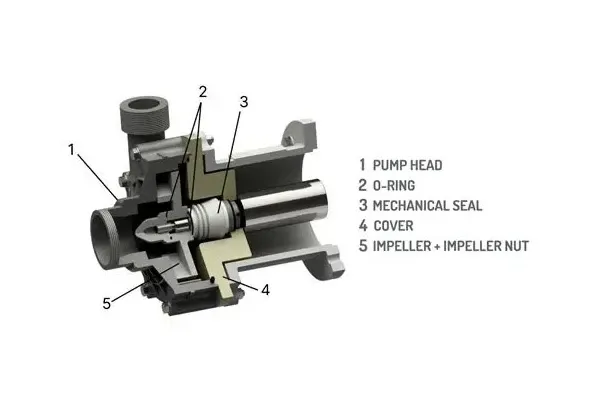
The magnetic-drive proposition
A magnetic coupling transmits torque through a static containment shell — no rotating shaft penetration, therefore no leak path. The L3MG class pushes this into screw-pump territory for viscous, hazardous or high-temperature media (up to 280°C and 10,000 cSt in the family), where a single drop escaping is an environmental or safety event. The cost: the containment shell adds hydraulic losses, dry running remains fatal, and a decoupled magnet means the pump turns while nothing pumps.
The mechanical-seal proposition
A mechanically sealed, immersed screw pump like the ALLIFT RU trades leak risk for honesty: you can see the seal, service the seal, and predict its wear. For lubricating oils, thermal fluids in ventilated plants, and duties where the media is not dangerous to people or process, the sealed pump is cheaper to buy and simpler to own.
The decision rule
Define what one drop costs. Toxic, hot, flammable or off-spec-product media makes the magnetic drive's premium the cheapest insurance in the plant. Benign media makes it an expensive prophecy. Within the wider transfer and measurement stack, the same logic repeats downstream — containment matters where consequences concentrate.
Do magnetic-drive pumps lose prime or cavitate differently?
They behave like the screw pump they are, but decoupling is their unique failure: torque spikes slip the magnets, flow stops silently. A power monitor or flow switch upstream catches it — worth wiring on any mag-drive installation.
Which one survives a dry start?
Neither, honestly — both rely on the media for lubrication. The difference is that a sealed pump warns you by leaking; a mag-drive pump warns you by nothing at all. Instrument accordingly.