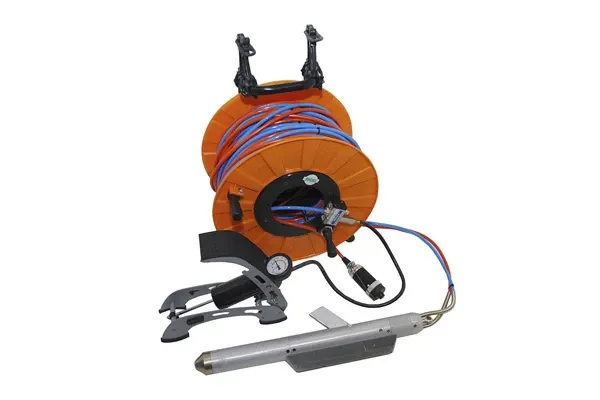
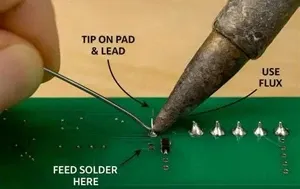
A governor is only as good as its speed signal, and three sensor families feed it: the magnetic pickup (MPU) reading gear teeth passively, the proximity probe detecting targets actively, and the tachometer solution packaging speed as a finished signal. Woodward controllers — 2301s, EPGs, ProAct — accept the MPU as their native language, which is why the choice usually starts there and escalates only when conditions demand it.
The magnetic pickup: passive and proven
An MPU is a coil around a magnet: gear teeth passing the tip induce pulses, frequency proportional to speed. No power required, no electronics to fail, immune to the dirt that blinds optical sensing — the reason it has survived every technology wave. Its discipline is mechanical: the gap to the gear (a few tenths of a millimeter) and the pulse amplitude at cranking speed, which rises with tooth count. A 60-tooth ring gear at 1800 rpm hands a 2301 a clean 1800 Hz to work with; a six-tooth sprocket gives it crumbs.
The proximity probe: active and amplitude-stable
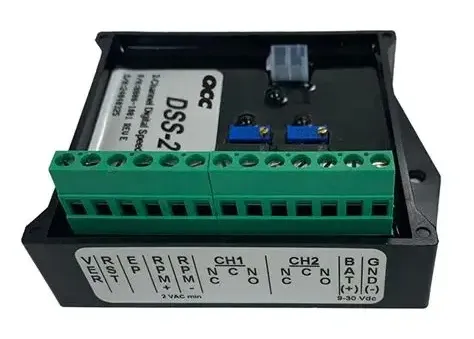
Powered proximity probes (inductive or Hall) deliver clean, amplitude-stable pulses down to zero speed — the answer where cranking-speed signal strength, very low speeds or wide gaps defeat the passive MPU. Digital speed-sensor modules in the Woodward ecosystem take the same idea further, self-calibrating and reporting speed as data rather than as a waveform to condition.
The tachometer route: signal as product
Where the panel wants speed displayed, overspeed-switched and governor-fed from one source, a tachometer family packages the chain: sensor, conditioner, display and relay contacts. It is the solution for panels that measure speed for operations, not just for the control loop.
The decision rule
Standard genset and engine duty: MPU into the governor, 60+ teeth, gap set and verified. Low-speed or wide-gap reality: powered probe or digital module. Operator-facing speed and trip needs: the tachometer package. The sensor family around the panel supplies them all — the governor does not care, as long as the pulses are honest.
Why does my MPU signal vanish at cranking speed?
Amplitude scales with tooth-passing rate and inverse gap squared — a wide gap plus few teeth at 200 rpm produces microvolts the controller cannot read. Close the gap to spec, add teeth, or move to a powered probe; the sensor is telling you the truth about its physics.
Can one MPU feed both governor and overspeed switch?
Electrically possible, architecturally wrong: the independent trip deserves its own sensor, or a governor-side failure takes the protection with it. Two pickups, two paths — the redundancy costs less than the incident.