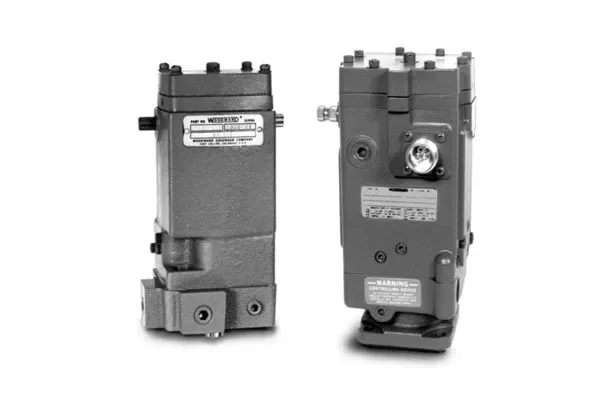
A governor decides; an actuator delivers. Woodward's EG-3P (E8250-501 class) is the delivery specialist: a rotary electro-hydraulic actuator with roughly 6 lb-ft of torque across 42° of rotation, driving fuel valves and throttle bodies on engines whose control loop lives in a 2301-class governor. The separation is deliberate — force and stroke on one side, algorithm and feedback on the other — and the pairing rules between them are the whole engineering exercise.
What the EG-3P owns
Torque and position. The electro-hydraulic stage generates the work that moving a loaded fuel valve demands — up to 400 psi hydraulic capability in the family — while responding to the governor's current command. Its rotary geometry suits butterfly and rotary fuel valves directly; linear fuel systems want the linear members of the actuator families. The actuator's local hydraulics mean the muscle sits at the valve, not at the panel.
What the governor keeps
The algorithm: speed control, load sharing, dynamics — all living in the 2301-class electronics, commanding the actuator over standard current signals. The separation keeps each element honest: the governor is tuned for engine response, the actuator is sized for valve demand, and neither specification compromises the other. When actuators wear, governors persist; when control philosophy changes, actuators persist.
The decision rule
Size the actuator by the valve's torque and travel; size the governor by the engine's dynamics and duty; connect them by the command standard. The pairing fails when either side is asked to do the other's job — an actuator chosen by control features, or a governor chosen by torque. Both live in the plant's governor control world as two documents, not one.
Why electro-hydraulic instead of a big servo motor?
Force density and stiffness: the hydraulic stage delivers torque from a package a motor of equal force cannot match, and holds position against load without fighting inertia. Where the valve's demand crosses the electric threshold, hydraulics is the honest answer — that threshold is the EG family's home.
Does the EG-3P need its own hydraulic supply?
No — the family's electro-hydraulic principle generates its working pressure locally from the electric stage. It is not a plant-hydraulic consumer; it is a self-contained muscle, which is exactly why it mounts at the valve.