Electrodeless (inductive) conductivity measurement wins the dirty-duty argument: no electrodes in the fluid means no coating to blind the measurement — the principle of choice for sludge, acids, and the conductive streams that eat contacting sensors. The Foxboro families deliver it in two architectures: the 875EC panel analyzer with dual 4-20 mA outputs, and the 876EC 2-wire loop transmitter with HART — and the choice is about the installation's nervous system, not the sensing physics.
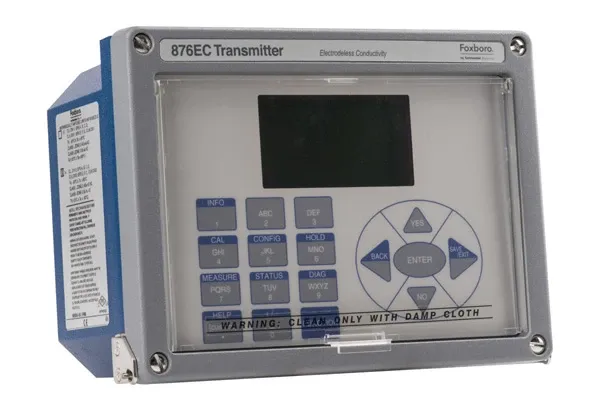
The 875EC: panel analyzer, dual outputs
The panel-analyzer architecture puts intelligence in the panel: the sensor is a toroid on a cable, the analyzer lives where maintenance lives, and the dual 4-20 mA outputs feed two consumers — a controller and a recorder, a DCS and a local indicator. Applications with secondary outputs (concentration plus temperature compensation displayed separately) and panel-service cultures are its home.
The 876EC: the 2-wire loop answer
The 2-wire architecture lives in the field: the transmitter is the loop — powered and communicating over the same pair, HART for configuration and diagnostics. For installations that standardize on loop-powered field devices and run their asset management over HART, the 876EC is the native citizen: one cable gland, one loop, no panel real estate.
The decision rule
Panel culture with dual-output needs: 875EC. Field-loop culture with HART asset management: 876EC. The sensing toroid serves both identically — the chemistry does not care where the electronics live. Both land in the plant's conductivity measurement population alongside their contacting cousins, which remain the right answer for ultra-pure water where the electrodeless principle's floor is too high.
Why electrodeless for dirty streams?
Contacting sensors measure by current between electrodes — coating the electrodes changes the geometry and the reading lies. The inductive toroid measures through the coating; sludge and scale are invisible to it, which is the entire argument.
Can 875EC and 876EC share a sensor?
The families pair with their own sensor classes; mixing analyzer and transmitter across one toroid is a compatibility check, not an assumption. Standardize per application and keep the spare philosophy honest.