A cooling tower chemical treatment program requires continuous monitoring of conductivity, pH, ORP (for oxidizer control), and often a corrosion-rate sensor and a flow switch to confirm sample flow. The traditional approach — five separate instruments, each with its own power supply, signal wiring, and calibration schedule — creates a panel with five transmitter faces, five sets of alarm relay contacts to wire, and five different calibration procedures for the maintenance technician to remember. A multi-parameter controller puts all of those measurements into one instrument with one display, one set of relay outputs, and one calibration workflow. This guide compares the two approaches on the metrics that matter when the instrument is mounted in a pump house at 2 a.m.
What a Multi-Parameter Controller Integrates
A typical multi-parameter water treatment controller accepts 4 to 8 sensor inputs — digital or analog — covering the core parameters of a cooling water or boiler water program:
- Conductivity
- 2-electrode or 4-electrode contacting sensor, 0–10,000 μS/cm, for total dissolved solids (TDS) estimation and bleed valve control
- pH
- Combination glass electrode, 0–14 pH, for acid feed control and corrosion index calculation
- ORP
- Platinum redox electrode, ±2000 mV, for oxidizer (chlorine/bromine) residual control
- Corrosion rate
- Linear polarization resistance (LPR) probe, 0–50 mpy, for corrosion inhibitor effectiveness monitoring
- Temperature
- Pt100 or thermistor, for temperature-compensated conductivity and LSI/RSI scaling index calculation
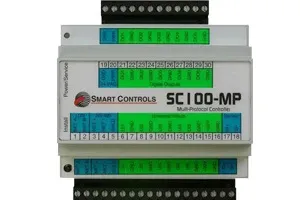
All sensors connect to a single controller that provides excitation, signal conditioning, and display. The controller runs the chemical feed pumps and bleed valve based on user-configured setpoints and interlock logic — if the conductivity sensor fails or the sample flow switch indicates no flow, all chemical pumps are locked out to prevent overfeed. This interlock logic is much simpler to implement inside one controller than across five separate instruments communicating to a PLC.
Five Instruments vs One: The Practical Trade-Offs
| Factor | Five Single-Parameter Instruments | One Multi-Parameter Controller |
|---|---|---|
| Panel cutouts | Five separate DIN or 1/2 DIN cutouts | One enclosure, one cutout |
| Wiring | 5× power, 5× signal outputs, 5× alarm relays | 1× power, 1× communication output, 1× relay bank |
| Calibration | Five different procedures, five different buffer solutions | Single guided calibration workflow, common buffers where applicable |
| Interlocks | Must be wired to external PLC or relay logic | On-board interlock matrix configurable from front panel |
| Failure isolation | One failed instrument = one parameter offline; rest still active | Controller failure = all parameters offline |
| Spare parts | One spare of each instrument type = five spares | One spare controller covers everything |
The failure-isolation concern is the primary argument for keeping parameters separate. A pH electrode crack that floods the signal input and shorts the controller's analog front-end could theoretically bring down the other measurements. Modern multi-parameter controllers mitigate this with galvanically isolated input channels — each sensor input is electrically isolated from the others and from the controller's processor, so a short on one channel does not affect the remaining channels. When evaluating a multi-parameter controller, verify that input-channel galvanic isolation is specified in the data sheet — it is the single feature that determines whether the consolidated architecture is robust or fragile.
Where Multi-Parameter Controllers Deliver the Strongest Return
Use a multi-parameter controller when:
- The water treatment program requires three or more continuously monitored parameters with chemical feed interlocks
- Panel space is at a premium — cooling tower skids, packaged boiler systems, and equipment-room wall panels
- The operator needs a single-screen summary of water chemistry, not five separate displays to scan in sequence
- The instrument connects to a building management system or process controller via a single Modbus RTU or BACnet drop rather than five analog loops
Use separate instruments when:
- Only one or two parameters are critical — conductivity and pH; the rest are periodic grab-sample tests
- The parameters require physically separated installation locations (conductivity at the cooling tower return, pH at the chemical feed injection point 30 meters away)
- Process-critical measurements demand independent redundancy — a boiler with a minimum safety instrumented function requirement may need a separate dedicated conductivity limiter, not a channel in a multi-parameter unit
The Aquametrix AM-2250 multi-parameter process controller accepts pH, ORP, conductivity, and flow inputs in a single 1/4 DIN package with galvanically isolated channels and on-board PID control for chemical feed pumps — a reference design for the consolidated instrumentation approach in water treatment applications.
A multi-parameter controller consolidates hardware, wiring, and calibration workload into one instrument. The decision hinges on galvanic input isolation and whether your process can accept the (low) probability of a single controller failure taking down all parameters simultaneously.