
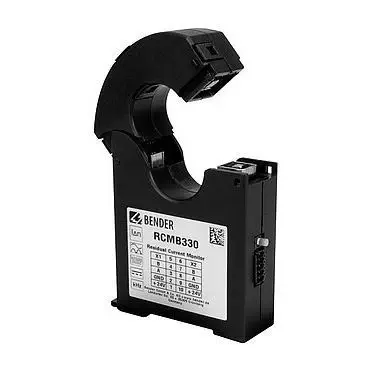
Product Specifications
- Manufacturer
- BENDER GmbH & Co KG (Germany)
- Model
- RCMB330 (Order No. B74043160)
- Product Type
- AC/DC Sensitive Residual Current Monitoring Module with Split‑Core CT
- Measurement
- IΔ = 10…500 mA; frequency range DC…100 kHz; separate evaluation of AC, DC, and RMS components
- Alarm Configuration
- Two separately adjustable response values (pre‑warning and main alarm); multicolour LED status indication
- Interface
- RS‑485, Modbus RTU (read measured values, set parameters, remote reset, software updates)
- Installation & Filtering
- Split‑core CT — no primary conductor disconnection; DIN rail or screw mounting; digitally adjustable low‑pass filters (Type B IEC 60755, Type B+ VDE 0664-400)
- Supply & Compliance
- DC 24 V (19.2…28.8 V); continuous monitoring in compliance with DGUV V3; optional STEP-PS/1 power supply modules available
Product Description
The BENDER LINETRAXX® RCMB330 is an AC/DC sensitive residual current monitoring module that consolidates a split‑core measuring current transformer and a microprocessor‑based evaluation unit within a single, DIN‑rail‑mountable housing. It is designed for continuous residual current monitoring in earthed power supply systems (TN and TT systems), measuring fault currents from 10 mA to 500 mA across a frequency spectrum extending from DC to 100 kHz. Unlike a conventional residual current device (RCD) that only trips at a single threshold, the RCMB330 provides two independent, adjustable alarm setpoints—typically configured as a pre‑warning and a main alarm—that enable a staged response to deteriorating insulation before a safety‑critical trip occurs. The integrated RS‑485 interface with Modbus RTU protocol allows the module to transmit both real‑time measured values and alarm states to a PLC, SCADA, or building management system, while also supporting remote parameter setting, alarm reset, and even firmware updates over the bus. This makes the RCMB330 suitable for predictive maintenance strategies in complex electrical installations—data centers, photovoltaic plants, battery storage systems, industrial manufacturing lines—where unexpected residual currents are an early indicator of insulation failure, equipment degradation, or potential fire hazard.
AC/DC Sensitive Measurement — Why It Matters
- Beyond AC‑Only Detection: Conventional type‑A residual current monitors detect purely sinusoidal AC fault currents but are blind to smooth DC residual currents—exactly the kind generated by modern power electronics: variable‑frequency drives, EV chargers, UPS rectifiers, and photovoltaic inverters. The RCMB330 addresses this gap with type‑B sensitivity (acc. to IEC 60755) and type‑B+ sensitivity (acc. to VDE 0664‑400), detecting residual currents from DC to 100 kHz. This is critical in installations where a DC fault current can saturate upstream AC‑only transformers, rendering them incapable of detecting subsequent AC faults—a dangerous cascade that the RCMB330 prevents by monitoring the full frequency spectrum continuously.
- Separate AC, DC, and RMS Evaluation: The module does not simply report a single "total leakage" figure. It evaluates the AC component, the DC component, and the RMS (effective) value of the residual current independently, and allows the user to set pre‑warning and main alarm thresholds specifically for any of these components. This means an operator can distinguish between a gradually rising DC leakage (typical of aging insulation in a PV string) and an intermittent AC fault (typical of a motor winding breakdown)—a diagnostic capability that directly reduces troubleshooting time and enables condition‑based maintenance scheduling.
- Digitally Adjustable Filtering: Built‑in digital low‑pass filters allow the user to tailor the measurement response to the specific electrical environment, suppressing the high‑frequency switching noise common in factories with large variable‑speed drives while maintaining full sensitivity to genuine fault currents in the lower frequency bands.
Pre‑warning and Main Alarm — A Two‑Stage Safety Concept
- Two Independently Adjustable Response Values: The RCMB330 provides two separate alarm setpoints. In practice, the lower threshold is configured as a pre‑warning: when the residual current exceeds this value, the multicolour LED changes state and a Modbus message is sent to the SCADA system—alerting maintenance staff that insulation is beginning to degrade but that immediate shutdown is not yet required. The higher threshold is configured as the main alarm: when this level is reached, the system can automatically trigger a controlled shutdown, activate a fire alarm relay, or escalate the work order priority. This two‑stage approach eliminates the binary choice between "ignore a nuisance alarm" and "shut down production unnecessarily" that plagues single‑threshold RCD installations.
- Multicolour LED for Local Status: A single multicolour LED on the front panel provides immediate visual indication of operating status (normal operation = green; pre‑warning = yellow; main alarm = red; device fault = flashing red), enabling a technician walking the panel row to assess the status of every RCMB330 in seconds, without a laptop or HMI.
Split‑Core CT and Modbus Integration — No Downtime, Complete Data
- Split‑Core Design — Retrofit Without Shutdown: The integrated measuring current transformer features a split‑core design, meaning the CT housing can be opened, placed around the existing primary conductors, and closed—all without disconnecting the cables or de‑energising the circuit. This is a defining advantage in data centers, hospitals, and 24/7 manufacturing where planned outages for sensor installation are prohibitively expensive. The magnetic screen renders the measurement insensitive to load currents, eliminating the risk of false residual current readings caused by magnetic fields from adjacent high‑current conductors.
- Modbus RTU — Beyond Data Reading: The RS‑485 interface with Modbus RTU protocol provides more than just measured value polling. From the SCADA or PLC, operators can: read the instantaneous residual current (RMS, AC component, DC component separately); read and reset stored alarm conditions; adjust the pre‑warning and main alarm response values remotely; initiate an offset calibration after installation; start a simulated test measurement to verify the Modbus communication path; and apply firmware updates to extend the module’s functionality over time. The module also supports local operation via the "T/R" button on the front panel for manual test, reset, degaussing, and offset calibration when a laptop is not available.
Applications
- Data centers: continuous residual current monitoring of power distribution units (PDUs) and UPS output circuits, where AC/DC sensitivity detects both traditional AC leakage and DC fault currents from rectifiers that would saturate standard AC current transformers
- Photovoltaic and battery energy storage systems: DC‑sensitive residual current monitoring on the AC side of inverters to detect insulation degradation in PV strings and battery racks before ground faults develop
- Industrial manufacturing: monitoring of motor feeder circuits controlled by variable‑frequency drives (VFDs), where the wide frequency range (DC…100 kHz) captures both low‑frequency winding faults and high‑frequency bearing currents
- Hospital and critical‑care facilities: preventive insulation monitoring of life‑support equipment circuits supplied from TN/TT systems, where the staged pre‑warning/main alarm structure supports planned maintenance without interrupting patient care
- Transportation infrastructure: railway signalling power supplies, airport ground power units, and tunnel ventilation circuits where split‑core installation avoids service disruption during retrofits
- Any earthed TN or TT system installation where DGUV Vorschrift 3 compliance, AC/DC sensitive residual current measurement, and Modbus‑based remote monitoring are required
Resources & Documentation
AC/DC Resid. Current Monitor, 10–500 mA, DC…100 kHz, Modbus – RCMB330 | BENDER
Product Specifications
- Manufacturer
- BENDER GmbH & Co KG (Germany)
- Model
- RCMB330 (Order No. B74043160)
- Product Type
- AC/DC Sensitive Residual Current Monitoring Module with Split‑Core CT
- Measurement
- IΔ = 10…500 mA; frequency range DC…100 kHz; separate evaluation of AC, DC, and RMS components
- Alarm Configuration
- Two separately adjustable response values (pre‑warning and main alarm); multicolour LED status indication
- Interface
- RS‑485, Modbus RTU (read measured values, set parameters, remote reset, software updates)
- Installation & Filtering
- Split‑core CT — no primary conductor disconnection; DIN rail or screw mounting; digitally adjustable low‑pass filters (Type B IEC 60755, Type B+ VDE 0664-400)
- Supply & Compliance
- DC 24 V (19.2…28.8 V); continuous monitoring in compliance with DGUV V3; optional STEP-PS/1 power supply modules available
Resources & Documentation
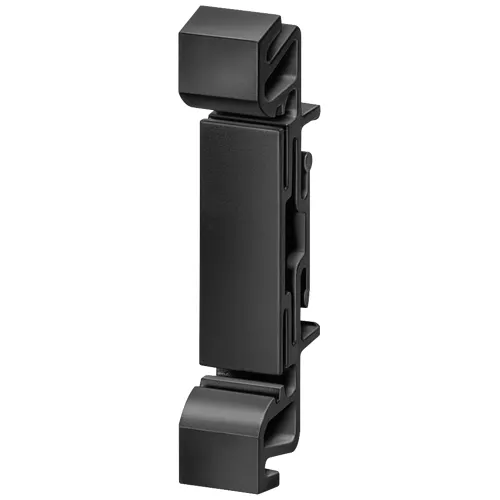
Siemens 5SV8900-1KK
DIN Rail Holder, 5SV8 Series, 5g