
Product Specifications
- Brand
- Mercury Systems
- Part Number
- LFS3506
- Type
- LWIR Enhanced Vision System
- Series
- LFS Series
- Sensor
- LWIR (Long-Wave Infrared)
- Resolution
- 640 × 512
- Field of View
- 32° H × 26° V
- Video Output
- NTSC / PAL, dual outputs
- Zoom
- 2× electronic
- Power
- 12–28 VDC, 5 W typical / 34 W max
- Weight
- ~0.54 kg (1.2 lb)
Product Description
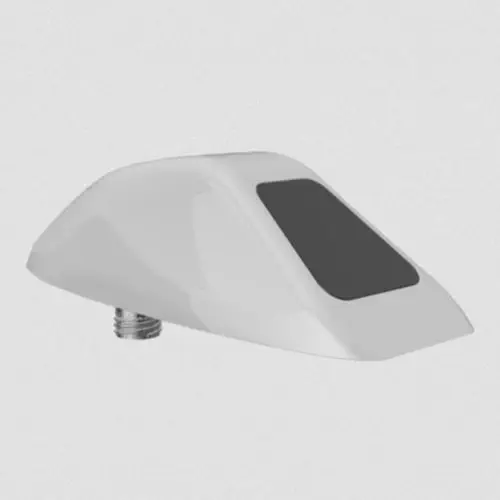
The Mercury Systems LFS3506 is a compact enhanced vision system (EVS) that fits a 640 × 512 long-wave infrared sensor into a single line-replaceable unit measuring roughly 8 × 3 × 2 inches and weighing 1.2 pounds. It is designed to give pilots a real-time thermal view of the outside world on any video-capable cockpit display — penetrating haze, smoke, fog, and darkness to reveal terrain, runway markings, obstacles, and traffic that would otherwise be invisible through the windscreen. The LFS3506 is the entry-point EVS in Mercury's LFS product family, targeting cost-effective situational awareness upgrades for general aviation, business jets, and special-mission aircraft.
How does enhanced vision differ from synthetic vision?
Synthetic vision systems (SVS) render a computer-generated terrain model from GPS position and a database — they show what should be outside, not what is outside. An enhanced vision system like the LFS3506 images the real scene in real time using an infrared sensor. When a runway is obscured by fog or a vehicle crosses an unlit taxiway, SVS will not show it; an LWIR-based EVS will. The LFS3506 therefore complements a synthetic-vision-equipped glass cockpit by providing an independent, database-free confirmation of the actual environment — a capability recognized in reduced-visibility approach regulations that grant operational credit for EVS-equipped aircraft.
What are the integration and control options?
The LFS3506 outputs NTSC or PAL video over dual channels, so it can feed a primary flight display, a multi-function display, and a dedicated EVS monitor simultaneously. Control interfaces span RS-232, RS-422, RS-485, ARINC 429, and Ethernet, allowing the camera to be operated directly from the aircraft's existing EFIS or through Mercury's LRK9106 controller. A 2× electronic zoom is selectable in flight, and display polarity can be toggled between white-hot and black-hot to match pilot preference and ambient lighting. The sensor angle is internally adjustable to accommodate different airframe mounting positions. Power consumption is 5 W typical and 34 W maximum from a 12–28 VDC aircraft bus.
What aircraft is the LFS3506 suited for?
With a depth under 8 inches, a weight of 1.2 pounds, and an aerodynamic low-drag housing, the LFS3506 targets aircraft where a larger, heavier multi-sensor EVS would be impractical — single-engine pistons, light turboprops, helicopters, and unmanned platforms. The compact form factor allows installation on the nose, wing, or fuselage hardpoint without substantial structural modification. Optional lightning protection is available for composite-airframe applications. The LFS3506 is also used as a forward-looking infrared sensor in multi-spectral surveillance pods and ground-based security applications where its 32° × 26° field of view and uncooled LWIR detector provide wide-area thermal coverage without the logistics burden of a cooled sensor.
Resources & Documentation
Mercury Systems LFS3506 640×512 LWIR Enhanced Vision System for Aircraft
Product Specifications
- Brand
- Mercury Systems
- Part Number
- LFS3506
- Type
- LWIR Enhanced Vision System
- Series
- LFS Series
- Sensor
- LWIR (Long-Wave Infrared)
- Resolution
- 640 × 512
- Field of View
- 32° H × 26° V
- Video Output
- NTSC / PAL, dual outputs
- Zoom
- 2× electronic
- Power
- 12–28 VDC, 5 W typical / 34 W max
- Weight
- ~0.54 kg (1.2 lb)
Resources & Documentation
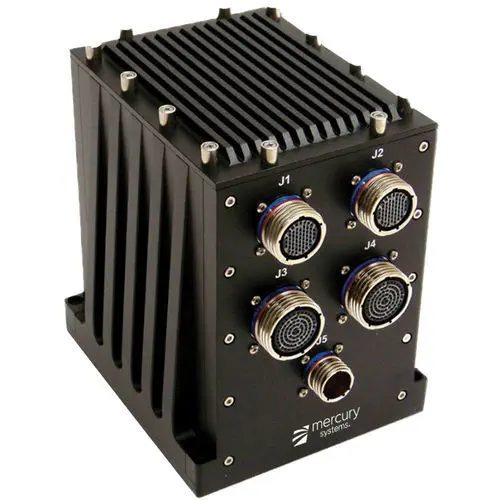
Mercury Systems MPS1202
Tactical EW Spectrum Processing Subsystem