
Product Specifications
- Brand
- ARBURG
- Product Type
- Industrial 3D Printer
- Series
- freeformer
- Technology
- Arburg Plastic Freeforming (APF)
- Discharge Units
- 2–3 (model-dependent)
- Build Chamber Temperature
- Up to 120°C (standard) / 200°C (HT variant)
- Plasticising Temperature
- Up to 450°C
- Material Form
- Standard injection-moulding pellets
- Droplet Frequency
- Up to 400 Hz
Product Description
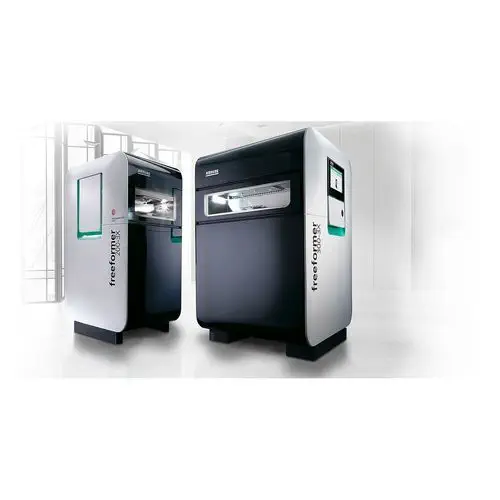
The ARBURG freeformer series is unlike any other polymer 3D printer on the market. It does not use filament. It does not use resin. It uses the same standard thermoplastic pellets that feed injection-moulding machines — ABS, PC, PP, PA, TPE, PEI, PEKK, and medically certified grades — at a fraction of the cost of proprietary filament spools. The enabling technology is Arburg Plastic Freeforming (APF): a screw-and-barrel plasticising unit derived from ARBURG's injection-moulding heritage melts the pellets, and a high-frequency piezo actuator drives a specialised nozzle that fires micro-droplets of melt at up to 400 Hz onto a position-controlled build tray. Because the raw material is unchanged from injection moulding, the resulting part density and mechanical properties approach those of conventionally moulded components — a claim few filament-based or resin-based printers can make.
How does APF pellet-based droplet deposition work?
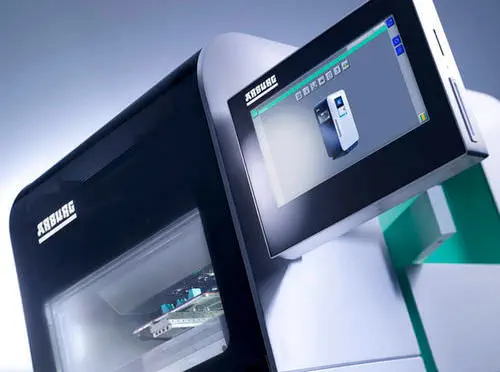
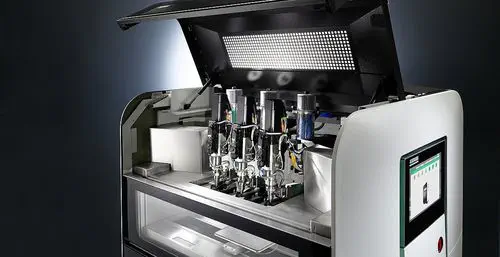
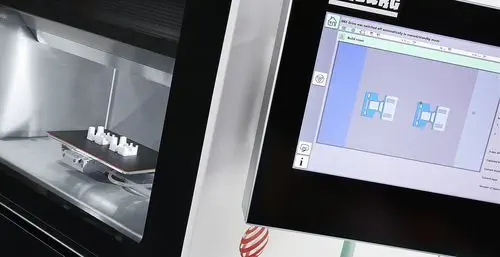
The process starts with standard plastic pellets loaded into a heated screw-and-barrel unit — identical in principle to ARBURG injection-moulding machines. The screw plasticises the material and feeds it to a compact melt-pressure generator. There, a piezo element oscillates a nozzle needle at up to 400 Hz, ejecting droplets measured in picolitres to nanolitres — the exact volume tuned by nozzle geometry, piezo stroke, and melt viscosity. The build tray moves in X, Y, and Z under CNC control, positioning each droplet where the sliced model requires it. Unlike filament extrusion, which lays down continuous beads and struggles with start-stop transitions, the droplet approach can start and stop material flow within a single piezo cycle — enabling precise droplet placement, variable infill density within the same part, and seamless transitions between materials in multi-discharge-unit configurations. The Gestica control system calculates exact material requirements per layer and adjusts dosing volume dynamically to minimise melt residence time and thermal degradation.
What can multi-material printing with up to three discharge units produce?
Each discharge unit carries its own plasticising screw and nozzle, fed independently — meaning two or three different materials can be deposited in the same layer without cross-contamination. Practical outputs include: hard/soft combinations (a rigid PP structural frame with flexible TPE sealing lips, printed as one part with no assembly), a build material plus a water-soluble or alkaline-soluble support material for complex internal channels, and two-colour parts where different shore hardnesses or colours are functionally required. The medical version processes resorbable polylactides for patient-specific implants — the freeformer is installed in cleanroom environments for this purpose, with the ProcessLog app capturing full per-part production data for regulatory traceability.
Which freeformer model fits which application?
| Model | Discharge Units | Build Area | Chamber Temp | Positioning |
|---|---|---|---|---|
| freeformer 550-3X | 2 | 230 × 230 × 230 mm | Up to 120°C | Latest generation — replaces 200-3X; Gestica production assistant for operator-guided workflow |
| freeformer 750-3X | 3 | 330 × 230 × 230 mm | Up to 200°C (HT) | Flagship — largest build chamber; 3 discharge units for hard/soft/support combinations; HT version processes PEI (ULTEM 9085) |
| freeformer 300-3X | 2–3 | 234 × 134 × 230 mm | Up to 120°C | Mid-range workhorse for multi-material functional parts |
| freeformer 200-3X | 2 | ~154 × 134 × 230 mm | Up to 120°C | Legacy — being phased out in favour of 550-3X |
All models share the same APF technology core, Gestica control platform, and open-material philosophy. The choice between them is primarily a question of build envelope size and the number of materials that must be combined in a single build.
Resources & Documentation
ARBURG Freeformer Series Pellet-Based Industrial 3D Printer with Open Material Platform
Product Specifications
- Brand
- ARBURG
- Product Type
- Industrial 3D Printer
- Series
- freeformer
- Technology
- Arburg Plastic Freeforming (APF)
- Discharge Units
- 2–3 (model-dependent)
- Build Chamber Temperature
- Up to 120°C (standard) / 200°C (HT variant)
- Plasticising Temperature
- Up to 450°C
- Material Form
- Standard injection-moulding pellets
- Droplet Frequency
- Up to 400 Hz
Resources & Documentation
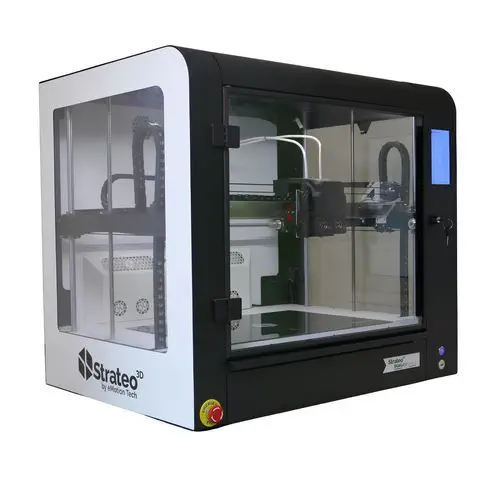
eMotionTech Strateo3D DUAL600 Série 2
126-liter IDEX FFF with open-material architecture
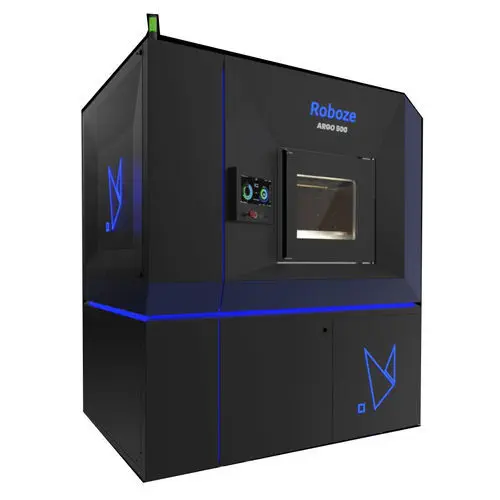
ROBOZE ARGO 500
500 mm³ heated-chamber FFF for PEEK, ULTEM, and composites
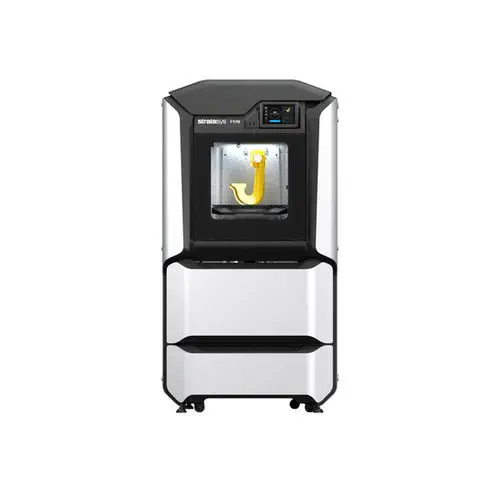
Stratasys F170
Office-ready FFF with GrabCAD Print and QSR support