
Product Specifications
- Brand
- CubeMars
- Part Number
- Driver-board-V2.1
- Product Type
- Integrated Motor Driver with Motion Controller
- Series
- AK Series
- Rated Voltage
- 48 VDC (18–52 VDC Operating Range)
- Rated Current
- 40 A Continuous (60 A Peak)
- Communication
- CAN Bus (1 Mbps), UART (TTL)
- Onboard Encoder
- 14-Bit Single-Turn Absolute
- Control Modes
- Servo Mode, MIT Motion Control Mode
- Compatible Motors
- AK70-10, AK80-6, AK80-8, AK80-64, AK10-9
- Dimensions
- 62 × 58 mm
- Operating Temperature
- -20°C to 65°C (Board Max 100°C)
- Protections
- Overload, Over-Temperature, Motor Phase-Loss Detection
- Standby Power
- ≤50 mA
Product Description
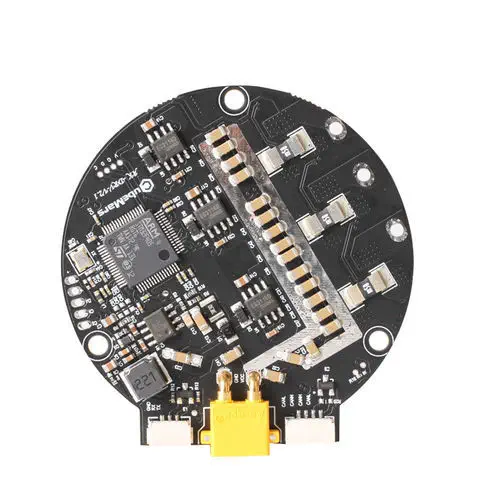
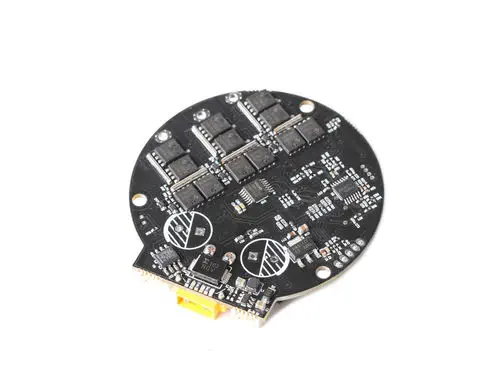
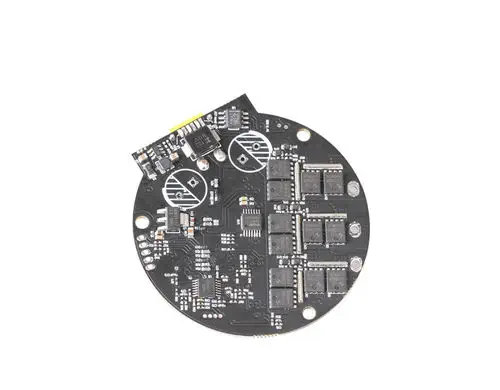
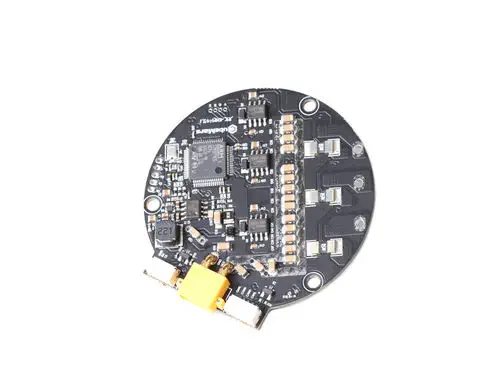
The CubeMars Driver-Board-V2.1 is a second-generation integrated motor driver that combines a 40 A BLDC power stage with an onboard motion controller on a single 62 × 58 mm PCB. Designed exclusively for CubeMars AK series low-voltage robotic actuators, it is the standard driver option for AK70-10, AK80-6, AK80-8, AK80-64, and AK10-9 motors — covering the torque and form-factor range most commonly used in quadruped robots, exoskeletons, collaborative arms, and mobile robot drive wheels. The board auto-identifies the connected motor on power-up, eliminating manual current and encoder configuration.
What is the difference between Servo mode and MIT motion control mode?
Servo mode provides classical three-loop cascaded control — position, velocity, and current (torque) loops — for applications that need precise trajectory tracking and point-to-point positioning. MIT motion control mode replaces the cascaded architecture with an impedance-regulated model that accepts position and velocity commands while dynamically modulating torque in response to external forces. This makes MIT mode the preferred choice for legged locomotion and direct physical human-robot interaction, where the actuator must comply with unexpected ground contacts or operator forces rather than rigidly holding a commanded position. Both modes support single-loop and multi-loop configurations selectable via the CubeMars Tool debugging interface.
How does CAN bus communication work for multi-axis systems?
The Driver-Board-V2.1 implements CAN bus at 1 Mbps, the de-facto standard for distributed robot actuator networks. Each driver appears as a node on the bus, addressable by the host controller for synchronised multi-axis motion. The CAN physical layer provides deterministic latency and built-in error detection, making it suitable for real-time coordinated control of 4–12 axes in a legged robot. For simpler single-axis setups or benchtop testing, the UART (TTL-level serial) interface connects directly to a USB-to-TTL adapter and the CubeMars Tool PC software — no CAN adapter required for initial configuration and firmware updates.
What protection features ensure reliable operation in dynamic robot environments?
The board monitors motor phase current, driver temperature, and motor connection integrity in real time. Overload protection limits output when the 60 A peak threshold is approached, while over-temperature protection throttles or shuts down output if the onboard sensor exceeds 100°C. Motor phase-loss detection identifies open-circuit or short-circuit conditions at the motor terminals and disables the output stage to prevent damage. The compact 62 × 58 mm footprint and -20°C to 65°C ambient operating range allow the driver to be mounted inside robot joint housings or actuator enclosures where space is constrained and thermal management must be considered.
Resources & Documentation
CubeMars Driver-Board-V2.1 CAN Bus Motor Driver with Integrated Motion Controller
Product Specifications
- Brand
- CubeMars
- Part Number
- Driver-board-V2.1
- Product Type
- Integrated Motor Driver with Motion Controller
- Series
- AK Series
- Rated Voltage
- 48 VDC (18–52 VDC Operating Range)
- Rated Current
- 40 A Continuous (60 A Peak)
- Communication
- CAN Bus (1 Mbps), UART (TTL)
- Onboard Encoder
- 14-Bit Single-Turn Absolute
- Control Modes
- Servo Mode, MIT Motion Control Mode
- Compatible Motors
- AK70-10, AK80-6, AK80-8, AK80-64, AK10-9
- Dimensions
- 62 × 58 mm
- Operating Temperature
- -20°C to 65°C (Board Max 100°C)
- Protections
- Overload, Over-Temperature, Motor Phase-Loss Detection
- Standby Power
- ≤50 mA
Resources & Documentation
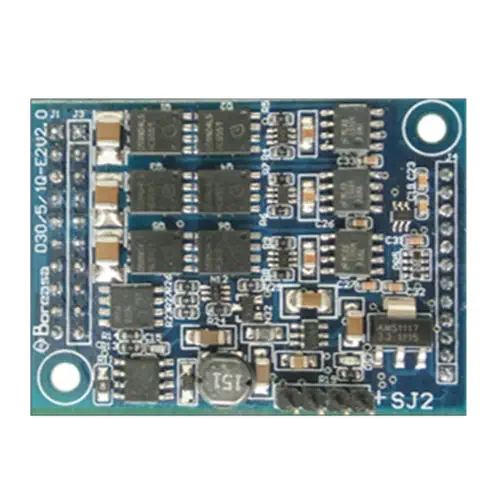
Boreasa Technologies D30/5/1Q-E2
BLDC driver, 5A, STM32-based, pin-header