
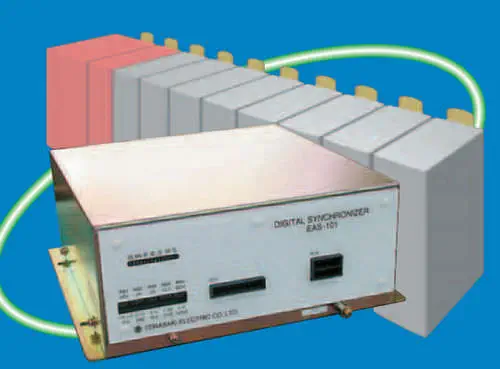
Product Specifications
- Brand
- Terasaki Electric Ltd
- Part Number
- GAC21
- Type
- Marine Power Plant Management System
- PLC Processing Speed
- 70 ns
- Max I/O Points
- 8,192
- Dedicated Bus Speed
- 25 Mbps
- Standards
- IEC 61131, CE, UL
- Architecture
- Decentralized independent function units
Product Description
The Terasaki Electric GAC21 is the central intelligence of a marine vessel's electrical power generation and distribution system. Rather than consolidating all control functions into a single processor, the GAC21 employs a decentralized architecture with four completely independent control units — safety, protection, automatic control, and manual control — so that a failure in one domain cannot propagate to the others. This design philosophy, combined with 70 ns PLC processing and a 25 Mbps dedicated bus, has made Terasaki the market leader in marine power distribution with over 21,000 systems installed on large ships globally.
What power management functions does the GAC21 perform during normal operation?
During routine vessel operation, the GAC21 handles synchronous generator control, frequency regulation, and preferential tripping to maintain stable busbar voltage and frequency. Generator voltage monitoring, power factor control, and fuel oil selection are managed continuously. On the busbar side, the system monitors voltage and frequency, detects undervoltage conditions, and controls the standby generator sequence — including start order selection, automatic standby start (single-start mode), and automatic synchronizing before load transfer. A Handy Type Setting Device (HT21-001) allows crew to adjust automatic generator control parameters without accessing the main PLC programming environment.
How does the decentralized architecture improve reliability?
In a conventional centralized power management system, a single processor fault can disable all generator control functions simultaneously. The GAC21's decentralized design assigns each control domain to physically independent hardware modules. The safety unit monitors for conditions requiring immediate protective action. The protection unit handles overload, short-circuit, and reverse-power conditions. The automatic control unit manages synchronizing, load sharing, and frequency regulation. The manual control unit provides a hardwired fallback path for crew intervention. Each module uses a P-ROM cartridge for software storage, enabling field replacement without specialized programming tools. Continuous self-monitoring of power supplies, CPU health, and signal transmission lines with per-module error indicators simplifies troubleshooting for the engineering crew.
How does the Terasaki Multiple Transmission System (TM) connect the GAC21?
The TM transmission network uses loop topology to connect the GAC21 with switchboards, group starter panels, and integrated engine monitoring systems across the vessel. Serial transmission links extend data to the bridge for remote monitoring and alarm annunciation. The system is compatible with Terasaki's watch-free system concept, where automated engine room monitoring reduces crew workload during extended voyages. IEC 61131 compliance ensures the programming environment and instruction set follow the international standard for programmable controllers.
| Function Category | Capabilities |
|---|---|
| Generator Control | Synchronizing, frequency control, preferential trip, voltage monitoring, power factor control |
| Busbar Monitoring | Voltage and frequency detection, undervoltage monitoring |
| Standby Management | Generator selection, start order, automatic standby start |
| System Diagnostics | Continuous self-monitoring, per-module error indication, self-diagnostic routines |
| Communication | TM loop network, serial bridge link, watch-free system integration |
Terasaki Electric GAC21 Marine Power Plant Management System with Decentralized Generator Control and 70 ns PLC
Product Specifications
- Brand
- Terasaki Electric Ltd
- Part Number
- GAC21
- Type
- Marine Power Plant Management System
- PLC Processing Speed
- 70 ns
- Max I/O Points
- 8,192
- Dedicated Bus Speed
- 25 Mbps
- Standards
- IEC 61131, CE, UL
- Architecture
- Decentralized independent function units

GE Grid Solutions Power plant management system
EBoP and GridBeats automation for gas, steam, and renewable power plants