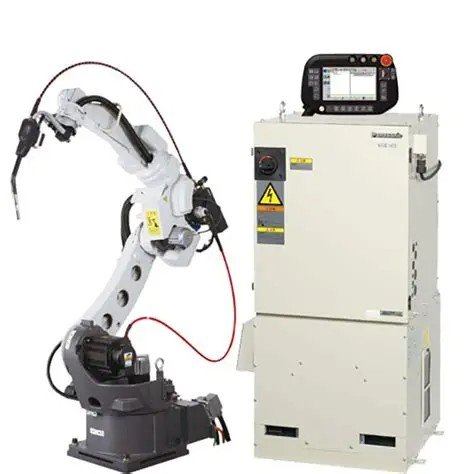
Panasonic called its integrated system TAWERS — The Arc Welding Robot System. The name itself makes the claim: the arc and the robot are one system, not two devices sharing a cable. Two decades later, most robot OEMs offer both integrated and separate architectures. But the choice is still framed wrong in most RFQs. It is not about whether the welding power source sits inside or outside the robot cabinet. It is about whether the arc feedback loop and the motion control loop run on the same clock.
Two control architectures, one hard ceiling
In a separate (robot + external power source) architecture, the robot controller runs a motion interpolation cycle — typically 1–4 kHz on modern hardware — while the welding power source runs its own waveform control loop independently. They communicate over a fieldbus: DeviceNet, EtherCAT, or a proprietary digital protocol. That fieldbus frame crosses a physical layer and a protocol stack. The one-way delay is 1–5 milliseconds under ideal conditions, and it is jitter-prone under heavy bus traffic.
In an integrated architecture like TAWERS, the welding inverter control runs as a software task inside the robot controller's real-time operating system. The motion trajectory and the arc waveform share a clock source. The consequence: the system can adjust welding current or voltage within the same interpolation cycle that corrects the TCP position.
Why this matters is visible at two specific moments in every weld:
- Arc start (0–200 ms)
- The robot must pause, establish the weld pool, then accelerate along the seam. With separate controls, the robot starts moving on a timer after receiving a "current OK" flag. With integrated control, the motion task and the arc task are synchronized — movement begins the instant the weld pool is stable, not when a flag arrives.
- Arc end / crater fill (last 100–300 ms)
- Reducing current while simultaneously decelerating to a stop requires coordinated ramp-down of heat input and travel speed. An overshoot in current during deceleration burns through thin material. An undershoot leaves a crater or a cold lap. Integrated control avoids both by running current ramp and speed ramp from the same schedule.
Seam tracking: where the integrated advantage compounds
Through-arc seam tracking (TAST) uses the welding current and voltage waveforms themselves to detect whether the wire is centered in the joint. As the wire oscillates across the groove, the current rises when arc length shortens (approaching a sidewall) and falls when it lengthens. The robot uses this real-time signal to correct its lateral position — keeping the wire centered even as the workpiece distorts under heat.
The tracking accuracy ceiling is set by the total loop delay: arc signal acquisition → filtering → position correction command → servo response. Separate systems insert a fieldbus round-trip (2–10 ms) into this chain. TAWERS eliminates it. At travel speeds above 2 m/min, the 2–10 ms delay translates to 0.07–0.33 mm of tracking error — enough to miss the joint on 0.6 mm automotive steel. Below 1 m/min, both architectures track adequately.
The integrated vs. separate decision matters most when travel speed exceeds 2 m/min on material thinner than 1.5 mm. Below those thresholds, either architecture works — and the decision should pivot to welding-process flexibility.
Why the separate architecture still dominates outside automotive
If integration is technically superior, why are separate robot + external power source setups still the majority in general fabrication? Four reasons, none of them about arc quality:
1. Welding process qualification is expensive and brand-specific. A shop that has qualified a Fronius CMT waveform for a structural aluminum part, or a Lincoln Electric STT procedure for a root-pass on pipe, cannot simply swap to Panasonic's waveform. Re-qualification involves destructive testing, radiography, and a paperwork trail that can cost $15K–$50K per procedure. If your competitive advantage is a specific weld procedure, the power source brand is non-negotiable — and the robot selection follows the power source, not the other way around.
2. Power source upgrade cycles are shorter than robot lifecycles. A robot runs 8–12 years. Welding waveform technology — especially in aluminum, nickel alloys, and advanced pulsed-spray transfer modes — advances meaningfully every 3–5 years. With separate architecture, you swap the power source while keeping the robot. With integrated architecture, upgrading the welding technology means replacing the entire system or waiting for the OEM's upgrade path.
3. Multi-process shops need flexibility. A job shop that runs MIG on carbon steel Monday, pulsed TIG on stainless Tuesday, and plasma cutting Wednesday cannot afford three different integrated robot cells. With separate architecture, one robot switches power sources via a quick-disconnect — the robot is process-agnostic.
4. Local service ecosystems create lock-in risk. Fronius and Lincoln Electric service technicians exist in nearly every industrial city worldwide. Panasonic welding service runs through the robot division channel — coverage in secondary markets is thinner. If your facility is 400 km from the nearest Panasonic robot integrator, a separate Fronius-powered robot serviced by the local welding distributor is the safer bet.
Decision table
| Your application | Recommended architecture |
|---|---|
| Thin sheet (<1.5 mm) high-speed (>2 m/min), single process, high volume | Integrated (TAWERS-style) |
| Existing weld procedures qualified on a specific power source brand | Separate — do not re-qualify |
| Multi-process job shop (MIG, TIG, plasma on same cell) | Separate — one robot, swappable power sources |
| Remote facility with limited robot service coverage | Separate — use the power source brand your local distributor supports |
| High-value parts where one weld defect scraps the workpiece | Integrated — arc-start and crater-fill consistency reduce scrap risk |
What specific problem does arc-start coordination solve?
On thin aluminum, the first 100 milliseconds of arc ignition determine whether you get full penetration or a cold start. In a separate system, the robot begins moving on a timer — typically 50–150 ms after receiving the "arc established" signal. If the weld pool needs 80 ms to stabilize but the timer fires at 60 ms, the robot moves before the keyhole forms, producing a 5–10 mm cold zone at the seam start. TAWERS integrates these events — motion begins when the arc feedback loop confirms weld pool stability, not when an external timer expires. For automotive heat-exchanger manifolds with 40 short seam segments per part, 40 clean starts vs. 40 potential cold starts is the difference between 98% and 82% first-pass yield.
Can you partially upgrade an integrated welding system mid-life?
Generally, no. The welding waveform engine is part of the robot controller's software build. You cannot attach a third-party power source and expect the same arc-response synchronization. If you expect to adopt a new waveform technology — for example, a new aluminum pulse mode that reduces spatter by 30% — within the next five years, verify the integrated system OEM's roadmap before committing. If the OEM is not actively developing that waveform, separate architecture is the safer capital plan.
Is the integrated premium justified for carbon steel fillet welds under 12 mm?
In most cases, no. Carbon steel fillet welds on material 3–12 mm thick are the most forgiving application in arc welding. A competent separate system with a quality digital power source (Fronius TPS/i, Lincoln Power Wave) will produce equivalent weld quality at equivalent travel speeds for these joints. The integrated advantage scales with thin material, high speed, and alloy sensitivity — not with fillet welds on structural steel.
Related Content
- Browse all Industrial Robots — including arc welding robot configurations
- Robot Controllers — compact and multi-axis controllers for welding cells
- Safety Relays — safety-rated monitoring for robotic welding enclosures
- Read our Safety-Rated Industrial Robot or Native Cobot? — if your welding cell also involves human interaction