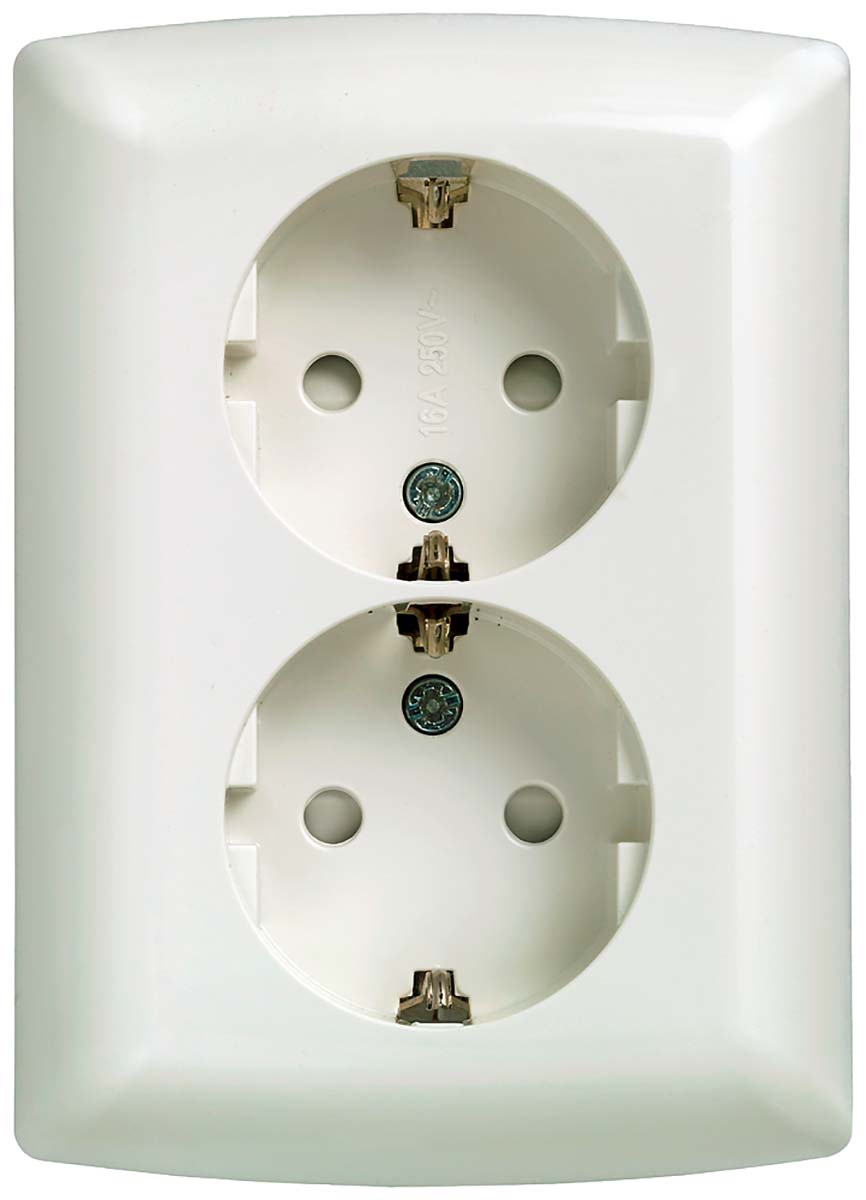
A dual Schuko socket — like the Delta line 5UB2211-3 in titanium white — fits two Schuko outlets into a single standard flush-mount back box. At first glance, it solves a simple problem: you need two outlets in one location, and you have one wall box. But the decision between a dual socket and two single sockets in a double box is not just about what fits. It changes how the circuit is loaded, how the wall looks, and how much the electrician charges for the second back box.
This article walks through the four trade-offs that actually matter — space, circuit capacity, installation cost, and aesthetics — so you can decide before the wall is chased and the plaster is drying.
Space: What Fits Where
A standard German flush-mount back box is 68 mm in diameter. A single Schuko socket fills it. A dual Schuko socket like the 5UB2211-3 also fills it — two outlets, one 68 mm box, one frame. If the wall already has a single box and adding a second means chasing brick, replastering, and repainting, the dual socket avoids all of that.
But a double back box — two 68 mm boxes ganged side by side with a bridge piece — is standard in German new-build practice for any location where two outlets are foreseeable: kitchen worktops, home office desks, behind the TV unit, either side of the bed. If the double box is already in the wall, two single sockets in a double frame give you the same outlet count as one dual socket in a single box. The real constraint is usually not the box but what is behind it:
- Single box, solid wall
- Chasing a second box into brick or concrete is messy, loud, and expensive. A dual socket is the clear winner — one existing box, two outlets, zero additional chasing.
- Single box, drywall
- Cutting a second hole in plasterboard and fitting a double box with a bridge takes 20 minutes. Two singles become a viable option — but the dual socket still saves the cost of the second box, the double frame, and the extra wiring between the two.
- Double box already in place
- Two singles cost roughly the same as one dual socket in a single box — but give you independent mounting and the ability to swap one socket later without disturbing the other. The trade-off shifts from cost to aesthetics and circuit design.
Circuit Capacity: The Real Constraint
A Schuko socket is rated for 16 A at 230 V — roughly 3,680 W. A dual Schuko socket shares that 16 A rating across both outlets. You can plug a 2,000 W kettle into one side and a 1,500 W toaster into the other — the internal busbars carry the combined 15.2 A without issue. But you cannot plug two 3 kW loads into a dual socket on a single 16 A circuit and expect the breaker to hold.
Two single sockets on the same circuit have exactly the same limitation — the breaker does not care whether the load passes through one dual socket or two singles, it sees total circuit current. The difference arises when two single sockets are on separate circuits. In a kitchen, German practice under DIN 18015-2 often puts the worktop sockets on two or three separate 16 A circuits so that the kettle, toaster, and coffee machine can all run simultaneously without tripping anything. A dual socket on one circuit cannot provide that separation. Two singles on two circuits can.
| Scenario | Dual Socket (1 circuit) | Two Singles (2 circuits) |
|---|---|---|
| Simultaneous kettle (2 kW) + toaster (1.5 kW) | Fine — 15.2 A on a 16 A breaker | Fine — loads split across circuits |
| Simultaneous kettle (2 kW) + microwave (2 kW) | Breaker trips — 17.4 A exceeds 16 A | Fine — 2 kW per circuit |
| Simultaneous two portable heaters (2 × 2.5 kW) | Breaker trips immediately | Fine — 2.5 kW per circuit |
The decision rule: if the two outlets are likely to run high-wattage appliances simultaneously, two singles on separate circuits is the only safe answer. A dual socket cannot split its two outlets across circuits — they share a common line terminal. Know what will be plugged in before choosing the socket format.
Installation Labor: The Hidden Cost
At the material level, the price difference between one dual socket and two single sockets with a double frame is small — typically within a few euros. The labor is where the costs diverge:
- New build with double box planned. Two singles add roughly 5 minutes of extra wiring time versus one dual socket — negligible. The electrician wires the first socket, bridges line, neutral, and earth to the second, screws both in. Total labor difference: a cup of coffee.
- Retrofit into a single existing box. Installing a dual socket takes 10 minutes. Adding a second box — chasing, plastering, painting, making good — takes a plasterer and a painter, not just an electrician. The dual socket saves roughly €100–200 in trade labor per location, sometimes more if the wall finish is expensive to match.
- Drywall retrofit. A second box takes 20 minutes with a holesaw and a bridge connector. The dual socket still saves materials (no second box, no double frame, no bridging wires), but the labor advantage shrinks to roughly €30–50.
In renovation work, the dual socket is not a convenience feature — it is a cost-avoidance tool. Every dual socket installed into an existing single box saves one wall cut, one back box, one set of bridging wires, and one decorating touch-up. Across a whole-house rewire with ten locations, that is real money.
Aesthetics: What the Client Actually Notices
Two single sockets in a double frame fill a horizontal rectangle roughly 150 mm wide. One dual socket in a single frame fills a square roughly 80 × 80 mm. The visual difference is significant — a double frame is nearly twice as wide and draws the eye along the wall. In a minimalist interior with clean sightlines, a single dual socket reads as a single point on the wall; a double frame reads as a horizontal stripe.
The Delta line 5UB2211-3 in titanium white is part of Siemens' mid-range Delta series — the same family as switches, dimmers, and data outlets in matching finish. A dual socket in titanium white paired with Delta line switches creates a uniform, single-brand look. Two singles from different brands — or even two Delta singles in a double frame — create a slightly busier visual because of the frame joint in the middle.
Neither choice is wrong. But in visible locations — the wall behind a glass desk, the kitchen splashback, the bedside wall in a hotel room — the difference between a single square and a double rectangle is one of the few electrical installation details that clients actually register with their eyes.
Can a dual socket be split across two circuits?
No. A dual Schuko socket has one set of line, neutral, and earth terminals that feed both outlets through internal busbars. If you need two circuits at one location, you must install two separate single sockets with a divider in the back box — or use a double box with each socket on its own circuit. Attempting to split a dual socket's internal busbars is unsafe, voids the VDE certification, and creates a fire hazard if the separation fails.
What if I need more than two outlets at one location?
For three or four Schuko outlets at one location, the options are: multiple dual sockets in a double box (two duals = four outlets in two 68 mm boxes), or a multi-gang box with individual single sockets. Desktop and under-cabinet applications often use a surface-mount multi-outlet strip instead — cheaper, accessible, and reconfigurable. Flush-mount multi-outlet solutions exist but are bulky and rarely specified in residential projects. In practice, for three or more outlets in a fixed location, surface-mount trunking with individual or dual sockets is more flexible than flush boxes.
Does a dual socket require a deeper back box?
Generally no — a standard 68 mm diameter, 45 mm deep flush box accepts both single and dual Delta line Schuko sockets. However, if the box is shallower than 35 mm (common in older buildings with thin walls), a dual socket may not seat fully because the internal busbars add roughly 3–5 mm of depth behind the mounting plate compared to a single socket. In shallow boxes, test-fit before committing to the dual — or switch to a 55 mm deep box during the rough-in stage. The 5UB2211-3 requires the same minimum depth as a standard Delta line single socket under Siemens' installation instructions, but a box that was marginal for a single may be too shallow for the dual.
Related Content
- Electrical and power products — sockets, switches, and installation materials including the full Delta line and Delta i-system ranges
- Surge protective devices — Type 3 socket SPDs and panel SPDs for protecting the equipment plugged into your Schuko sockets
- Circuit breakers and protection devices — MCBs, RCDs, and RCBOs that protect the circuits feeding your socket installation
- Read our related article on where to install surge-protected Schuko sockets — a room-by-room decision guide for when to pay extra for the overvoltage protection variant