Walk into a German control room and the first thing you notice is not the PLC racks or the HMI screens — it is the wall. Four colors of SCHUKO sockets, side by side: silver, green, orange, red. Each feeds a different class of power. Get the color wrong and you could land a non-critical server on emergency backup, or worse, a life-safety device on standard mains. This article explains what each SCHUKO socket color means under VDE 0100, where each belongs, and how to avoid the most common misconnection errors in European industrial and medical installations.
Why SCHUKO Sockets Use Color Coding
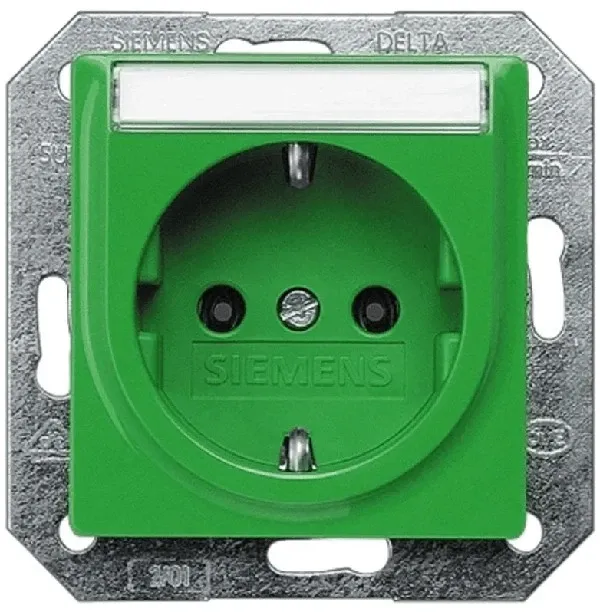
SCHUKO (Schutzkontakt, "protective contact") is the standard CEE 7/3 socket used across Germany and much of continental Europe. Every SCHUKO socket delivers 230 V / 16 A through the same pin geometry regardless of color — so the color is not about voltage or amperage. It signals the type of power supply circuit behind the socket, as defined by DIN VDE 0100. For maintenance teams, commissioning engineers, and electrical inspectors, the color is a visual shortcut: it tells you whether the socket is backed by a UPS, isolated from earth, or reserved for life-safety equipment. No multimeter needed.
A standard 55×55 mm cover plate, such as the Siemens SCHUKO cover plate with spring flap in electric white, fits across all four color-coded insert types within the same frame system — so the color difference sits in the socket insert itself, not the surrounding trim.
The Four SCHUKO Socket Colors Under VDE 0100
| Socket Color | Circuit Type | Where It Is Required |
|---|---|---|
| Silver / Grey | Standard mains (AV) | General-purpose wall outlets, offices, corridors, non-critical equipment |
| Green | Safety power supply (SV) / IT system | Operating rooms, ICU, data center emergency cooling, fire alarm panels |
| Orange | Backup / UPS supply (AV) | Server racks, BMS controllers, security systems, emergency lighting with battery handover |
| Red | Special safety circuits | Smoke extraction fans, sprinkler pump controllers, evacuation alarms, life-support equipment |
Silver SCHUKO Sockets: Standard Mains
Silver is the default. In DIN rail enclosures and office walls alike, the silver SCHUKO socket taps directly into the building's standard low-voltage distribution — no UPS, no generator backup, no isolated transformer behind it. If mains power drops, a silver socket goes dead.
What belongs on silver: workstations, desk lamps, phone chargers, non-critical test equipment, general workshop tools. Anything that can lose power mid-operation without creating a safety hazard or data loss. If your device has its own internal battery and the outage is a nuisance rather than a danger, silver is the right socket.
Common mistake: Plugging a BMS monitoring PC into silver. Mains blip, PC reboots, facility manager loses trending data. That PC belongs on orange.
Green SCHUKO Sockets: Safety Power Supply and IT Systems
Green is the socket you do not touch unless you know exactly which circuit it feeds. Under VDE 0100-710 (medical locations) and VDE 0100-560 (safety services), green identifies two overlapping use cases that share a common requirement: continuity of supply during a mains failure, with no interruption permitted.
In medical Group 2 locations — operating theaters, intensive care, neonatal units — green sockets are fed from an IT (Isolé Terre) medical transformer with an insulation monitoring device (IMD). The IT system means a first earth fault does not trip the breaker; the IMD alarms, the procedure continues, and maintenance schedules a controlled shutdown. The green color tells clinical staff and biomedical engineers: this socket stays live even when something faults.
Outside medical settings, green can also designate a general SV (Sicherheitsversorgung) safety power supply per VDE 0100-560 — for example, the control power to a fire detection panel or the actuation circuit of a smoke damper. The common thread is zero transfer time: green circuits must not experience even a 0.5-second interruption.
What is the difference between green and orange SCHUKO sockets?
Green sockets feed safety circuits that cannot tolerate any interruption — less than 0.5 seconds of downtime in an ICU or fire panel is unacceptable. Orange sockets feed backup circuits that can ride through a brief transfer gap (typically under 15 seconds) while the generator starts or the static transfer switch engages. If your equipment can survive a 10-second outage without data loss or safety consequence, orange is sufficient. If it cannot, you spec green.
Orange SCHUKO Sockets: Backup and UPS Supply
Orange designates the AV (Ausfallversorgung) backup power supply — circuits that tolerate a short interruption while an automatic transfer switch hands over from mains to generator or from utility to UPS inverter. The key distinction from green: brief interruption is allowed. VDE 0100-560 permits a transfer time of up to 15 seconds for most AV circuits, though in practice a well-designed UPS handover happens within 20–50 milliseconds.
What belongs on orange: server and network racks, BMS and SCADA workstations, security camera NVRs, access control panels, emergency lighting with battery-backup luminaires, and any industrial controller where a reboot means lost batch data but not a safety incident. In a typical industrial facility, orange sockets are concentrated in the IT closet, the control room, and the security panel wall.
Common mistake: Chaining a UPS into an orange socket that is already on UPS-backed distribution. Double-conversion wastes energy and creates a false sense of redundancy — the downstream UPS batteries never cycle, so you discover they are dead only when the upstream UPS fails.
Red SCHUKO Sockets: Special Safety Circuits
Red is the rarest and most restrictive color. It marks circuits that serve life-safety and structural protection functions: smoke extraction fan controllers, sprinkler pump control panels, evacuation alarm sounders, pressurization fans for escape stairwells, and certain medical life-support equipment circuits. These circuits are often fed from a dedicated safety generator or a separate UPS bus that is physically segregated from general backup power.
In German hospital electrical design, red sockets in Group 2 medical locations are fed from a dedicated SV safety source — separate from the IT system that feeds green sockets in the same room. A cardiovascular bypass machine might use a green socket (IT system, no interruption on first fault), but the room's evacuation alarm controller uses red (separate SV supply, fire-rated cable, 90-minute survivability).
What belongs on red: Only equipment explicitly listed in the facility's safety power schedule. Never add a device to a red circuit without the electrical designer's sign-off. Red circuits are sized for a fixed load inventory — an extra 50 W can push a fire-rated cable over its thermal limit under fault conditions.
Can I replace a silver socket insert with a colored one on the same circuit?
No. Changing a silver socket insert to green, orange, or red without changing the circuit behind it creates a dangerous misidentification. A green insert on a standard mains circuit means a biomedical technician trusts that socket with a ventilator — and it drops out on the first utility fault. Socket color must match the upstream distribution: standard mains, UPS-backed bus, IT transformer, or dedicated safety generator. If you need a colored socket, the circuit must be re-fed from the correct power source first.
How do SCHUKO color codes interact with emergency lighting requirements?
Emergency lighting with individual battery backup (single-battery luminaires per DIN EN 60598-2-22) can be fed from a standard silver mains circuit — the internal battery provides the safety function, so the circuit itself does not need SV/AV classification. Central-battery emergency lighting systems without per-luminaire batteries, however, must be fed from a green (SV) or orange (AV) circuit depending on the required transfer time. Check your emergency lighting design basis before deciding which socket color to allocate in the electrical room where the lighting control panel is installed.
Choosing the Right Color for a New Installation
The decision flow is straightforward, but it requires an honest assessment of what happens when power fails:
- Identify the consequence of power loss. If someone could die, the equipment is damaged, or the building cannot be evacuated safely → red (dedicated safety circuit). If data is lost, a batch is scrapped, or a process must restart → orange (backup). If only convenience suffers → silver (standard mains).
- Determine the acceptable transfer time. If the answer is "zero seconds" → green (SV / IT). If 10–15 seconds is tolerable → orange (AV with generator handover). If a 30-minute outage while the utility crew works is fine → silver.
- Check your transformer and distribution capacity. Green and red circuits require dedicated transformers or generator feeders. Adding a green socket to a floor that has no IT transformer means pulling new cable and installing a new isolation transformer — budget for the upstream infrastructure, not just the socket insert.
- Document it. Every colored socket should appear on the facility's single-line diagram with its circuit designation, upstream transformer or UPS, and load inventory. An undocumented colored socket is a near-miss waiting to happen.
Related Content
- Browse all Electrical & Power products — full range of power distribution and installation components
- Power Distribution Units — complementary products for structured power distribution in racks and enclosures
- Read our DELTA i-system vs Profil Compatibility Guide — if you are mounting colored SCHUKO inserts, the frame system determines which covers and rockers fit