ABB's IRB 1010 reaches 370 mm, carries 1.5 kg, and repeats to ±0.01 mm. A mid-range SCARA robot lands at similar accuracy, similar reach, similar payload — and costs 30–40% less. On a spreadsheet, the SCARA wins every time. But the two extra axes on the IRB 1010 — the pitch and roll that let the tool tilt off the horizontal plane — answer a question that never appears on the datasheet: does your assembly process have any motion that is not vertical? If the answer is yes, those extra axes stop being a cost premium and become the difference between a working cell and one that needs additional fixtures, reorientation stations, or manual intervention.
What SCARA cannot do, in concrete terms
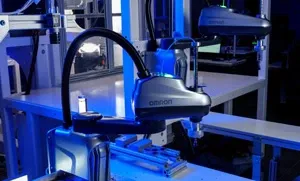
A SCARA robot has four axes: X, Y, Z, and rotation about Z (Rz). The tool axis stays parallel to the Z-axis — always perpendicular to the work plane. This makes SCARA mechanically rigid in the vertical direction and extremely fast for planar pick-and-place. But it also means the tool cannot tilt. Five real assembly tasks where this limitation surfaces:
- Tilt-assisted connector insertion
- Micro-USB, board-to-board, and fine-pitch connectors often require a 3–7° insertion angle to engage the guide features. The connector is tilted to align the lead-in chamfer, then straightened to complete the insertion. A SCARA cannot execute this dynamic tilt-and-straighten motion. It inserts vertically from the start — and when the alignment is off by 0.1 mm, the pin bends.
- Side-entry screw fastening
- Camera modules, MEMS sensor packages, and miniature gearboxes frequently have fasteners on the side face — the screw axis is horizontal, not vertical. A SCARA needs a right-angle screwdriver attachment and a reorientation fixture that flips the workpiece 90°. Each additional station adds 1–2 seconds of cycle time and a tolerance stack-up.
- Non-planar dispensing paths
- Lens barrel interior adhesive dispensing and curved medical device sealing follow 3D paths — the dispensing tip must maintain a constant angle relative to the curved surface. SCARA can only trace paths on a flat XY plane at a fixed Z height. Any surface curvature requires the six-axis robot's ability to pitch and roll the tool in synchronization with the path.
- Irregular part presentation
- Parts arriving from vibratory bowl feeders or flexible feeders do not all sit flat and horizontal. A six-axis robot can adjust its approach angle to match the part's resting orientation. A SCARA requires the part to be singulated and leveled before pickup — adding a vision-guided reorientation station between the feeder and the assembly point.
- Insertion with compliance in multiple axes
- Precision press-fit assembly (bearings into housings, pins into bushings) benefits from a Remote Center Compliance (RCC) device that allows the tool to "float" laterally and angularly. An RCC works in 6 degrees of freedom. A SCARA with an RCC can compensate for lateral misalignment but cannot correct for angular misalignment out of the XY plane — because the robot itself has no pitch or roll axes to participate in the compliance loop.
Where SCARA still beats every six-axis, including the IRB 1010
SCARA's advantages are not legacy — they are physics:
- Cycle time. A SCARA achieves XY positioning with two motors driving a parallel linkage. A six-axis robot solves a full inverse-kinematics computation across six joints for every motion. In repetitive planar pick-and-place, a SCARA is 30–50% faster. If your cycle time is above 2 seconds, this gap may not matter. Below 1.5 seconds, the SCARA's speed advantage is decisive.
- Z-axis stiffness. SCARA drives the Z-axis directly — a linear ball-screw or voice-coil actuator, mechanically stiff in the vertical direction. A six-axis robot achieves Z-axis motion by coordinating joints 2 and 3 through a kinematic chain that includes harmonic-drive compliance and link deflection. For press-fit insertion with 50–200 N of insertion force, SCARA's vertical stiffness produces more consistent insertion depth.
- Accuracy uniformity. A SCARA's positioning accuracy is nearly uniform across its entire rectangular work envelope. A six-axis robot's accuracy degrades near the edges of its spherical workspace — where the arm is fully extended, joint-angle errors propagate with maximum leverage. The IRB 1010's 0.01 mm repeatability is measured at rated payload near the center of its workspace. At full 370 mm reach with the arm near singularities, actual path accuracy can be 2–3× worse.
- Simplicity of calibration. Four joints vs. six. The kinematic error model for SCARA calibration has 12–16 parameters. For a six-axis robot, 24–30 parameters. If your process can tolerate SCARA's degrees of freedom, the maintenance and recalibration burden is lower.
What the IRB 1010 specifically changes
Before the IRB 1010, the smallest industrial six-axis robots — ABB's own IRB 120, FANUC LR Mate 200iD, Yaskawa GP4 — occupied a rough footprint of 180–250 mm base diameter and required a controller cabinet roughly the size of a desktop PC tower. The IRB 1010 shrinks the base to 135 × 135 mm and pairs it with the OmniCore C30, a compact controller that mounts on a wall or under a bench. This matters in 3C electronics and medical device assembly lines where floor space is priced per square centimeter.
The IRB 1010 does not beat a SCARA on speed or cost. What it does is remove the "the six-axis won't fit" objection from the decision. Before the IRB 1010, many lines chose SCARA not because the process was planar but because the six-axis robot's physical footprint exceeded the available space between conveyor rails. The IRB 1010 changes that constraint — and forces the decision back to the process requirements where it belongs.
Decision logic for micro-assembly robot selection
| Process characteristic | Recommended solution |
|---|---|
| All insertions vertical, all parts horizontal, simple pick-and-place | SCARA |
| Vertical insertions but cycle time <1.5 s/part | SCARA — six-axis cannot match the speed |
| Any tilt insertion, side fastening, or non-planar dispensing | Six-axis (IRB 1010 class) |
| Press-fit with >100 N insertion force | SCARA — Z-axis stiffness advantage matters |
| Space-constrained 3C line, mixed planar and spatial tasks | Six-axis (IRB 1010 specifically fits where older six-axis robots cannot) |
| Parts arrive in random orientations, no reorientation station budgeted | Six-axis — compensates for part pose |
How different is the actual accuracy of a six-axis at full reach vs. a SCARA?
Repeatability — the number on the datasheet — is not accuracy. A SCARA with 0.01 mm repeatability will typically hold ±0.02–0.03 mm absolute positioning accuracy across the full XY work envelope. A six-axis robot with 0.01 mm repeatability will hold ±0.02 mm near the center of its workspace, but at full horizontal extension (370 mm for the IRB 1010), joint-angle errors in J2 and J3 amplify through the kinematic chain to produce ±0.04–0.06 mm absolute positioning. If your assembly requires better than ±0.03 mm at the extremes of the robot's reach, quantify this difference with a laser tracker measurement — do not assume the datasheet repeatability applies uniformly.
Can a six-axis robot with an RCC device match SCARA insertion performance?
Partially. An RCC device absorbs lateral and angular misalignment, allowing a six-axis robot to insert a peg into a chamfered hole even when the approach angle is not perfect. For low-force insertions (<20 N), this works well. For higher-force press-fit operations, the RCC compliance reduces the effective insertion force and can cause inconsistent seating depth. SCARA's direct Z-axis drive with an RCC provides both compliance (for alignment) and stiffness (for insertion force) simultaneously. If your process requires both high insertion force and high tolerance for misalignment, this is one of the rare cases where SCARA genuinely outperforms six-axis architecture regardless of axis count.
Is the IRB 1010's 1.5 kg payload enough for a real micro-assembly tool set?
At first glance, 1.5 kg looks tight. But break it down: a compact electric gripper (Schunk EGP 25 or equivalent) weighs 0.19 kg. A mounting bracket and cable dress package adds 0.15 kg. The workpiece — a smartphone camera module, a MEMS accelerometer, a miniature connector — rarely exceeds 0.05 kg. Total: under 0.4 kg, about 27% of rated payload. The payload margin means the robot runs at lower joint torque, which reduces harmonic-drive wear, improves path accuracy, and extends service intervals. For true micro-assembly (workpieces under 100 g), 1.5 kg is not a limitation — it is headroom that improves reliability. The limitation appears when you add a screwdriver (0.7–1.2 kg with cable) plus a vision camera (0.2–0.4 kg). That pushes 1.0–1.5 kg at the tool flange, leaving minimal margin for workpiece and acceleration. If your tool stack exceeds 1.2 kg, verify the IRB 1010's derated accuracy at full payload before committing.
Related Content
- Browse all Industrial Robots — including SCARA and six-axis models
- Robot Controllers — compact controllers for robot workcells
- Servo Drives & Motors — drive and motor components for axis control
- Read our Injection Molding Robot or General 6-Axis? — when the robot selection decision spans across automation platforms