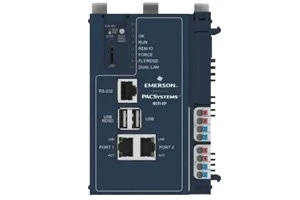
Selecting a compact PLC from a multi-model family is a Goldilocks exercise: the smallest model costs less but runs out of I/O before the machine is fully instrumented; the largest model has capacity to spare but overshoots the budget. The VersaMax Micro family from Emerson spans roughly 14 to 64 onboard I/O points across multiple models, with different expansion capabilities, communication ports, and high-speed counting options. The difference between choosing the right model and the wrong one is not performance — all models in the family execute the same instruction set — but whether the controller has enough I/O terminals and enough expansion headroom to accommodate the machine as it will actually be built, including the two extra sensors that always get added during commissioning. This article maps each VersaMax Micro model tier to the machine applications where it fits best.
The VersaMax Micro Model Range: Understanding the Tier Structure
The VersaMax Micro family organizes into three capability tiers. The entry tier — typically 14–28 I/O points — provides discrete inputs and relay or transistor outputs with basic high-speed counting on a subset of inputs. These models are designed for simple sequential machines: a small conveyor with two photoeyes and a motor starter, a pump controller with float switches, a labeling applicator with a trigger sensor and a solenoid. Communication is typically a single RS-232 or RS-485 serial port for programming and HMI connection.
The mid tier — typically 28–40 I/O points — adds analog I/O capability (0–10 V or 4–20 mA), more high-speed counter inputs, and often pulse-train outputs for basic motion control. These models target machines with analog sensors — pressure transmitters, temperature probes, level sensors — or machines that need to drive a stepper motor for simple positioning. The analog inputs are typically 10–12 bit resolution, adequate for process monitoring but not for precision measurement applications that require 16-bit resolution with isolated inputs.
The upper tier — typically 40–64 I/O points — adds Ethernet connectivity for HMI, programming, and peer-to-peer data exchange, plus expanded expansion capability for adding I/O modules beyond the onboard count. These models target machines that need network connectivity for production data collection or remote access, and machines whose I/O count may grow beyond the base unit's onboard capacity. The Ethernet port on these models typically supports Modbus TCP and sometimes a basic web server for diagnostics. Browse compact PLCs for similar small-machine controllers.
Application-to-Model Matching: Four Scenarios
Scenario 1 — Simple on-off control (14–20 I/O): A small conveyor, a pump controller, a compact packaging station with start/stop buttons, limit switches, and motor contactors. Entry-tier Micro with 14–16 discrete I/O handles this with room to spare. Analog I/O and expansion are unnecessary; the machine's I/O count is fixed by its mechanical design.
Scenario 2 — Process-sensed machine (20–30 I/O): A temperature-controlled mixing tank, a pressure-regulated test stand, a small dosing system with analog level feedback. Mid-tier Micro with 24–28 I/O, including 2–4 analog inputs, is the minimum. The analog inputs read the process variable; the discrete I/O handles valves, pumps, and interlocks. Verify the analog input resolution meets the process accuracy requirement before locking in a model.
Scenario 3 — Connected machine with data collection (30–50 I/O): A machine that reports cycle count, reject rate, and uptime to a plant MES system, or a machine that the OEM supports remotely via VPN. Upper-tier Micro with Ethernet is required. The Ethernet port serves both the HMI connection and the data collection function; verify that the PLC's Ethernet protocol (typically Modbus TCP) matches the MES or remote access platform before committing.
Scenario 4 — Machine with future expansion (30+ I/O, expandable): A machine whose I/O count may grow as options are added — an additional infeed lane, an extra reject station, a downstream conveyor interlock. Upper-tier Micro with expansion capability is the correct choice even if the expansion slots are empty on day one. The cost of unused expansion capacity is a fraction of the cost of replacing a non-expandable controller mid-lifecycle. See our PLC catalog for the full range of compact and modular controllers.
Key Specification Checks Before Ordering
Three specifications differentiate Micro models within the same tier and should be verified against the application before selecting a part number. High-speed counter inputs: entry models typically support 1–2 high-speed inputs at 5–10 kHz; upper models may support 4–6 inputs at 20 kHz or higher. If the application uses an encoder for position feedback or a flow meter with a pulse output, verify both the count and the frequency rating. Pulse-train outputs: models with PTO can drive a stepper motor driver directly — verify the number of PTO channels (usually 1–2) and the maximum frequency (typically 65–100 kHz). Analog input type: some models accept only 0–10 V; others accept both 0–10 V and 4–20 mA. If the application's sensors are 4–20 mA loop-powered, a voltage-only analog input model requires an external 250-ohm shunt resistor per channel — functional but adds wiring complexity and reduces accuracy.
The VersaMax Micro that fits today's I/O count exactly is the wrong choice if the machine will grow. Pick the model that fits the I/O count the machine will have after two years of field-driven improvements — not the count on the P&ID revision A.