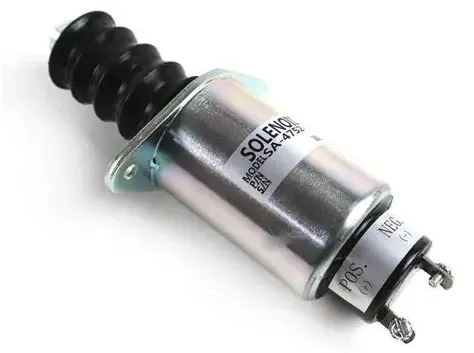
The 5484 family is Woodward's permanent-magnet rotary actuator line — the muscle at the end of a 2301A governor's command. The variants divide by travel speed and voltage class: the 5484-803's 24 V, 4 rpm-class rotation for standard duties, the 5484-804 variant for the speed-matched cases, and the wider 5464 family where the actuator scope outgrows the PM class. Matching actuator to governor is a three-number exercise: speed, voltage, torque.
Why speed is the spec
An actuator too slow for the engine's fuel response turns the governor's precision into lag — the loop sees its command arrive late and compensates with gain, borrowing stability to buy speed. The 5484 family's rpm classes exist so the actuator's travel time fits the engine's response budget: dial in the fuel-travel requirement from the engine side, then pick the variant whose rotation speed meets it with margin.
Voltage and the panel's world
24 V is the family's native class — it inherits the panel's control power and the battery-backed conventions of genset architecture. Where the installation's control power differs, the family's variants and the wider 5464 mechanical classes provide the scaling; the command interface to the 2301A stays the honest constant.
The decision rule
Standard standby genset duty with a 2301A: the 5484-803 at 24 V is the textbook pairing — speed class matched to fuel-travel need, voltage native to the panel. Speed-critical or unusual travel demands: the 804 variant. Scopes beyond the PM class's torque: the 5464 family. All land in the same governor loop with the same commissioning discipline.
Can one actuator serve different engines?
The actuator serves the fuel valve, and fuel valves differ — linkage, torque and travel are per-engine realities. Fleet standardization lives at the controller level; the actuator follows the valve, or the modification grows a bracket.
What does the PM construction buy over older actuator types?
Response and efficiency: permanent-magnet fields react without field-building delay and draw power proportional to work. In governor terms, the loop gets the speed its tuning asked for — which is the whole point of the family.