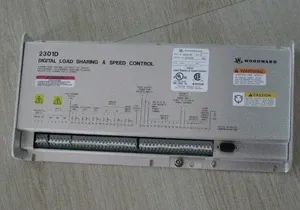
Isochronous load sharing between paralleled gensets is a solved problem with three solutions, sized to three plant scales. Woodward's catalog carries all three: the standalone real-power sensor (8272-781 class), the integrated EGCP-3 control package (8406-113), and the load-share accessories that ride with the 2301E/EPG governor family. Picking by scale instead of by habit is how plants avoid buying a control system to do a transducer's job — or a transducer's job for a control system.
The standalone kW sensor: sharing for small fleets
The real-power sensor measures one genset's kW output and drives the analog load-share line directly — the minimal hardware that makes two or three sets share proportionally on an isochronous bus. It partners with the plant's existing governors, adds one device per set, and stays invisible until it quietly makes the bus behave. Small paralleling plants and budget retrofits are its home.
The integrated package: EGCP-3
The EGCP-3 owns the whole per-genset scope — engine interface, breaker control, sync, protection and load sharing — in one engineered package. Multi-set plants that want one vendor, one commissioning story and one spare-part philosophy standardize here. The cost is commitment: the package's way of structuring I/O and sequencing becomes the plant's way.
Governor accessories: sharing where the governor lives
The 2301E/EPG family's load-share modules bolt the sharing function onto the governor itself — the control loop and the sharing line live in the same chassis, tuned together. Fleets standardized on a governor generation upgrade their sharing capability as part of the governor lifecycle, not as a separate project.
The decision rule
Two or three sets and a working governor fleet: standalone sensors. Five-plus sets, breaker authority, plant-level sequencing: the EGCP-3 tier. Governor-standardized fleets mid-lifecycle: the accessory route. All three keep the control-room interface conventional — sharing is a loop-level function, and the plant SCADA only sees a well-behaved bus.
Can the three methods mix on one bus?
The sharing medium (analog lines) is convention-compatible, but mixing philosophies on one bus trades clarity for inventory — pick per plant, not per set, unless a documented transition plan says otherwise.
Why isochronous sharing at all — why not droop?
Droop shares load by trading frequency; tight-bus applications (datacenters, island grids) need frequency held while sets join and leave. Isochronous sharing — whichever hardware method — is how the bus stays honest.