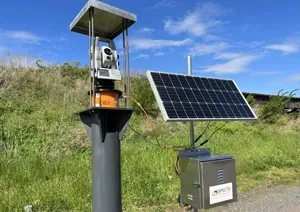
Solar Wireless Geophone
Cabled seismic arrays bury kilometers of cable and swap batteries yearly. Solar wireless nodes like Resensys SeniMax run a decade — what changes on the survey.

Selection guides, head-to-head comparisons, and field-tested configuration notes for control engineers, integrators, and maintenance teams.
Cabled seismic arrays bury kilometers of cable and swap batteries yearly. Solar wireless nodes like Resensys SeniMax run a decade — what changes on the survey.
The G120X FSG frame covers 160, 200 and 250 kW. Sizing rules, EMC filter choices and DC-terminal options for large pump rooms.
Long motor cables stress motor insulation and drive output. How cable length, du/dt chokes and the G120X DC-terminal option fit together.
Belt-driven SCARAs drift; ball-screw Z-axes and full closed-loop feedback hold repeatability. What the upgrade buys on precision assembly duty.
A failing battery can hold 12.6 V open-circuit while its internal resistance has already tripled, collapsing under load. Internal resistance testing catches the failure mode that voltage monitoring completely misses.
As roll diameter grows from core to full roll, constant tension crushes inner layers. Taper tension reduces setpoint as diameter increases, and inertia compensation adds dynamic torque during acceleration.
A batch weighing controller accumulates weight until a target is reached — ingredient dosing and filling.
A practical guide to Class I Division 1 vs Division 2 hazardous location classification — protection methods, cost implications, certification markings, and when to use intrinsically safe barriers vs explosion-proof enclosures for field instruments.
A pneumatic pump controller runs a diaphragm dosing pump entirely on compressed air — no electrical supply, no arc-flash hazard, intrinsically safe by design.
A multi-protocol room controller speaks KNX to lighting, Modbus to the FCU, BACnet to the BMS, and ONVIF to cameras — one device bridging four networks.
A lights-out laser cell loads sheet, cuts, unloads parts, sorts by job, and stacks components with zero operator intervention across a weekend shift.