Solar Wireless Geophone
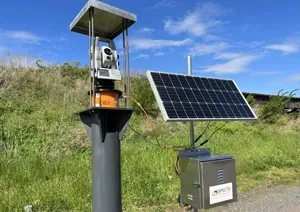
Cabled seismic arrays bury kilometers of cable and swap batteries yearly. Solar wireless nodes like Resensys SeniMax run a decade — what changes on the survey.

Selection guides, head-to-head comparisons, and field-tested configuration notes for control engineers, integrators, and maintenance teams.
Cabled seismic arrays bury kilometers of cable and swap batteries yearly. Solar wireless nodes like Resensys SeniMax run a decade — what changes on the survey.
A 2-axis pulse output module plugs into the PLC backplane and drives steppers or servos via PTO — no separate motion controller.
Pneumatic temperature controllers need no power, survive gas explosions, and self-purge with instrument air. Electronic PID delivers sub-degree accuracy and remote setpoints.
Break-before-make transfer opens utility then closes generator — a 100-500 ms blackout that resets every PLC and VFD on the bus. No-break changeover synchronizes and parallels before transferring, so the load never sees the interruption.
GuardLink replaces point-to-point safety wires with one daisy chain for rich diagnostics. Compare with hardwired safety on cost and diagnostics.
A multi-channel weighing controller monitors up to sixteen scale inputs in one unit — one power supply, one fieldbus drop, one configuration.
Build a reliable EtherNet/IP cabinet: right managed switch, star or ring topology, clean grounding. Avoid flooded multicast and noisy cabling.
DySC (Dynamic Sag Corrector) protects against voltage sags without batteries — no replacement cycle, no thermal management, smaller footprint. When a battery-free sag corrector is the better choice vs a UPS for industrial power quality.
ASTM D3078 submerges packages in water under vacuum and watches for bubbles — simple but operator-dependent. ASTM D4991 measures pressure decay inside a vacuum chamber — quantitative and automated.
An electric fire pump controller starts on utility power — simple and reliable until a blackout. A diesel controller must auto-start the engine, monitor battery, oil, and coolant — and do it during a fire when utility power is already lost.
Migrating from SLC 500 to CompactLogix means more than swapping the processor — I/O wiring, network topology, and program conversion each hide costs. A practical migration guide for controls engineers planning the SLC-to-Logix transition.