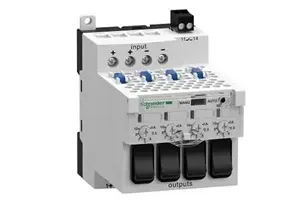
A batching system with four hopper scales, a loss-in-weight feeder, and a checkweigher can be instrumented two ways: six single-channel weight indicators, each wired independently to the PLC, or one multi-channel weighing controller that reads all six scales from a single DIN-rail or panel-mount unit. The multi-channel approach consolidates hardware and wiring, but it also concentrates failure risk. This guide walks through the trade-offs so you can decide whether consolidation serves your process or creates a single point of failure.
What a Single-Channel Weighing Controller Does
A single-channel weight indicator reads one load cell array — typically 4 or 6 strain-gauge load cells wired in parallel to a junction box — and provides a processed weight value. The controller excites the bridge, amplifies the millivolt signal, digitizes it through an ADC (usually 16–24 bit), applies tare and calibration factors, and outputs the result as a 4–20 mA signal, a serial data stream, or a fieldbus frame. Each channel is electrically and functionally independent. If the controller for hopper 3 fails, hoppers 1, 2, and 4 continue operating. The downside: six controllers need six panel cutouts, six power supplies, six communication drops, and six calibration procedures.
What a Multi-Channel Weighing Controller Brings
A multi-channel controller packages 2, 4, or 8 independent weighing channels into a single instrument. Each channel has its own excitation supply, its own ADC, and its own calibration table. The channels share a common processor, display, and communication interface. The processor scans each channel sequentially — at 250 Hz per channel on a modern unit, meaning a 4-channel controller completes a full scan cycle in 16 milliseconds. For a batching application where valve closure latency is 50–100 ms, a 16 ms scan introduces no meaningful measurement lag.
The primary advantage is wiring consolidation. One power supply, one fieldbus node, one panel cutout, one setup routine. The secondary advantage is cross-channel logic: a multi-channel controller can perform comparative functions — is hopper A within 5% of hopper B? — without sending every weight value to an external PLC, computing the comparison there, and sending the result back. The controller handles the inter-channel math on-board and outputs only the actionable result.
Scan Rate and the Multiplexing Penalty
Multi-channel controllers scan channels sequentially, not simultaneously. A single-channel controller dedicates 100% of its ADC time to one scale. A 4-channel controller divides that time across four channels. This matters for dynamic weighing — checkweighing, in-motion conveyor weighing, and high-speed filling — where the weight is changing during the measurement window. At 250 Hz per channel, a 4-channel controller captures one weight sample every 4 ms. A 1 kg/s fill rate means the measured weight changes by 4 grams between samples. If your fill tolerance is ±10 grams, the multiplexing error is under half the tolerance band and can be ignored. If your fill tolerance is ±2 grams, a single-channel controller with dedicated 1 kHz sampling is the correct instrument.
The rule of thumb: if your required weight update rate divided by your number of channels still exceeds 50 Hz, a multi-channel controller is fast enough. Below 50 Hz, the time between samples begins to degrade dynamic measurement accuracy.
Failure Mode Analysis: Consolidated vs Distributed
This is the trade-off that matters most in production environments. A single-channel controller failure takes down one scale. Production may slow or the affected hopper runs in manual mode, but the rest of the line keeps running. A multi-channel controller failure takes down every scale connected to it. For a batching system with four scales on one controller, a power supply failure, processor fault, or communication dropout stops the entire batching process.
The mitigation is not to avoid multi-channel controllers — it is to design the failure response. If your process can tolerate a full batching stop for the 30 minutes it takes to swap a panel-mount controller (with pre-loaded configuration on an SD card), the consolidation benefit outweighs the failure risk. If every minute of downtime costs thousands in lost production, the distributed reliability of single-channel controllers may justify the extra wiring and panel space.
When to Choose Each Architecture
Use single-channel controllers when:
- Each scale operates on a different production line and failure isolation is paramount
- Dynamic weighing requires dedicated high-speed sampling (above 500 Hz per channel)
- Scales are physically distant from each other and home-run wiring to a central controller is impractical
- The process already has a PLC handling inter-channel logic, so the controller's on-board math is redundant
Use a multi-channel controller when:
- Multiple scales serve the same process unit — multi-ingredient batching, multi-hopper filling, multi-silo inventory
- Panel space is constrained and reducing cutouts is a design goal
- Cross-channel comparison or totalization is needed and you want to offload that logic from the PLC
- Fieldbus node count is at a premium and you want one network drop for all scales
The Rice Lake 920i programmable weight indicator and process controller supports both single-channel high-speed operation and expandable multi-channel configurations through plug-in option cards — a flexible platform for weighing systems that may start with one scale and grow to several.
If one failed controller stops the entire line, weigh the downtime cost against the wiring savings. For most multi-scale batching processes, a dual-channel controller with a spare unit on the shelf is the pragmatic middle ground.