
Product Specifications
- Brand
- SHAREBOT
- Part Number
- Snowwhite 2 HT
- Product Type
- SLS 3D Printer
- Series
- Snowwhite
- Build Volume
- 50 × 50 × 50 mm
- Technology
- Selective Laser Sintering (SLS)
- Laser
- CO₂ 14 W, 10,640 nm
- Max Chamber Temperature
- 350°C
- Scan Speed
- Up to 3,500 mm/s
- Atmosphere
- Nitrogen or Argon
Product Description
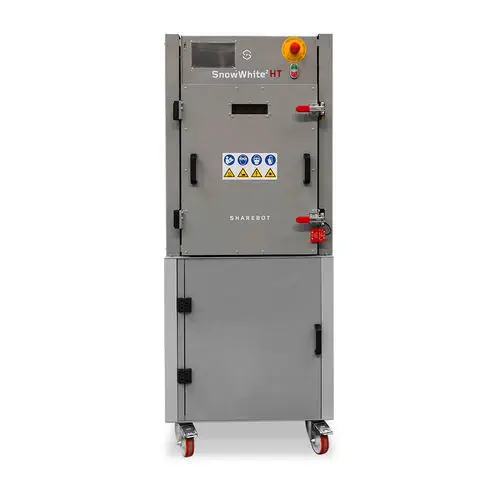
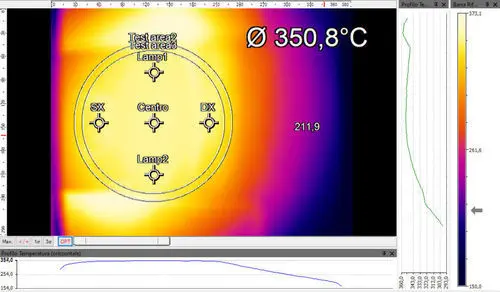
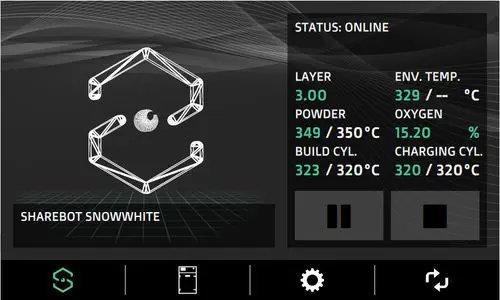
The SHAREBOT Snowwhite 2 HT is a compact selective laser sintering (SLS) system that addresses a specific gap in polymer additive manufacturing: accessible, open-parameter processing of high-temperature thermoplastics — PEEK, PEKK, PAEK — whose sintering windows sit far above the 190–200°C ceiling of standard polymer SLS machines. With the powder bed, build cylinder, and loading cylinder all heated to a uniform 350°C, the machine creates the near-isothermal thermal environment that semi-crystalline high-performance polymers require: the powder is held just below its melting point throughout the build, so the CO₂ laser only needs to add the delta to cross the melt threshold, and the part cools uniformly after the build completes, minimising the residual stress and crystallisation-gradient warping that destroy dimensional accuracy in PEEK parts sintered on lower-temperature machines.
Why does PEEK require 350°C for SLS processing?
PEEK's melting point is approximately 343°C, and its crystallisation temperature sits around 260°C. In a standard SLS machine capped at 190°C, PEEK powder cannot be held near its melting point — the laser must supply an enormous thermal gradient to reach melt temperature at each scan vector, and the surrounding powder, 150°C colder than the crystallisation threshold, quenches the fused region almost instantly. The result is a part with high amorphous content, severe anisotropy between layers, and warping forces that peel the part from the build plate mid-build. At 350°C chamber temperature, the powder is preheated to within a few degrees of melting, the laser contributes only the incremental energy needed to cross the phase transition, and the entire powder bed serves as a quasi-isothermal oven during cooling — the part crystallises uniformly as the chamber temperature ramps down, producing parts with predictable, repeatable crystallinity and minimal residual stress. A 50 × 50 × 50 mm build volume may seem small, but for PEEK powder priced at several hundred euros per kilogram, it represents a sensible trade-off: enough volume for mechanical test coupons, small implant prototypes, and material qualification specimens, without committing kilograms of powder to a single build.
What does fully open parameter control enable?
The Snowwhite 2 HT gives the user unrestricted access to every process variable: laser power, scan speed, hatch spacing, layer thickness (minimum 50 μm in Z), bed temperature, loading-cylinder temperature, and heating and cooling ramp rates. There are no locked material profiles, no OEM-qualified-only powder restrictions, no firmware gates that refuse to print unless an approved material code is detected. For a university materials-science group developing a novel PAEK-carbon nanotube composite, this means the entire parameter space is explorable — they can test five laser-power settings across three bed temperatures in one afternoon and compare sintered density, crystallinity (via DSC), and tensile properties. The modular powder distributor further supports this: a compact 20 × 40 × 60 mm recoater module enables testing with as little as 300 g of experimental powder, a meaningful consideration when the material being characterised costs more per gram than the machine time. A CO₂ laser at 10,640 nm wavelength is standard for polymer SLS — most engineering thermoplastics absorb strongly at this wavelength — and the 14 W power level is sufficient for the small scan field. An internal thermal camera mount and automatic per-build log-file generation support the documentation requirements of academic and industrial research.
How does the HT differ from the standard Snowwhite 2?
The standard Snowwhite 2 caps its chamber at 190°C and provides a 100 × 100 × 100 mm build volume — suitable for PA11, PA12, TPU, and filled nylons. The HT variant trades half the linear build dimension for a 160°C increase in chamber temperature, switching the material capability from commodity polyamides to the PAEK family. The laser, optics, galvanometer, and f-Theta lens are shared between both variants. A lab running both machines can develop a new PAEK formulation on the HT, qualify the sintering parameters, and — if the application eventually justifies it — transfer the parameter set to a production-scale high-temperature SLS system, having consumed only tens of grams of powder during the entire development phase.
Resources & Documentation
SHAREBOT Snowwhite 2 HT High-Temperature SLS 3D Printer with 350°C Build Chamber
Product Specifications
- Brand
- SHAREBOT
- Part Number
- Snowwhite 2 HT
- Product Type
- SLS 3D Printer
- Series
- Snowwhite
- Build Volume
- 50 × 50 × 50 mm
- Technology
- Selective Laser Sintering (SLS)
- Laser
- CO₂ 14 W, 10,640 nm
- Max Chamber Temperature
- 350°C
- Scan Speed
- Up to 3,500 mm/s
- Atmosphere
- Nitrogen or Argon
Resources & Documentation
DEMGY Polyamide 3D printer
SLS additive manufacturing with 700 × 380 mm build for prototyping and series
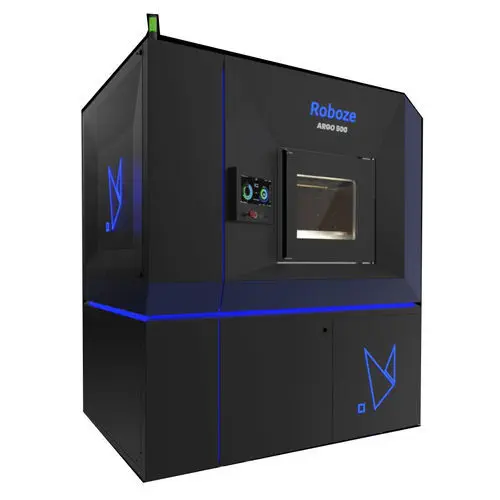
ROBOZE ARGO 500
500 mm³ heated-chamber FFF for PEEK, ULTEM, and composites