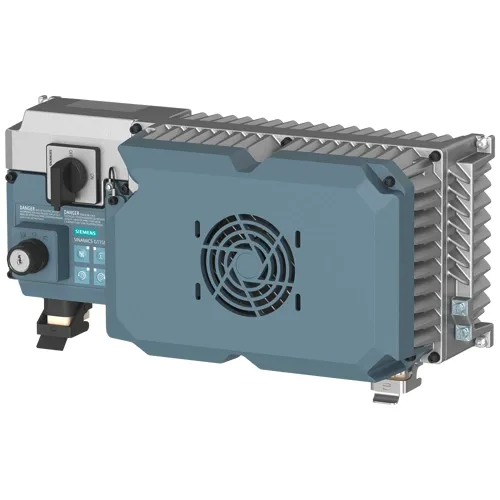
Every order code for a SINAMICS G120X forces one decision early: unfiltered, C2-filtered, or C3-filtered. It is not a spec sheet detail — it decides who owns EMC compliance in the pump room, and getting it wrong shows up as a failed site acceptance or a retrofit filter bill.
What C2 and C3 actually mean
The classes come from the EMC product standard for power drive systems. Category 2 covers the first environment — industrial sites fed from a dedicated transformer, where a drive may inject moderate conducted emissions. Category 3 covers the second environment — installations whose low-voltage supply can reach residential premises, so the emission limits are stricter. An unfiltered drive assumes you will provide all filtering externally.
Dividing the responsibility
Three legitimate layouts exist. First, integrated filtering: order a C2-filtered G120X such as the 90 kW general-purpose unit and the drive carries its own compliance — the simple path for a standalone pump room. Second, external central filtering: order unfiltered drives and put one large filter at the supply — economical when five or ten drives share one intake. Third, mixed: a C3-filtered 250 kW unit on the main feeder with unfiltered distributed drives behind it.
The same logic applies across the VFD family, not just the G120X — the question is always who certifies the installation, and the filter class is the contract line that answers it.
Can I upgrade an unfiltered drive to C2 later?
Externally, yes — a compliant external filter can bring the installation into category limits. Integrated filters are built into the drive chassis and cannot be added in the field, which is why the order code matters more than the retrofit plan.
Is C3 always the safe answer?
It costs more and adds a little impedance. If the site is genuinely first-environment industrial with its own transformer, C2 is compliant and cheaper. Buying C3 "just in case" wastes budget; buying C2 for a residential-feeder site fails acceptance.