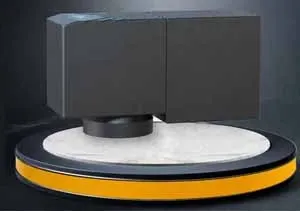
For a century, hardened steel meant grinding: turn it soft, harden it, finish it on a grinder. Hard turning broke that sequence — modern lathes with rigid bases, CBN tooling and stiff spindles turn parts at 58–65 HRC straight to final size. The DANOBAT Mikroturn concept pushes the logic to its end: full hydrostatics, sub-micron results on 70 HRC steel, and a thirty-year wear story on the guideways. The question for a production engineer is no longer "can it be done" but "when does it pay."
Where hard turning wins
Every eliminated transfer is eliminated error. Grinding a part that was just turned means re-clamping, re-indicating and re-establishing the datum — each move spends tolerance. Hard turning finishes the part in the setup that roughed it: one machine, one datum, one chip. For shoulders, grooves and moderate surface requirements, cycle time drops hard because material comes off three orders of magnitude faster than grinding allows.
Where grinding keeps the job
Grinding owns the extremes: surface finish below Ra 0.2 µm on bearing races, tolerances held over long batches without tool wear, and thin-walled parts where cutting forces deform the work. A grinding wheel does not get dull the way an insert does — over a 10,000-piece run, the grinding process stays constant while hard turning needs tool-change discipline to stay honest.
The decision rule
Tolerance from geometry (roundness, concentricity between features) favors staying in the lathe — hard turning inherits it. Tolerance from surface (finish, waviness, burn) favors grinding. Batch size compounds both: short runs love the lathe's setup economy; long runs forgive grinding's slower cycle.
The machine platform matters as much as the process: hydrostatic guideways like the Monforts MNC 1000's hydrostatic Z-axis remove stick-slip and wear from the accuracy chain — the physical foundation that makes micro-class turning credible. Control-wise these cells run standard CNC controllers, so programming discipline carries over from turning.
Does hard turning burn the surface?
With correct CBN grades, negative rake geometry and flood coolant or dry-hard cutting strategies, white-layer formation is controlled and inspectable. It is a process-window discipline, not an inevitability — and it is exactly where cheap hard turning earns its bad reputation.
Can one machine do both?
Turn-mill-grind centers exist for large, expensive parts where re-clamping is impossible. For commodity shafts, two good machines beat one compromise — buy the process, not the versatility.