A ball screw is a wear part pretending to be a structure. Every micron of positioning passes through a recirculating ball circuit that loads, rolls and slowly fatigues — and in high-duty milling, that circuit is the axis's accuracy budget. Linear motors delete the intermediate machinery entirely: the drive force is generated directly between slider and stator, with nothing to wear but the guideway's air or rollers.
What the linear motor buys
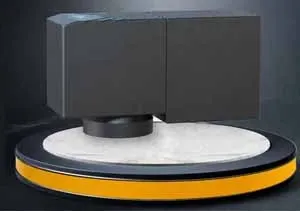
Speed and dynamics first: no screw means no critical speed limit, no backlash, and accelerations that screws physically cannot follow — useful on short-stroke, high-frequency paths like dental milling, where a disc spends its cycle in constant direction changes. Röders' RXD-class machines push the architecture to its conclusion: water-cooled linear axes, sub-micron resolution, and — the telling detail — a sister laser system on the same bed to measure tool geometry in-process, because at that precision class the tool itself is a variable.
What the ball screw keeps
Friction. A screw and nut present a large damping, self-locking property and mechanical advantage — the axis holds position against load without servo current, and vertical axes do not fall when power drops. Screws are also cheap to size for big masses: force scales with motor and pitch, not with magnetic circuit area. For general milling at moderate dynamics, the screw remains the honest engineering default.
The decision rule
Continuous high-duty precision — dental discs, optical molds, electrode milling — justifies linear axes because wear removal is accuracy insurance, not a luxury. General-purpose milling stays on screws until accuracy decay, not capability, is the problem. Either way the axis answers to the same motion controller; the tuning philosophy differs, not the integration.
Do linear motor axes hold position at power-off?
No — without a screw's self-locking, vertical linear axes need brakes or counterbalance. That is a real architecture cost on tall machines, and one reason horizontal configurations favor linear drives more easily.
What actually wears on a linear axis?
The guideway, cable chain and encoders — all long-life items compared to a loaded ball circuit. The wear budget shifts from "accuracy-critical" to "maintenance-scheduled," which is the entire argument.