
Product Specifications
- Brand
- GE Additive
- Part Number
- Spectra H
- Product Type
- Electron Beam Melting (EBM) 3D Printer
- Build Volume
- Ø 250 × 430 mm
- Beam Power
- 6 kW
- Process Temperature
- 600–1,100°C
- Beam Translation Speed
- 8,000 m/s
- Atmosphere
- Vacuum (4 × 10⁻³ mbar He partial pressure)
- Materials
- TiAl, Alloy 718, Ni-superalloys
- Weight
- ~2,915 kg
Product Description
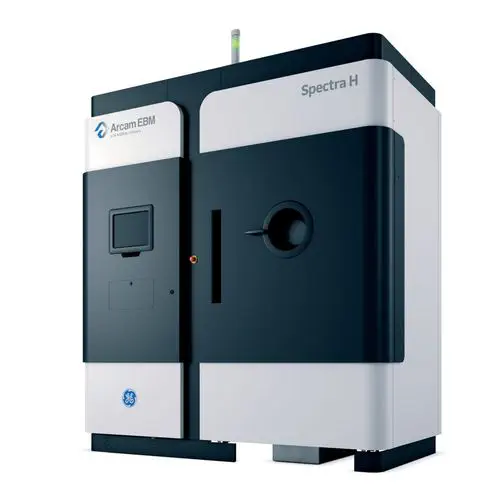
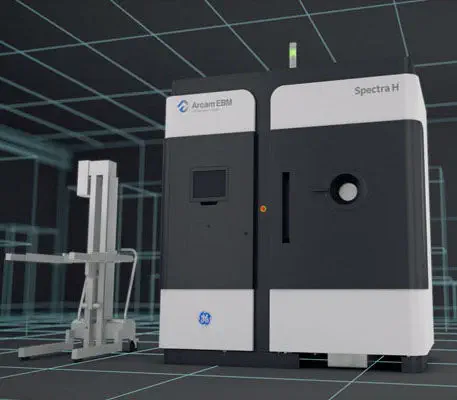
The Arcam EBM Spectra H is GE Additive's electron beam melting 3D printer purpose-built for high-temperature, crack-prone metal alloys that defeat laser-based powder bed fusion. It centers on a 6 kW electron beam — double the power of previous Arcam EBM systems — operating in a vacuum chamber at process temperatures from 600 to 1,100°C. The Ø 250 × 430 mm build volume is 39% larger than the preceding Q-series, and the combination of a single-crystalline cathode, xQam auto-calibration, and closed powder handling makes the Spectra H the only commercial AM platform capable of producing titanium aluminide (TiAl) components at production scale. Applications center on aerospace turbine blades, turbocharger wheels, and nickel superalloy components where hot-cracking during solidification makes laser-based L-PBF non-viable.
Why can EBM print TiAl when laser powder bed fusion cannot?
Titanium aluminide (TiAl) is a lightweight intermetallic with exceptional high-temperature strength — ideal for low-pressure turbine blades and turbocharger rotors — but it is notoriously brittle at room temperature and cracks under the thermal gradients typical of laser melting. A laser spot at 1,000+ W/mm² heats a powder particle from ambient to melting point in microseconds, creating steep thermal gradients and residual stresses that TiAl cannot accommodate. EBM works differently: the entire build is maintained at 600–1,100°C throughout the process, so the electron beam only adds the incremental energy needed to locally melt each new layer. The thermal gradient between the melt pool and the surrounding part is a few hundred degrees, not a few thousand. This near-isothermal condition eliminates solidification cracking in TiAl and reduces residual stress to the point where post-build stress relief is unnecessary. The vacuum atmosphere (4 × 10⁻³ mbar helium partial pressure) prevents oxidation of the reactive titanium at these elevated temperatures.
How does the 6 kW beam accelerate the build?
Doubling beam power from the 3 kW of previous Arcam systems to 6 kW cuts pre-heating and post-heating time in half — the two non-printing phases that dominate total cycle time in EBM. The 6 kW beam also enables a faster melt scan at up to 8,000 m/s translation speed, increasing the area melted per unit time during the build phase. The combined effect is approximately 50% shorter total build time on a full-height job. The single-crystalline cathode produces a more stable electron emission profile than the polycrystalline cathodes in earlier systems, maintaining beam focus diameter (140–250 µm) consistently over multi-day builds. xQam auto-calibration reduces the beam alignment procedure from 3–4 hours to approximately 15 minutes between builds.
What distinguishes the Spectra H from the Spectra L?
Both use the same vacuum chamber architecture (1,328 × 2,344 × 2,858 mm, ~2,915 kg) and share the xQam auto-calibration and closed powder handling system. The Spectra H prioritizes beam power over build area for high-temperature alloys: 6 kW over Ø 250 × 430 mm. The Spectra L prioritizes build area for large titanium parts: 4.5 kW over Ø 350 × 430 mm with Point Melt technology for improved surface quality on orthopedic implants. The Spectra H is the tool for TiAl and crack-prone nickel superalloys; the Spectra L is the tool for large-format Ti6Al4V production.
Resources & Documentation
GE Additive Arcam EBM Spectra H Electron Beam Melting 3D Printer with 6 kW Beam
Product Specifications
- Brand
- GE Additive
- Part Number
- Spectra H
- Product Type
- Electron Beam Melting (EBM) 3D Printer
- Build Volume
- Ø 250 × 430 mm
- Beam Power
- 6 kW
- Process Temperature
- 600–1,100°C
- Beam Translation Speed
- 8,000 m/s
- Atmosphere
- Vacuum (4 × 10⁻³ mbar He partial pressure)
- Materials
- TiAl, Alloy 718, Ni-superalloys
- Weight
- ~2,915 kg
Resources & Documentation
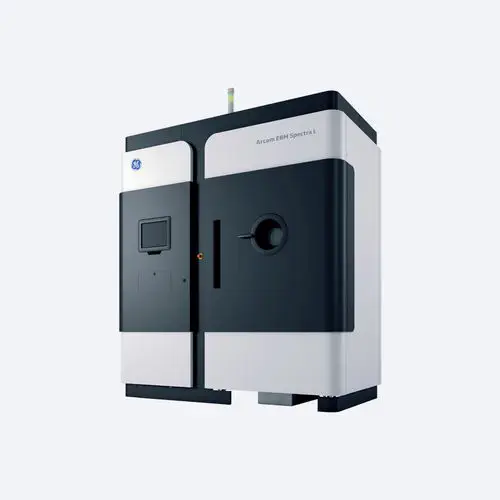
Arcam Spectra L
Largest build volume in the Arcam EBM portfolio
BLT S1025
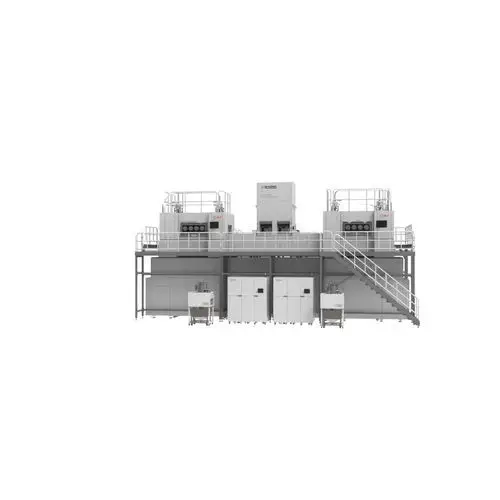
Extra-tall L-PBF for meter-scale aerospace parts
HP 1200
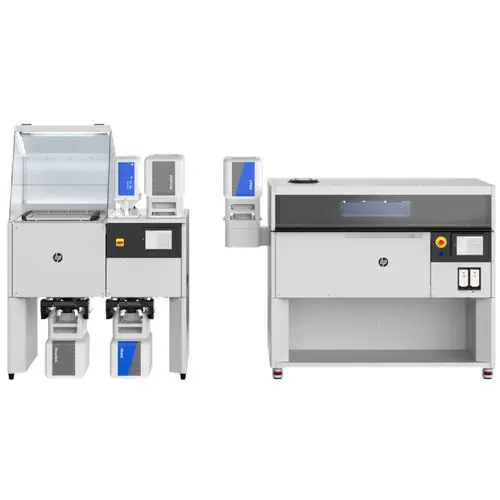
Compact MJF for engineering offices and university labs
TRUMPF TruPrint 1000
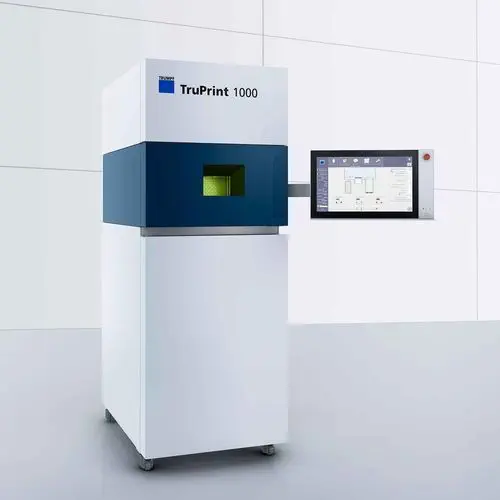
Compact LMF for precision dental and medical parts
SHAREBOT Snowwhite 2 HT
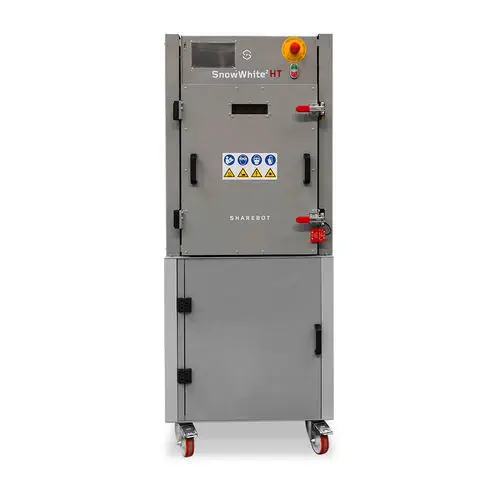
Compact SLS for PEEK, PEKK, and PAEK powder research