
Product Specifications
- Brand
- Arcam
- Part Number
- Spectra L
- Product Type
- Electron Beam Melting (EBM) 3D Printer
- Build Volume
- Ø 350 × 430 mm (largest in Arcam EBM portfolio)
- Beam Power
- 4.5 kW
- Melt Strategy
- Point Melt technology
- Layer Thickness
- 50 µm / 70 µm
- Materials
- Ti6Al4V Grade 5, Ti6Al4V Grade 23, Pure Copper
- Key Features
- xQam auto-calibration, LayerQam monitoring, Plate-Free Start
- Weight
- ~2,915 kg
Product Description
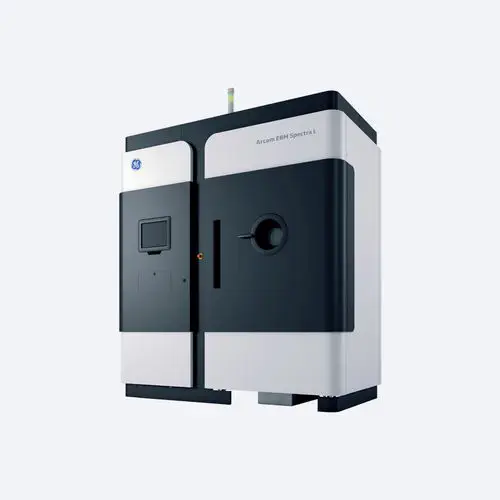
The Arcam Spectra L is the largest-build-volume system in the Arcam EBM portfolio, with a cylindrical build envelope of Ø 350 × 430 mm — nearly double the build volume of the Spectra H and approximately 13% larger than the prior-generation Q20plus. Designed for cost-efficient serial production of large titanium parts, the Spectra L targets two markets: aerospace structural components too large for a single-laser L-PBF system, and orthopedic implant trays, cages, and stems produced in high volumes where the ability to stack parts densely in three dimensions without support structures gives EBM a unit-cost advantage over laser-based alternatives. An upgraded 4.5 kW electron beam, Point Melt scan strategy, and LayerQam in-process monitoring round out a platform that transforms EBM from a niche prototyping technology into a production-line tool.
What is Point Melt technology and how does it differ from line-based EBM?
Conventional EBM uses a line-based melt strategy: the electron beam scans continuous parallel lines across each layer, similar to the hatch pattern in laser powder bed fusion. While fast, line-based melting creates a large, continuous melt pool that is difficult to control at the edges — leading to variable surface finish and occasional over-melting at thin wall sections. Point Melt replaces the continuous line with a sequence of discrete melt points, each individually controlled in time and energy. The beam dwells at a point for a precisely calibrated duration to melt the powder, then jumps to the next point. This point-by-point approach gives the thermal control system time to dissipate heat between adjacent spots, producing sharper feature edges, simpler support structures that break away easily, and improved surface quality on downward-facing surfaces. For orthopedic implant manufacturers, the surface finish improvement translates directly to reduced post-processing on porous bone-ingrowth lattices.
How does LayerQam monitor build quality during the print?
LayerQam is a high-resolution camera system integrated into the Spectra L's build chamber that images every powder layer after recoating and after melting. The before-and-after comparison detects powder spread defects (streaks, voids, insufficient coverage), incomplete melting, and geometric deviations from the sliced CAD model at each layer. The Build Performance Analyzer — a companion analytics module — correlates LayerQam imagery with process data (beam power, vacuum level, temperature) to perform root cause analysis on detected anomalies. For regulated industries (aerospace, medical implant), this layer-by-layer inspection record provides the traceability and process documentation required for production part certification without relying solely on post-build CT scanning.
What makes the Spectra L suited for serial implant production?
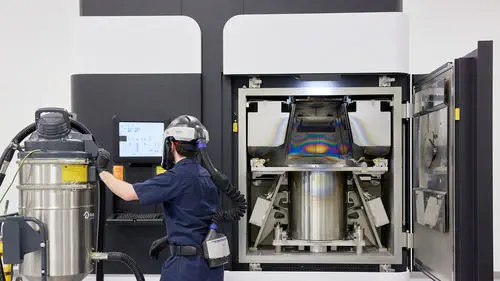
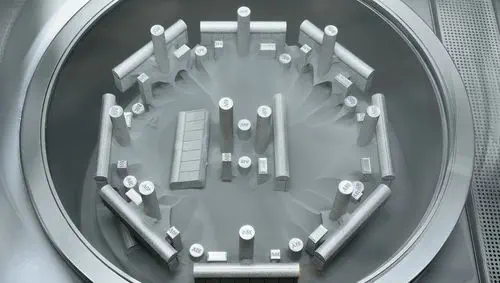
EBM is the dominant additive manufacturing technology for mass-produced orthopedic implants — particularly acetabular cups, spinal cages, and femoral stems — for three reasons specific to the process. First, the high-temperature vacuum environment (600–1,100°C) produces Ti6Al4V microstructures with fatigue properties that match or exceed cast and wrought equivalents, which is critical for load-bearing implant regulatory submissions. Second, the semi-sintered powder bed is load-bearing, so parts can be stacked in three dimensions without the rigid support structures required in laser PBF — the powder itself supports overhanging features such as porous bone-ingrowth lattices. A single Spectra L build can produce several hundred spinal cage bodies in a densely nested arrangement. Third, Plate-Free Start eliminates the need for a build plate: parts are built free-floating in the powder bed, maximizing usable build volume and simplifying part removal. The PRS 30 automated powder recovery station closes the material handling loop, sieving and conditioning unused powder for the next build with minimal operator exposure to fine titanium dust.
Resources & Documentation
Arcam Spectra L Large-Format EBM 3D Printer with Point Melt Technology
Product Specifications
- Brand
- Arcam
- Part Number
- Spectra L
- Product Type
- Electron Beam Melting (EBM) 3D Printer
- Build Volume
- Ø 350 × 430 mm (largest in Arcam EBM portfolio)
- Beam Power
- 4.5 kW
- Melt Strategy
- Point Melt technology
- Layer Thickness
- 50 µm / 70 µm
- Materials
- Ti6Al4V Grade 5, Ti6Al4V Grade 23, Pure Copper
- Key Features
- xQam auto-calibration, LayerQam monitoring, Plate-Free Start
- Weight
- ~2,915 kg
Resources & Documentation
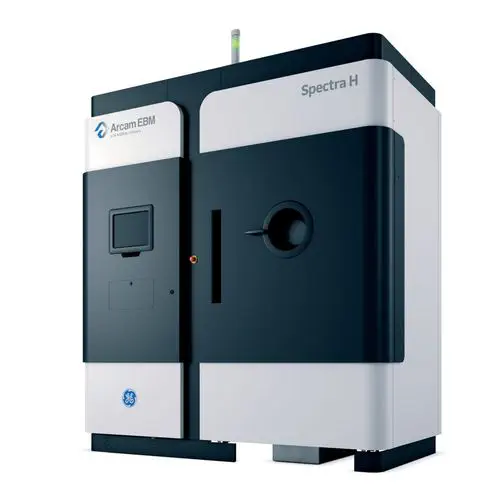
GE Additive Spectra H
High-temperature EBM for crack-prone superalloys
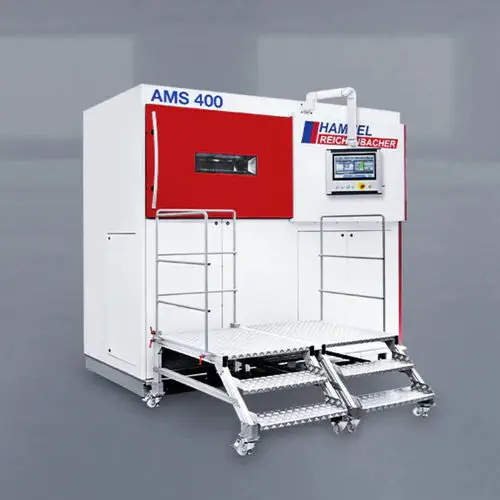
Reichenbacher Hamuel Group AMS 400
Open-system L-PBF with 1 kW fiber laser
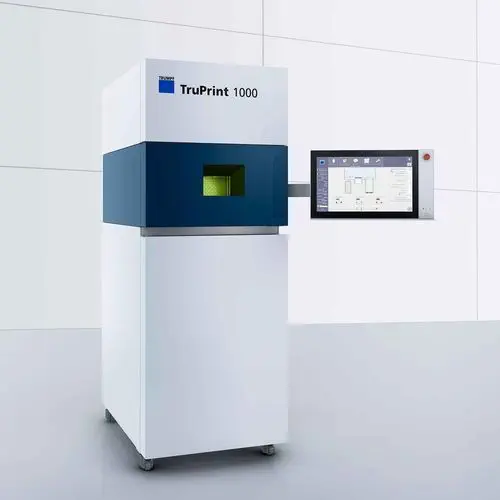
TRUMPF TruPrint 1000
Compact LMF for precision dental and medical parts
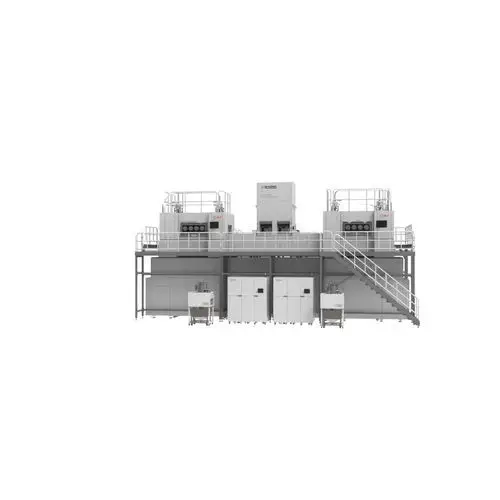
BLT S1025
Extra-tall L-PBF for meter-scale aerospace parts
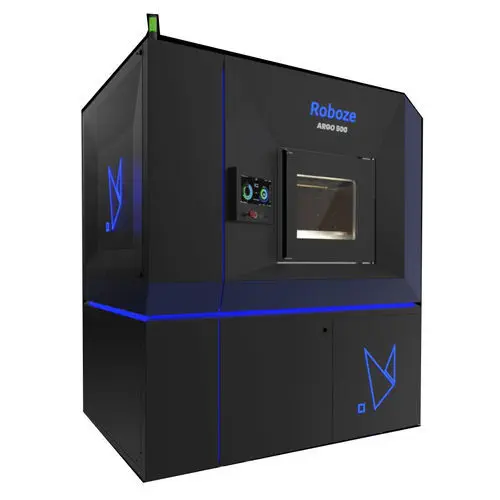
ROBOZE ARGO 500
500 mm³ heated-chamber FFF for PEEK, ULTEM, and composites